• Home
  • About
  • Food Gal Boutique
  •  

    The Only Sustainable Sushi Bar in North America

    October 1st, 2008

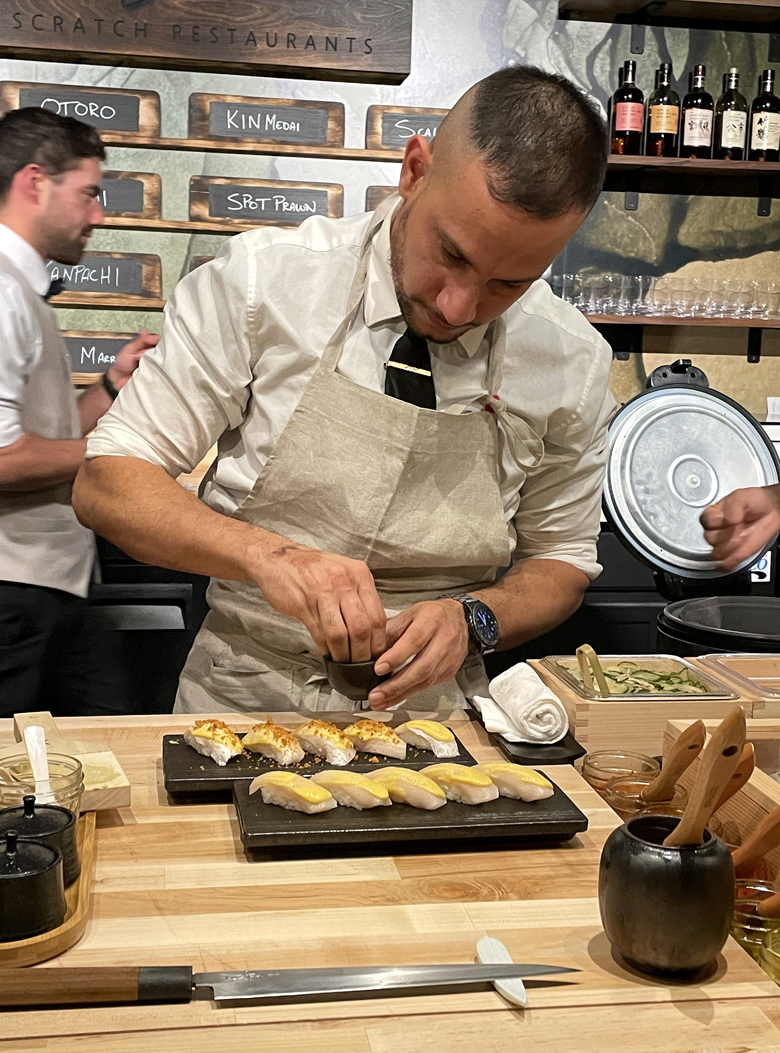
    At Tataki Sushi & Sake Bar, it\s not business as usual.

    That is just what Tataki Sushi & Sake Bar in San Francisco is believed to be.

    The tiny, seven-month-old restaurant serves only seafood that isn’t overfished, farmed without proper management, or contains high levels of mercury and other contaminants.

    Find out more about why business partners, Chef Kin Lui, Chef Raymond Ho, and Casson Trenor (a sustainable fisheries expert) decided to open such a restaurant by reading my story today in the San Francisco Chronicle Food section.

    Tataki, the site of a former Subway sandwich shop, grabs your attention right when you walk in. A Monterey Bay Aquarium “Seafood Watch” pocket guide, which lists best and worst sustainable seafood species, is front and center on every table. A copy is also tucked into every take-out menu.

    Co-chefs Raymond Ho (left) and Kin Lui (right).

    Oct. 22, Tataki will be the site of the official launch of three new, ground-breaking sustainable sushi guides created in partnership with the aquarium, Blue Ocean Institute, and Environmental Defense Fund. Each will include information on as many as 60 different seafood species commonly found on sushi menus.

    Sustainable artic char, similar to farmed salmon in taste and texture, but without environmental and health concerns.

    Want to do the right thing? Then, you’ll stop eating unagi, bluefin toro, hamachi, octopus (tako), monkfish liver (ankimo), farmed salmon (sake), imported King crab (kani), imported albacore tuna (shiro maguro), and sea urchin (uni) from Maine — all of which are unsustainable, according to the aquarium’s new guide.

    Read the rest of this entry »


    A Most Eggs-cellent Taste

    September 24th, 2008

    Fresh eggs, only two days old.

    Having been born and raised in San Francisco, I’m a big-city girl. I sheepishly concede that really shows sometimes, too. 

    When I was a summer intern at the Portland Oregonian newspaper way back when, my editors sent me to the county fair to write a story. Any story. 

    When I arrived, I noticed the dairy cow competition was about to begin. Admittedly, growing up in cramped, congested San Francisco, I never even lived anywhere that had room for grass in the yard. Not surprisingly, my experience with cows was limited to seeing them grazing off in the distance as I rode in a car on the freeway. Getting up close and personal with one was novel, to be sure. 

    I walked up to a young man at the fair, who was tending his cows. “Excuse me, Sir?” I asked. “Are you in the dairy cow competition?”

    The young man looked at me, looked at his cows, then looked at me again: “Ma’am, these are beef cows.” 

    Ohhh, right. The cows were dark as coal, muscular, and rather hefty, I realized on second glance, as I slinked off in complete shame. 

    So it goes without saying that I grew up getting my eggs from supermarkets, too. Sure, I’d read and heard people say that farm-fresh eggs were so much better. But I had been content to take the easy route, just picking up a carton of 12 on my regular trips to the grocery store. 

    But a few weeks ago, my husband’s co-worker, who raises chickens, gave us two dozen of his farm-fresh eggs. They were about two days old, with shells that ranged in hue from alabaster to biscuit to bronze. 

    Supermarket egg on the left; farm-fresh egg on the right. 

    My husband, who also had never experienced fresh eggs, was eager to try them, too. The next morning, he cracked two open for sunny-side up eggs with toast. The difference was immediately apparent. The yolks were orange, not the standard yellow. Some say the more vivid color is due to the chickens being less stressed; others say it’s because farmers feed marigolds to the poultry to purposely attain that color in the eggs. And still others say the color comes from the farm chicken’s natural diet of grains, leaves and bugs, in contrast to the commercial chicken, which is usually fed soy and fish meals. 

    Read the rest of this entry »


    Eat Well — Without Going Broke

    August 26th, 2008

    With the price of everything on the rise, we’re all tempted to cut back on buying organics and wild seafood, which can put a big dent in the pocketbook.

    But there’s a way to still enjoy all of that — and eat it, too.

    The key is to choose wisely. That’s the message in my latest posting on the Slow Food Nation blog, which gives tips and advice on eating right in these economically challenging times.


    Farmed Seafood That Gets the Thumbs-Up

    July 25th, 2008

    Farm-raised Loch Duart salmon

    We’ve been conditioned to stay away from most farmed seafood — and for good reason.

    But there are some types that have won over critics. Read my primer that I wrote for the Slow Food Nation blog.

    Slow Food Nation is a mega-event that takes place Aug. 29 to Sept. 1 in San Francisco. It will feature a marketplace, speakers’ forum, panel discussions, and dinners — all revolving around the celebration and continued fostering of sustainable food around the world.


    Showcasing Wild Alaskan Salmon

    July 24th, 2008

    Salmon mousse at the cook-off

    CORDOVA, Alaska — How spectacular is the salmon here?

    Allow me to let Regan Reik, executive chef of Pier W restaurant in Lakewood, OH, answer that. Reik was one of three chefs who created the magnificent 5-course dinner ($50) spotlighting Copper River salmon at the Reluctant Fisherman Inn’s July 12 gala event. Like me, Reik has tasted salmon before in the lower 48, but this was his first time — and mine – to Alaska.

    His summation: “The fish from the Copper River is the best damn fish I ever had.”

    Indeed, it is. Brilliant pink-orange, buttery flesh with a rich flavor that just fills your mouth.

    Reik, who has cooked at Alain Ducasse in New York, had help with the dinner from chef Jeremy Storm, a Vermont native who fell in love with Alaska and now cooks in Juneau and Cordova; and fellow Ohio chef Dominic Cerino, who learned the art of sausage making alongside Mario Batali’s father, Armandino.

    Parfait of Copper River Salmon tartare

    Cerino created the dinner as if “you’d had a salmon run in Italy.” Indeed, his family recipe for pillowy spinach gnocchi  with goat cheese fondue was capped off by a sprinkling of Copper River salmon caviar that had been smoked to add an unexpected depth. He and Reik also spotlighted salmon in a robustly-flavored sausage made with Cerino’s house-cured guanciali; and in a beautiful tartare parfait with house-made ricotta.

    Salmon sausage, gravalax, and fennel sauerkraut

    The chefs had sent a list ahead of time of the provisions they would need. But with only one delivery of produce a week here by plane, and Cordova’s cool, misty weather not conducive for growing much at all, they ended up scrounging for a few key things at the last minute.

    But that’s where the generosity and kindness of the town came into play. No kimchee brine to be found in the two main grocery stores in town? No problem. Walk into the “Oriental gifts and jewelry” store and a kind Vietnamese-American woman there will hand over just the needed amount from her own home refrigerator. No rhubarb delivered? The friendly neighbor in town with the organic yard will let you cut just what you need to make your gelato. Amazed by the smoked salmon caviar? The guy who makes it will give you his last jar at no charge just so you can use it for your special dinner.

    “It’s that mentality that made us fall in love with the community,” Reik says.

    Before the professionals got to strut their stuff, the locals got in on the act. At the salmon cook-off, 18 contestants brought their best dishes forward for tasting by judges that included yours truly. There was everything from salmon tamales to sweet-spicy Thai salmon cakes to salmon mulligatawny soup. Winners included perfectly grilled salmon with fruit salsa, and a show-stopping salmon mousse piped fancily in rosettes over a whole salmon.

    If all this talk of salmon is getting you hungry, there’s no better time than now to try this easy salmon recipe from “The New Alaska Cookbook” (Sasquatch Books), which was written a few years ago by noted New York Times food writer, Kim Severson.

    Barbecued Salmon

    Read the rest of this entry »