Category Archives: Chefs

Take Five with Chef Gloria Dominguez About Closing Her Oakland Restaurant And New Beginnings

Chef Gloria Dominguez, who nutured Tamarindo Antojeria Mexicana for 14 years. (Photo by Eva Kolenko)

Chef Gloria Dominguez was nearly set to sign a lease for a restaurant space in Tucson, AZ in 2005 when her architect son Alfonso called to stop her. He had found the perfect place in Old Oakland, a Victorian with soaring ceilings and immense possibility. No matter if the neighborhood was rather a ghost town back then with empty storefronts all around, Gloria and Alfonso believed in it.

They put their heart and soul into creating Tamarindo Antojeria Mexicana. They transformed the space into a vibrant oasis with a pressed tin ceiling, vivid canvasses, and artsy white-washed wood chairs that Alfonso made himself. He created what’s thought to be the first Mezcal-focused bar in the area, serving up inventive cocktails to be enjoyed as old black and white Mexican movies projected on one of the walls of the lounge. Gloria attracted crowds, including the coaches and players of the Golden State Warriors, for her authentic chiles en nogada and chicken mole.

But now after 14 years, they plan to close the restaurant, following notice from their landlord that their rent was not only going to increase, but that they were limited to a two-year lease.

The restaurant’s last dinner service will be Nov. 30. After that, the restaurant will be available for private bookings through the end of December. The bar will be open during limited hours, 5 p.m. to 9 p.m., Thursdays, Fridays, and Saturdays until the end of the year. And a special mezcal and tequila tasting on Dec. 8. Tickets are $55 each.

I had a chance to get to know Gloria when I profiled her in my cookbook, “East Bay Cooks: Signature Recipes from the Best Restaurants, Bars, and Bakeries” (Figure 1). Last week, I had a chance to talk to her about the restaurant’s impending closure and what the future holds.

Q: How hard of a decision was this to make?             

A: Very, very difficult. Every day, I couldn’t sleep. It really hurt my son, too. There are so many beautiful memories here and all the graduations, proposals, bridal showers and weddings that were celebrated. People have been coming by with tears in their eyes and choking up.

Sometimes I think that things happen for a reason, though. I think better things will come along. Some investors who are doing projects in San Francisco and Walnut Creek have already approached us. We haven’t made any decisions. We’lll just see how it goes. We don’t want to rush into things.

Q: You still have your other restaurant in Antioch?

A: Yes, Taqueria Salsa, which we opened in 1988, which is much more casual. When we first opened, it was going to be everything with masa — like gorditas and sopes. But then we started selling burritos for the students and the Kaiser employees. Everyone always wants burritos. They are the Mexican burger. (laughs)

Q: When Tamarindo closes, what will you do with your time?

Read more

No-Fuss Rosemary Clodagh Bread

An impressive addition to your holiday table that's super simple to make.
An impressive addition to your holiday table that’s super simple to make.

This hearty bread bakes up with the heavenly scent of rosemary, a dense yet soft crumb, and a sturdy crust as impressive as one from an artisan bakery.

Best yet, there’s no fussing with yeast or hours of proofing time to let the dough rise.

“Rosemary Clodagh Bread” is a take on Irish soda bread. It’s from the new “Clodagh’s Suppers: Suppers to Celebrate the Seasons” (Kyle), of which I received a review copy. The book is by Clodaugh McKenna, chef and owner of the now-shuttered restaurant, Clodagh’s Kitchen in Dublin, who has been hailed as Ireland’s Rachael Ray for her breezy manner and approachable cooking.

The collection of one-page recipes definitely don’t intimidate yet they’re enticing enough to want to make for company. McKenna also helpfully includes themed menus to give you ideas on putting dishes together. Savor everything from “Maple & Harissa Chicken Wings with Tabbouleh” and “Irish Farmhouse Cheese Souffle” to “Roast Butternut Squash, Blue Cheese & Saffron Pappardelle” and “Plum Pudding Ice Cream.”

Read more

Pastelaria Adega Opens Its Sweet Doors in Downtown San Jose

Expect a line for these Portuguese custard tarts at the new Pastelaria Adega.
Expect a line for these Portuguese custard tarts at the new Pastelaria Adega

If heaven is a warm, eggy custard tart, you’re sure to be in total bliss then when the new Pastelaria Adega opens in downtown San Jose today.

From the team behind the award-winning, fine-dining Portuguese restaurant Adega in the city’s Little Portugal in the Alum Rock district comes a artisanal Portuguese bakery. It is open Tuesday through Sunday, 9 a.m. to 4 p.m.

Last night at a preview party, I had a chance to check out the new spot at at 30 E. Santa Clara St., Suite 130.

Bakery case.
Bakery case.

As Chef-Owner David Costa, a native of Portugal, says: It’s the type of place you would go to in Lisbon every day for coffee, pastry and bread.

Read more

Tartine’s Sweet Potato Tea Cake with Meringue

Not your average loaf cake.

A tea cake is a tea cake is a tea cake — until Tartine gets its hands on it.

Like a basic little black dress that turns extraordinarily chic with the right broach or necklace, this sweet-potato loaf cake goes from fundamental to fancifully froufrou enough to be the life of the party, thanks to a halo of torched meringue.

“Sweet Potato Tea Cake with Meringue” is from the new “Tartine: A Classic Revisited: 68 All-New Recipes + 55 Updated Favorites” (Chronicle Books), of which I received a review copy. It’s by co-founders Elisabeth Prueitt and Chad Robertson of the famed Tartine bakery founded in San Francisco, with locations worldwide now.

It’s a revised edition to their original book that came out 13 years ago. Of the 122 recipes, 67 are new, including one for Tartine’s ever-popular “Morning Bun.” There are also more recipes that use less sugar and more global flavors, as well as more gluten-free ones.

A few of these recipes are indeed for ambitious bakers, including a sleek, contemporary “Buche de Noel.” The majority of them, however, shouldn’t intimidate most home-bakers. “Black Tea Blondies with Caramel Swirl,” “Cranberry Upside-Down Cake,” and “Brioche Jam Buns” just entice you into the kitchen.

Imagine your favorite pumpkin bread, but made with sweet potato instead. That’s what this moist, tender loaf cake is like. But it goes one better by getting a cloud of meringue on top that gets swirled with the cake batter to produce pretty streaks in it.

Read more

Where’s the Beef At Gozu? It’s In Practically Everything

At the new Gozu -- dining is like theater with the kitchen its stage.
At the new Gozu — dining is like theater with the kitchen its stage.

Much like you wouldn’t expect to a half chicken set before you at a yakitori restaurant, don’t come to the new Gozu in San Francisco craving a brontosaurus-sized steak.

Nope, you won’t find that here.

Unlike so many Wagyu-focused restaurants of late in the Bay Area, this one doesn’t focus solely on the primo primal cuts. Instead, Chef-Owner Marc Zimmerman employs a nose-to-tail philosophy here, making use of far more parts of the Japanese specialty-breed, heavily marbled cow than a typical steakhouse ever would.

You’ll find him burning the bones as charcoal, rendering the fat to make sauces and to preserve vegetables, and using lean cuts to even make a house-made version of shoyu.

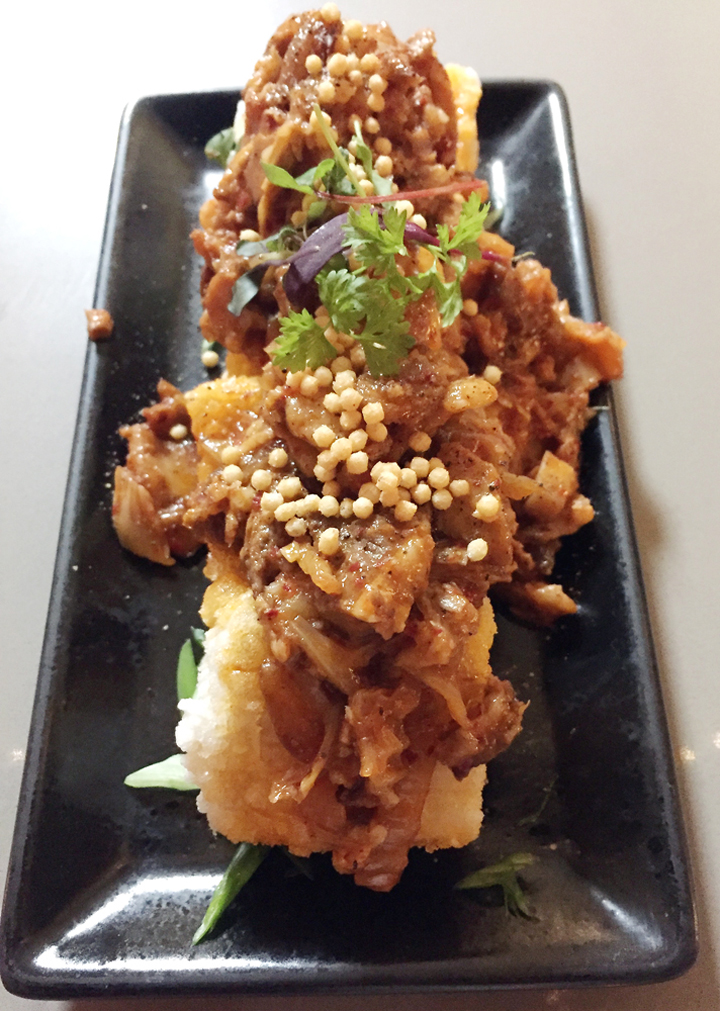
Charcoal-grilled skewer of the flat-iron of Hokkaido A5 Wagyu Snow Beef.

Zimmerman got the idea for this unique restaurant about five years ago when he was the chef at Alexander’s Steakhouse in San Francisco. He would regularly travel to Japan to source Wagyu from farmers there. But back then, he was only buying the loins, which prompted the farmers to question when he would buy the entire animal. After all, a farmer can’t make a living by only selling part of a cow. The only way to maintain a sustainable business is to make use of every bit of what you’re raising.

It got Zimmerman thinking, and agreeing that it only made sense to buy the entire animal.

Read more
« Older Entries Recent Entries »