Category Archives: Chefs

Oakland — The New Culinary Mecca

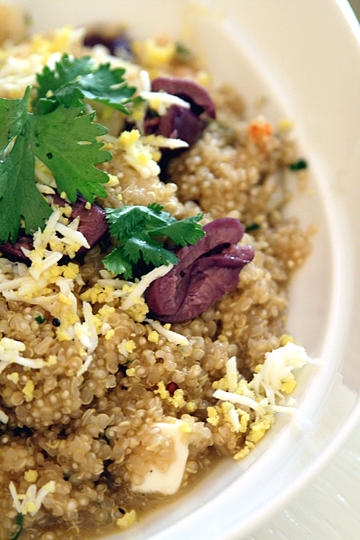
The just-opened Bocanova serves up pan-American cuisine, including quinoa salad with shrimp and orange vinaigrette. (Photo courtesy of Ashley Teplin)

If you think you’ve noticed an unusually high number of new restaurants opening in Oakland in the past year, it’s not your imagination.

Much-buzzed-about Commis, Camino, Barlata, Pican, Miss Pearl’s Jam, and Bocanova all chose to locate in Oakland. Many more are on the way, too, including Bracina from Daniel Patterson of San Francisco’s famed Coi.

Indeed, of the 160 new businesses that have opened in downtown Oakland in the past six years, 65 of them have been restaurants.

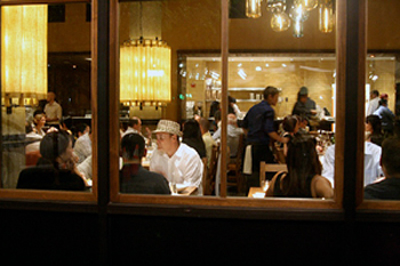
A throng of diners at Bocanova. (Photo courtesy of Ashley Teplin)

Each week, the city’s redevelopment agency fields requests for tours of available properties by San Francisco restaurateurs contemplating a new project on the other side of the Bay.

Read more

Recession? Not at Poggio

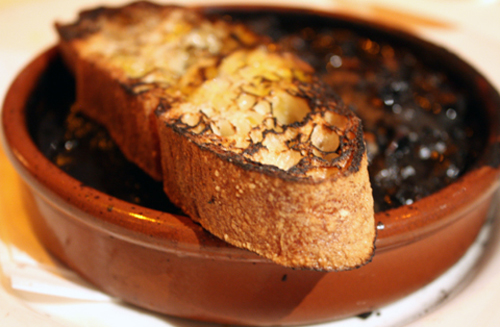
Can you guess what this deep, dark dish is?

My husband and I play this game whenever we go out to eat somewhere new.

If the place is a true delight from food to ambience to price, we will invariably turn to one another and say, “If we lived here, this would be our neighborhood place.”

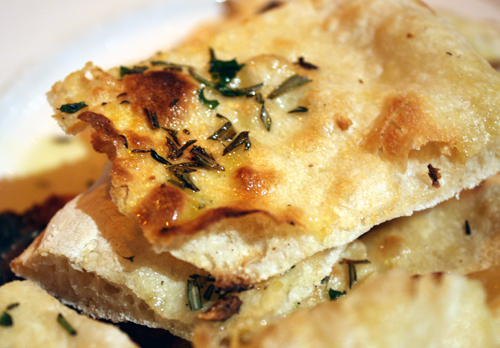
Peter McNee, chef of Poggio trattoria in Sausalito, laughed when I told him we’d already made that declaration about his restaurant from the moment the bread (a special order of just-baked shards of pizza dough, scattered with piney rosemary and drizzled with fruity extra virgin olive oil) was set down at our table. If only we didn’t live some 50 odd miles south, Poggio would definitely be our neighborhood haunt.

Crisp, warm, and delicious fragrant rosemary pizza slab shards.

Turns out he plays that game, too, when he dines out. And so must the throngs of diners crowding the very lively Poggio the recent Saturday night when McNee invited me in to try his dishes. It was my first time at the nearly 6-year-old restaurant. Every seat was taken inside the warm dining room, the bustling bar, and at the outside tables where you can feel the gentle breeze from the Bay.

Seems like a lot of people are making this satisfying Northern Italian restaurant their neighborhood spot.  They’re racking up smaller tabs now, a manager told us. And they are bringing in their own wine more often now to take advantage of the reasonable $20 corkage fee. But recession or no recession, diners continue to flock here.

It’s easy to see why. The cheery sommelier arrives at your table wearing suspenders and armed with the most colorful and memorable stories about the featured wines. Entree prices are moderate, considering the caliber of food and the amount of it. Portions are very generous here. Our half-orders of pasta resembled full-size plates at other establishments.

It’s a place where you can drop in for a Calabria pizza (Calabrian chile roasted pork, gypsy peppers, and picholine olives; $12) or a rustic spit-roasted goat leg with eggplant, and roasted onion and goat cheese gratin ($18).

A taste of the sea with albacore crudo.

The menu changes daily. From time to time, McNee also offers week-long specialty menus, including the “Festa de Pesce,” which we got to try the last night it was offered. This festival of seafood featured both cold and warm small-plate preparations of fresh local seafood.

After McNee told us how painstaking the stuffed calamari ($9) was to make, and how many pounds of squid bodies that he, himself, had to hand-stuff with a mixture of sofrito and diced squid tentacles, how could we not order it?

A shallow earthenware dish arrived as black as a Texas oil pool. The plump squid bodies were braised in their own ink. The squid were tender, and the sauce so deep, earthy, and complex that it was hard not to spoon up every drop.

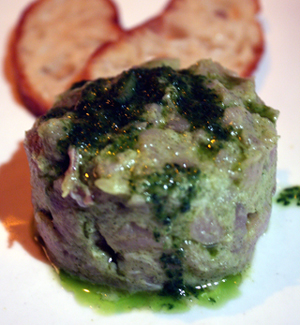
From the “Festa de Pesce” menu, we also tried the local albacore crudo ($8), a mound of cubed buttery tuna with the refreshing hit of chile, lime, and mint.

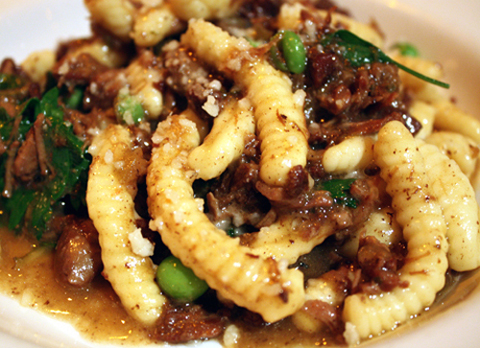
Pasta with lamb

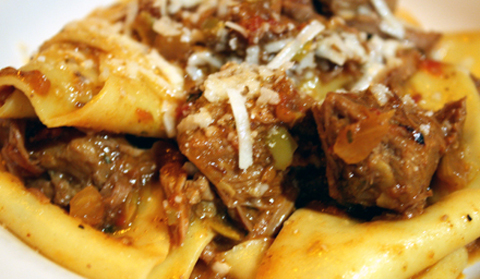
Pasta with veal

The two half-orders of pastas were not only ample in size, but plentiful with meat. The cavatelli with lamb sugo featured ridged, fresh pasta in a hearty, robust sauce. The pappardelle with slow-cooked veal and green olive sugo was a soul-satisfying dish with big chunks of fork-tender meat accented by salty, nutty Pecorino Romano.

Read more

Take Five with Chef Dominique Crenn, the Bay Area Favorite On”The Next Iron Chef”

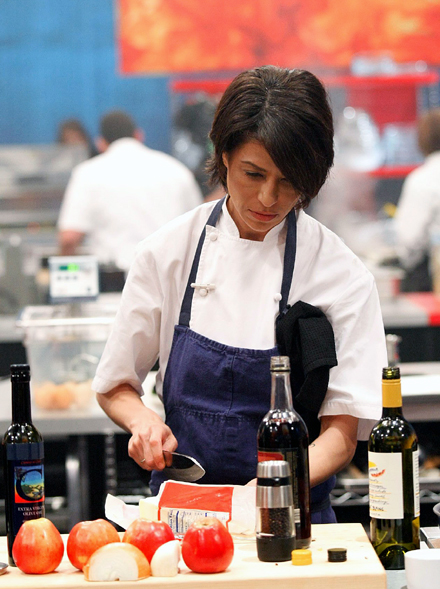
San Francisco's Dominique Crenn dukes it out on "The Next Iron Chef.'' (Photo courtesy of the Food Network)

Of the 10 competitors set to do battle starting 9 p.m. Oct. 4 in the second season of the Food Network’s “The Next Iron Chef,” only one is from the Bay Area.

With competitor Nate Appleman, late of San Francisco’s A16, moving to New York earlier this year, that leaves only competitor Dominique Crenn of San Francisco’s Luce restaurant as the hometown favorite.

That’s just fine by this gutsy 44-year-old French woman, too. She’s never been one to back off from any challenge. Indeed, Crenn, who was told early on by French cooking school administrators that she’d never make it as a chef because she’s a woman, has always held her own. Not only did she go on to cook at one of the most illustrious restaurants of its time — Stars in San Francisco — but she also became the first female executive chef in Indonesia.

Tune in to see if she has what it takes to join the ranks of Mario Batali, Cat Cora, Bobby Flay, Masaharu Morimoto, and Michael Symon as an “Iron Chef.”

I had a chance to preview the first episode — albeit without the ending included (say what?) — and all I can say is the production values have really gone up from the first season. There’s even more flash and pomp this time around.

Last week, Crenn and I talked by phone about her experiences on the show, one of the bizarre ingredients she ended up with, and the weird dynamics she experienced while competing with Appleman.

Q: So how did you get involved with “The Next Iron Chef”?

A: When I was in New York, the producers approached me. I was cooking for the James Beard Foundation, and cooking for the press. They flew me to Los Angeles to cook for them. And then they asked me to be on the show.

Q: Why did you want to do the show?

A: To be honest, I didn’t really want to at first. (laughs)

Weeks before that, I was approached for “Top Chef.” I think it was for the “Masters” show.  I don’t really watch TV. “Top Chef” seemed more like a drama, while “The Next Iron Chef” seemed more about food and getting together with chefs who have unbelievable talent. It seemed more credible and interesting.

Q: Had you been a fan of the “Iron Chef” shows before all of this?

A: My favorite is the Japanese “Iron Chef” show. I watched it all the time in the 1990’s. Those chefs were amazing. You really saw their pedigree. And you saw things you’ve never seen before. You saw Ron Siegel (now executive chef of the Dining Room at the Ritz-Carlton San Francisco) win. Plus, it was funny.

But no, I had not watched “The Next Iron Chef” before. I just got cable two days ago!

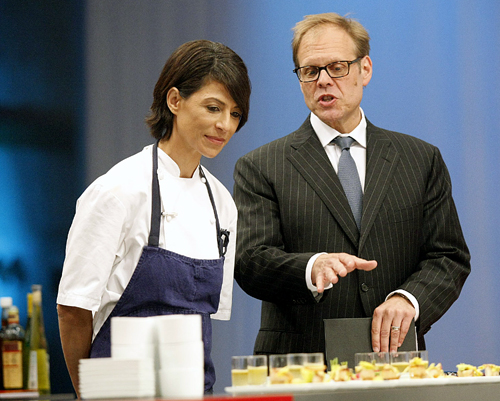
Chef Dominique Crenn gets last minute instructions from commentator Alton Brown. (Photo courtesy of the Food Network)

Q: I know you have a very competitive spirit. Did you also compete in sports when you were younger?

A: I used to play soccer. I used to kick some ass! (laughs) It’s a man’s world again — the soccer world. I used to play soccer with men a lot.

I also did judo for many years. I was a runner; I did the 200-meter. I’m very competitive, but really with myself. I love to win. But it’s more than winning. It’s pushing the envelope. It’s not about failing or succeeding; it’s about trying your best.

Q: On the premiere episode, it looks like Chef Appleman is acting a bit condescending toward you. What’s up with that?

Read more

You Won’t Believe How Much Ginger Is In This Scone

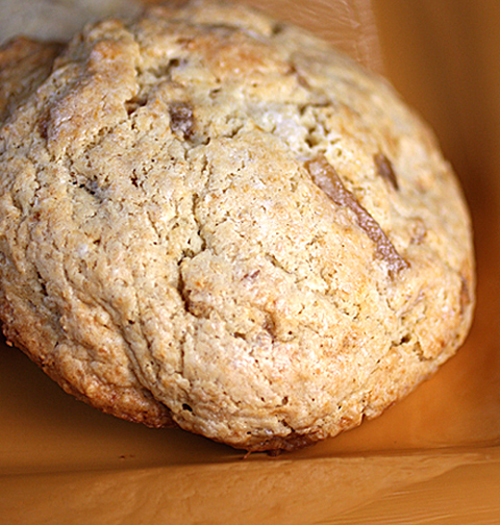
Tender, cakey ginger scones to start your day with.

You all know by now that I have a thing for ginger.

Big time.

So when I spied this recipe for “Ginger Scones” in the Los Angeles Times’ food section last year, it was only a matter of time before I made these lovelies.

They tempted me with their 1 cup of diced crystallized ginger, and their 1/2 pound — yes, you read that correctly — of fresh ginger.

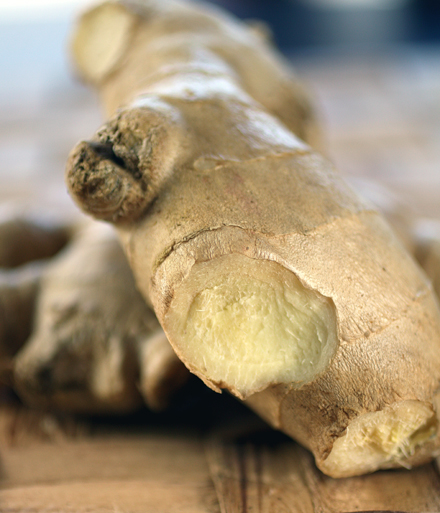
Just how much fresh ginger is that exactly? See that pile below? All of that — yes, indeedie — went into making a mere 10 scones.

A whole lotta lovely ginger.

Don’t let that scare you. It may seem like a lot of ginger, but I promise that your throat will not be ablaze. This is no four-alarm bowl of chili. This is far more nuanced and measured. It’s subtle heat that merely tickles.

The recipe comes from Chef Hans Rockenwagner, who bakes these scones at his Rockenwagner Bakery in Los Angeles and 3 Square Cafe + Bakery in Venice.

The scones bake up crisp on the outside. The interiors are not crumbly like traditional scones, but more tender, moist and cakey in texture. Bite into one, and you get the sugary-tingling hits of candied ginger immediately, followed by a warm, soothing, noticeable yet surprisingly moderated burn of fresh ginger at the every end.

Read more

Cooking with Chef Guillaume at Marche in Menlo Park

Look familiar?

No, that’s not him above.

But Chef Guillaume Bienaime does bear more than a passing resemblance to the Alfredo Linguine character from the movie, “Ratatouille,” especially with the glasses drawn on. You have to love a chef with the playfulness to keep a Pez dispenser like this on a shelf in his bustling professional kitchen.

Below is the real Bienaime, executive chef of Marche restaurant in Menlo Park. And believe me, he doesn’t need a cute talking rat named Remi or anyone else to help him do his job. This 27-year-old chef is a talent, and a giving one at that. Last Sunday, on what was supposed to be his day off when the restaurant is normally closed, he decided instead to teach his first cooking class.
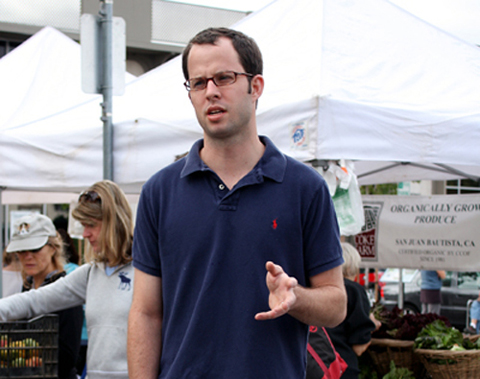
Chef Guillaume Bienaime of Marché at the Menlo Park farmers market.

Marche opened its doors that morning to 16 eager students — most of them regular diners at the restaurant — as well as yours truly and the chef’s Mom to partake in what was the first of four seasonal cooking classes planned annually. And believe me, you will not leave hungry from this $105 class.

We met up with the chef at the nearby Menlo Park farmers market to help gather peppers, corn, peaches, squash, and tomatoes for the dishes we would cook back at the restaurant.

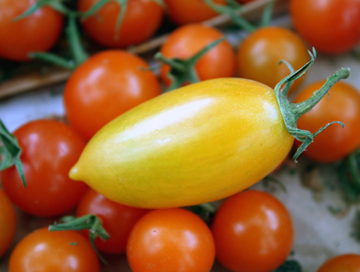
Marche gets all its tomatoes from Baia Nicchia Farm in Sunol, which sells at the Sunday farmers market. Owner Fred Hempel, a geneticist, owns 9 1/2 acres where he grows 30 types of tomatoes, half of them varieties he has created, himself. Indeed, Chef Bienaime is working with Hempel to create a signature “Marche” tomato, resulting from cross-breeding a couple varieties together. It will take two years of tinkering before the tomato will be ready to be grown for the restaurant.
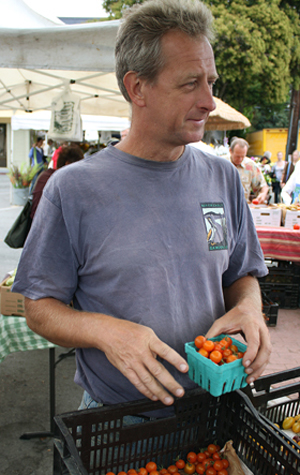
Fred Hempel, geneticist turned tomato grower.

Baia Nicchia Farm's tomatoes.

We carried the provisions back to the restaurant, where we divided up into teams of two or three. The chef explained the dishes we could be cooking that day: Roast Pork Loin a` la Provencal, Summer Squash a` la Grecque, Confit Tomatoes, Summer Corn “Polenta,” Piperade Basquaise, Gratin of Swiss Chard, and Plum & Peach Shortcake.

Chef Bienaime, though, had a special plan for my buddy, Carissa, and I. He was going to have us make Escargots Sommiroise, a traditional dish from Saint-Guilhem Desert in the Langueduoc region, which is snail country. Neither Carissa nor I had ever cooked with snails before, so we were eager to give it a go.
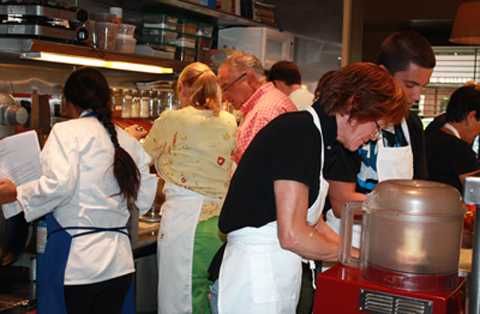
Cooking in Marché's kitchen on a Sunday morning.

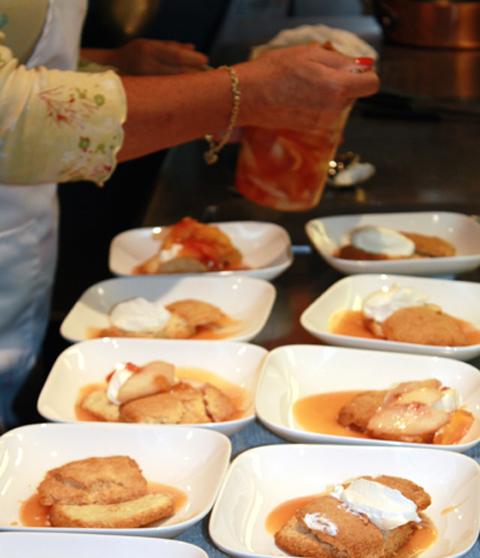
Plating the just-baked shortcakes.

We all donned aprons and set to work in the restaurant’s gleaming stainless steel kitchen, grabbing knives, chinoises, copper pots, and food processors. And no, we didn’t escape doing dishes. But we didn’t mind, what with the restaurant’s nifty machine at our disposal. You rinsed off the dishes, piled them into a rack, and slid it all into the machine, where everything would emerge spotless in just three minutes. Why can’t we have one of these at home, we all thought!

At Marche, the garlic is almost always grated into dishes, using a Micrcoplane, rather than chopped or sliced with a knife. Bienaime says he likes how the garlic disappears into a dish this way. Skin on bell peppers is always peeled off, too, even if they are not roasted. The chef does this, he says, because he finds that the peppers are more easily digested this way.
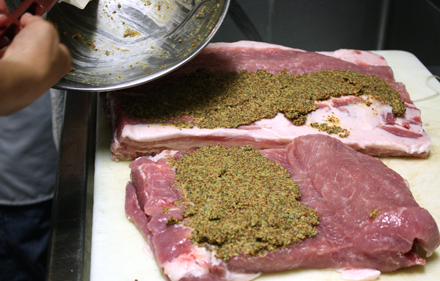
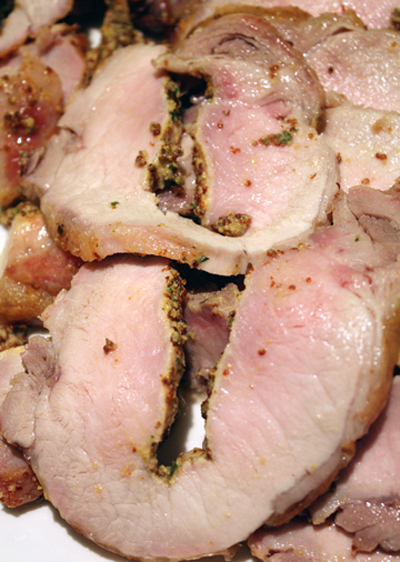
Center cut pork pork loin being smeared with a mixture of grainy mustard, anchovies, garlic, rosemary and thyme.

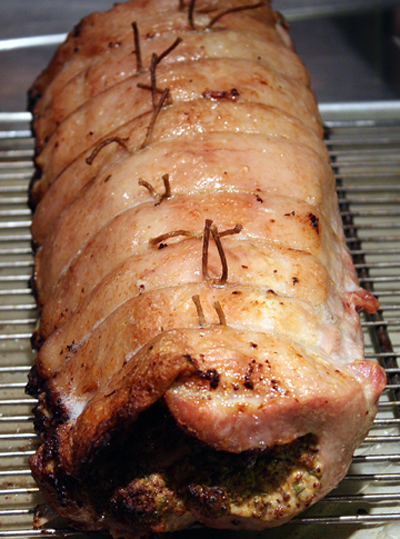
The pork just after it came out of the oven.

Sliced for serving.

All through the kitchen, students worked at shucking corn; peeling tomatoes; blanching herbs; sauteing chanterelles; and slicing open large pork loins to fill with a spread of grainy mustard, anchovy, garlic, rosemary and thyme.

Now and then in the close quarters, someone would call out “Behind you, behind you — hot, hot, hot!” as a simmering pot was ferried from the stove to a counter. There’s major heat generated in a professional kitchen when all the burners and ovens are turned up. So much so, that we all breathed a sigh of relief whenever we had to make a trip to the chilly walk-in to grab an ingredient.

It wasn’t long before the aromas of roasting pork, toasted nuts, and sauteed garlic were making us very, very hungry.

Read more

« Older Entries Recent Entries »