Category Archives: Meat

Kobe Beef and Killer Cabernet Sauvignon Redux — at Signorello Estate

There are many wonderful ways to taste wine in the Napa Valley.

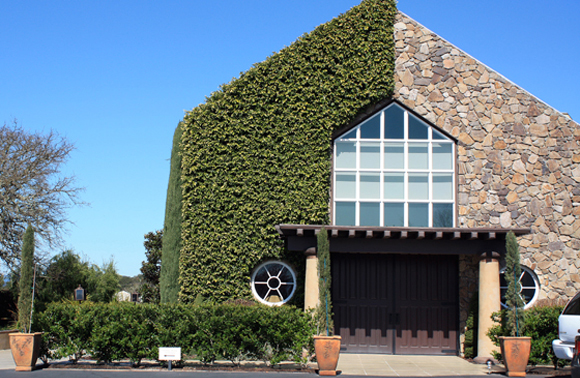
Few are as grand yet intimate as the “Enoteca Signorello” tasting at Signorello Estate on the Silverado Trail.

Raymond E. Signorello, proprietor of the winery that his late-parents established in 1985 on 100 acres of former racehorse-grazing land, wanted to recreate the experience of wine-tasting in Europe. There, wine is often tasted with the winemaker at a table set with food for a more personalized and more relaxed time.

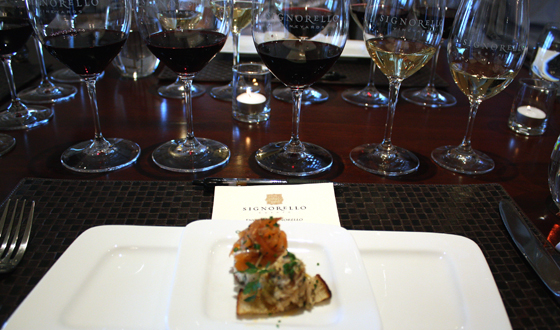
The result is the “Enoteca Signorello” food and wine paired tasting, where guests are seated in a private, light-filled dining room or on the lovely terrace beside the pool overlooking the vineyards, if weather permits. Oliver the dog will probably be on hand to greet you, too.

The special 90-minute tastings are by appointment only, 11 a.m. and 2:30 p.m. daily. Price is $65 per person. That might seem pricey. But this is no basket of water crackers that we’re talking about. It’s a flight of five wines, paired with seven, good-sized gourmet treats prepared in the winery’s professional kitchen by a chef.

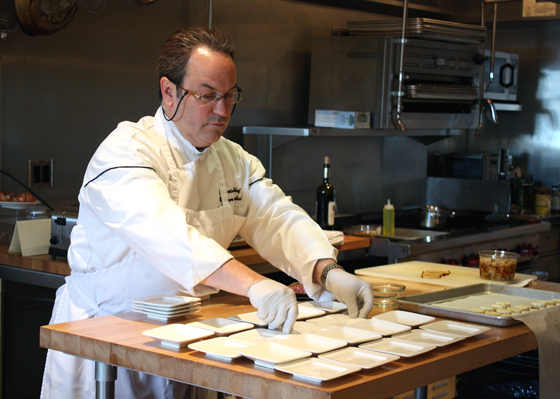
In March, I was invited as a guest to one of these private tastings, which started being offered a year ago and feature menus that change with the seasons.

You’re welcomed with glasses of the 2008 Seta Estate, a Semillon and Sauvignon Blanc blend that had just the right amount of acidity and buttery-ness; and the 2007 Chardonnay Vielles Vignes Chardonnay, made from the fruit from the original 26-year-old vines planted on the estate.

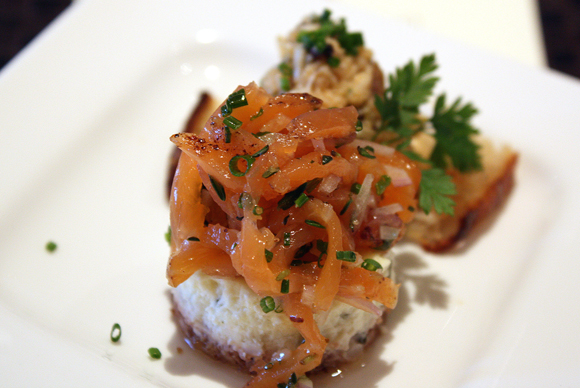
They’re paired with two-bite hors d’oeuvres — a tiny chevre cake topped with julienned salmon cured with star anise and honey; and a crostini of albacore tuna poached in olive oil and dressed with preserved lemons, picholine olives and the fragrant North African ras el hanout spice blend.

Read more

Kobe Beef and Killer Cabernet Sauvignon — at Two South Bay/Peninsula Restaurants

Take some of the richest, most marbled beef around.  Pair it with an inky, full-bodied, Old World-style Napa Valley Cab.

What’s not to like?

Especially when it’s Snake River Farms’ American-style Kobe and Signorello Estate’s 2005 and 2006 Estate Cabarnet Sauvignon with its balance of raspberry, cedar, earth, and tobacco notes.

The two specialty producers have partnered for the past few years to introduce foodies to the luxurious combination of Kobe and Cab. In fact, Signorello even runs a “Kobe & Cabarnet Club,” in which participants receive three shipments a year of Kobe cuts with bottles of Cabernet Sauvignon. Each shipment averages $390.

If that’s a little too rich for your blood, those in the South Bay will be glad to know they can experience the “Kobe & Cab” magic in a slightly more economical way at two local restaurants.

The Grill on the Alley in San Jose is serving a 12-ounce New York Snake River Farms steak seasoned with grilled asparagus ($65) with a bottle of 2005 Signorello Cab ($75)  through at least the end of May.

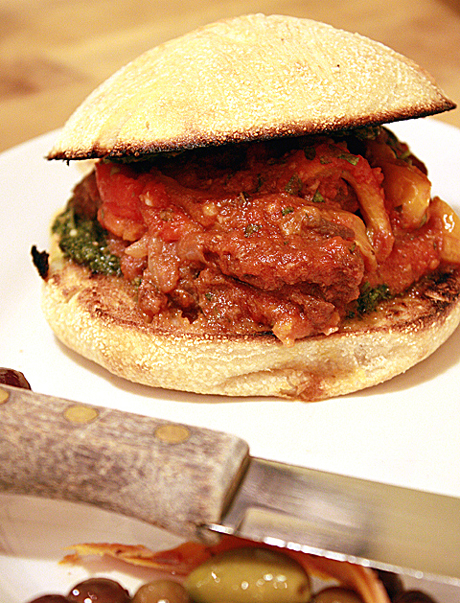
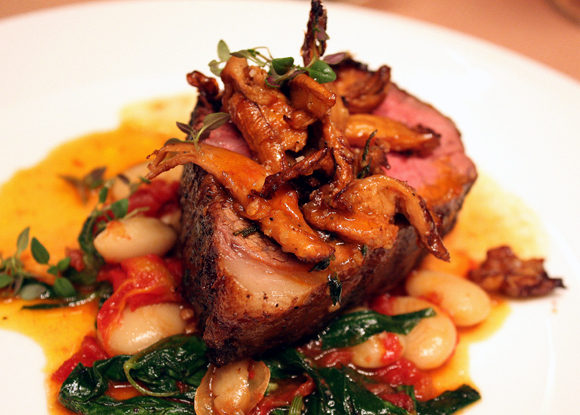
And Quattro at the Four Seasons Silicon Valley in San Jose is featuring two dishes at lunch and dinner through the end of April: An open-face Snake River Farms tri-tip steak sandwich with porcini gravy, fried artichokes and aioli ($19); and a Snake River Farms rib eye with gigante beans, oven-cured tomatoes, black chanterelles and spinach ($45).

The 2006 Signorello Estate Cabarnet Sauvignon is available there by the glass ($21) or bottle ($85).

I had a chance to find out just how wonderful the meat pairs with the wine when I was a guest at a special kick-off dinner at Quattro last month that spotlighted not only Signorello wines and Snake River Farms’ Kobe beef, but also its incomparable Kurobuta pork.

The Wagyu breed is famous in Japan, where the cattle have been raised in the Kobe region for hundreds of years. Snake Rivers of Boise, Idaho crosses Japanese Wagyu with Black Angus cattle for its American-version of Wagyu beef.

No, Snake River Farms doesn’t massage its cows with sake and feed them beer as the folklore in Japan goes. Instead, the Snake River Farms cows are fed Idaho potatoes, white wheat, corn and alfalfa hay. While most other cows in the United States are brought to market at 16 months, the Snake River ones are fed up until they’re 30 months old, resulting in more flavor and a whole lot more marbling.

Just how good is this stuff? Uber-chefs, Michael Mina, Wolfgang Puck and Thomas Keller are huge fans, especially Keller who buys almost all of the Snake River rib eye caps produced (the extremely marbled muscle around the outside of a center-cut rib-eye steak).

Read more

A Celebration of Lamb and Asparagus

If there are two ingredients that sing of spring, it’s lamb and asparagus.

To celebrate both, the Lark Creek Restaurant Group is partnering with California asparagus growers and lamb ranchers to showcase those ingredients on menus at four of its San Francisco Bay Area restaurants through the end of the month.

Guests also can take home recipes for each dish to recreate them in their own kitchen.

Here are some of the dishes you can enjoy:

*  One Market in downtown San Francisco, walking distance from the Hotel Vitale, will be serving up warm, grilled Zuckerman’s Farm asparagus salad with 62-degree Marin Sun Farms chicken egg; and grilled Sonoma lamb loin chops marinated with espelette chili and garlic.

* LarkCreekSteak, also in downtown San Francisco, steps from the Marriott Marquis, will feature pan-roasted local asparagus with toasted macadamia nuts; and grilled lamb chops with harissa, mint sour cream, and fava beans.

Read more

Bacon Ecstacy and Winner of the “Toast of the Town” VIP Tickets

Four words: Bacon. Jam. In one.

If that doesn’t make your lips smack, it should. When a pork-happy colleague of my husband’s happened to mention how much he loved a most unusual spread called Bacon Jam, well, I just had to spring for a jar to see what the fuss was about.

It’s made by Skillet Street Food of Seattle, which was founded by Joshua Henderson, a graduate of the Culinary Institute of America at Hyde Park. Turns out working in restaurants wasn’t all that it was cracked up to be. So, Henderson took to the streets — refurbishing an old Airstream trailer with a full commercial kitchen to rev up to office parks and farmers markets to sell freshly made bistro-style food. Consider it a cooler, retro version of the taco truck.

Bacon Jam, a concoction that Henderson has been making for years, tops the burgers he creates. Thankfully, he started selling this magical stuff in jars for those like me who aren’t in Seattle.

It’s almost like a thick, ropey ragu in texture, with wonderful smokiness and the sweet-tangy flavor of a relish. Henderson renders bacon, then adds onions, brown sugar, and balsamic vinegar, before letting it all cook down for six hours until it’s concentrated and jammy.

My husband’s colleague, Bruce, enjoys Bacon Jam  slathered on Triscuits. It was a great addition to a spinach and cheese omelet I made one weekend. Now, I’m dreaming of it in a tart with crumbles of blue cheese.

An 8-ounce jar is $12. A 1-ounce serving has 140 calories, 120 of which are fat calories. But don’t think about that. I know I won’t as I reach for one more little spoonful.

And now for the winner of the pair of  VIP tickets to “Toast of the Town”:

Read more

Exquisite Italian Small Plates at Barbacco at San Francisco

Who doesn’t feel fiercely proud when a younger sibling shines?

Such is the case with Barbacco in San Francisco, the new sibling to the ever-popular Perbacco in San Francisco, both just a short hop from the Mandarin Oriental.

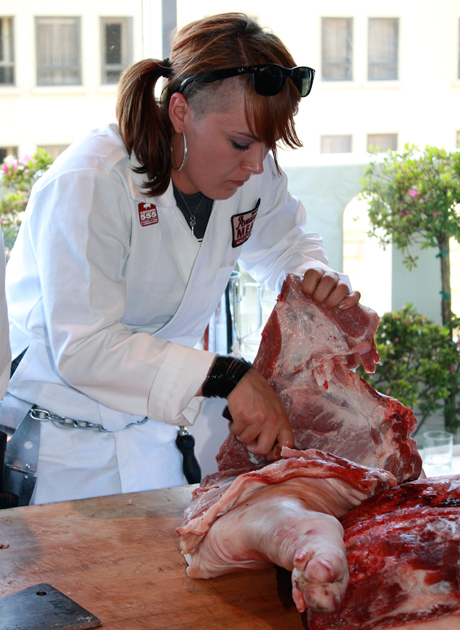
The chef is Sarah Burchard, who was a protege of Perbacco Executive Chef Staffan Terje for three years. In this day and age of macho men butchering their own animals with major bragging rights, Burchard was right in there with them. Formerly in charge of Perbacco’s salumi program, the petite chef regularly broke down whole pigs just like the guys. And no surprise — the salumi continues to be outstanding at Barbacco.

Opened in January, this sleek Cass Calder Smith-designed restaurant rocks a decidedly New York vibe. The narrow 66-seat restaurant has brushed stainless steel columns, exposed pipes, a brick wall, and seating at a long counter stacked with jars of olives. The bare wood tables are at just-below bar stool-height with chairs that have comfy rests for your feet. A couple of large flat screen TVs add buzz without being too distracting.

The lively restaurant is a perfect spot to stop in for a glass of wine and something to nosh on. At lunch, there are to-go items, with the menu displayed on the TV screen at the front counter. Or take your time at dinner, and wind your way leisurely through the extensive menu of mostly shared plates.

That’s just what we did on a recent evening when I was invited in to dine as a guest. Ever since I first tried fried olives many years ago in Spain, I haven’t been able to resist them. I mean, come on — something oily and rich made even more oily and more rich? What’s not to like?

At Barbacco, they come stuffed with pork. The $5 “ascolane” are large, meaty green olives with a serious crunch on the outside. You know they’re bad for you, but you can’t stop yourself. Not with these.

No way could we pass up the house-made salumi here. We went for the small chef’s selection ($11 or $18, depending upon the size of the platter). Among the standouts was the mortadella, which tastes like the most exquisite, grown-up, gourmet version of baloney you’ll ever eat; and the ‘nduja, a crock of spicy, spreadable smoked Calabrian salame. Dolloped with Calabrian chili peppers, it was creamy, fatty, and mind-blowing good.

Read more

« Older Entries Recent Entries »