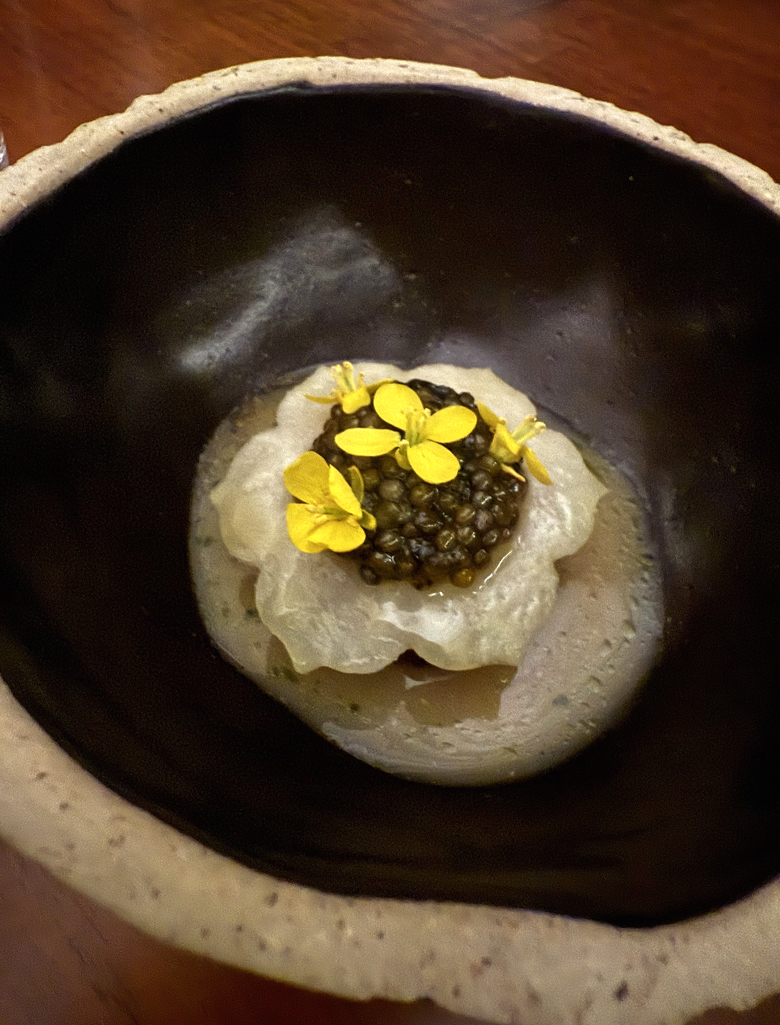
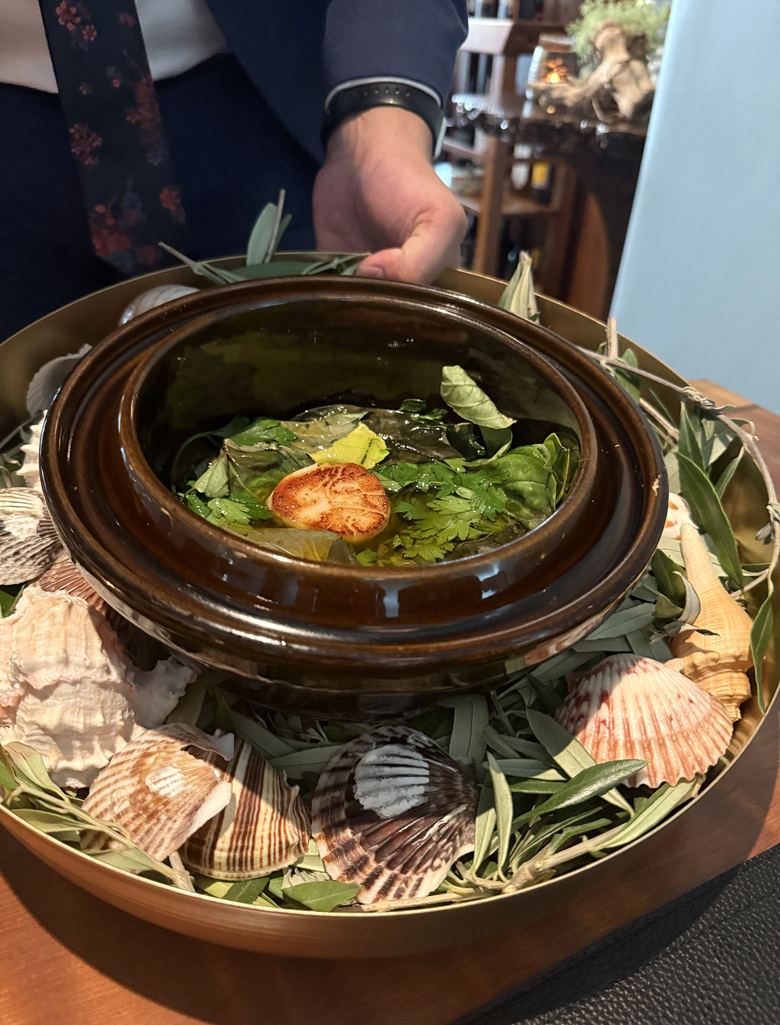
Scallop, smoked mussel and caviar, a dazzling dish from the Atelier Crenn & Atomix collaboration dinner.
When a Michelin three-starred restaurant reaches a milestone 15th anniversary, you know it will pull out all the stops.
Such is the case with San Francisco’s acclaimed Atelier Crenn, which marks that occasion this year by debuting Continuum, a new collaborative dining experience. It brings visionary chefs from around the world to cook at the Cow Hollow neighborhood restaurant with Chef-Owner Dominique Crenn and Pastry Chef Juan Contreras.
I was fortunate enough to be invited in as a guest for the inaugural dinner last week with Chef Junghyun Park of Atomix, the modern Korean restaurant in New York City that’s garnered two Michelin stars, and was named No. 1 on “North America’s 50 Best Restaurants” list. It also catapulted him to a James Beard “Best Chef New York” in 2023.
Not surprisingly, it took less than a day for the $596.55-per-person dinner to sell out.
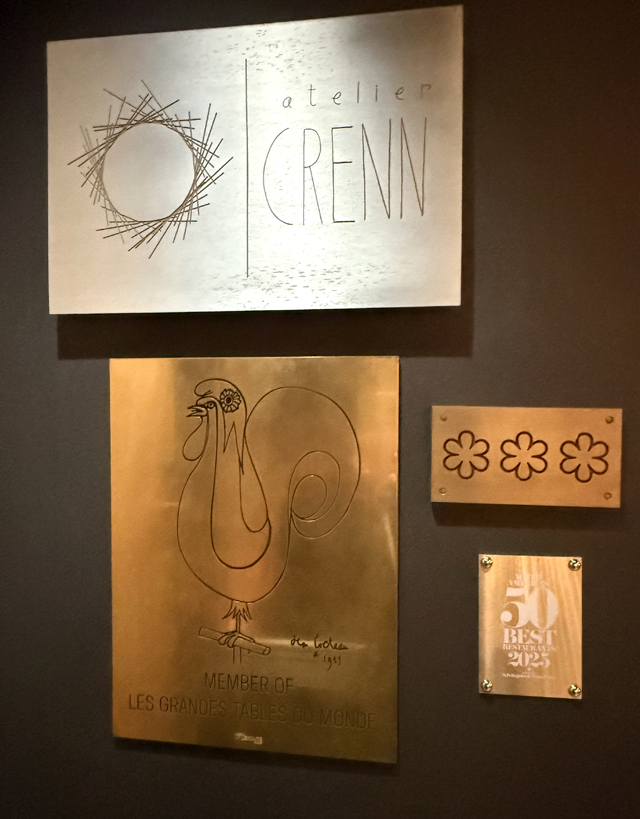
Chef Dominique Crenn.The entrance to the Michelin three-starred restaurant.
Once seated, you’ll find a small packet at your place setting. Inside, you’ll find cards introducing Chef Park, along with information about some of his dishes to be served.
It’s a good bet that if you see anyone dressed up in Carmel-by-the-Sea, a charming beach town and major laid-back tourist draw where shorts and sweatshirts are the norm, they are likely headed to dinner at Aubergine.
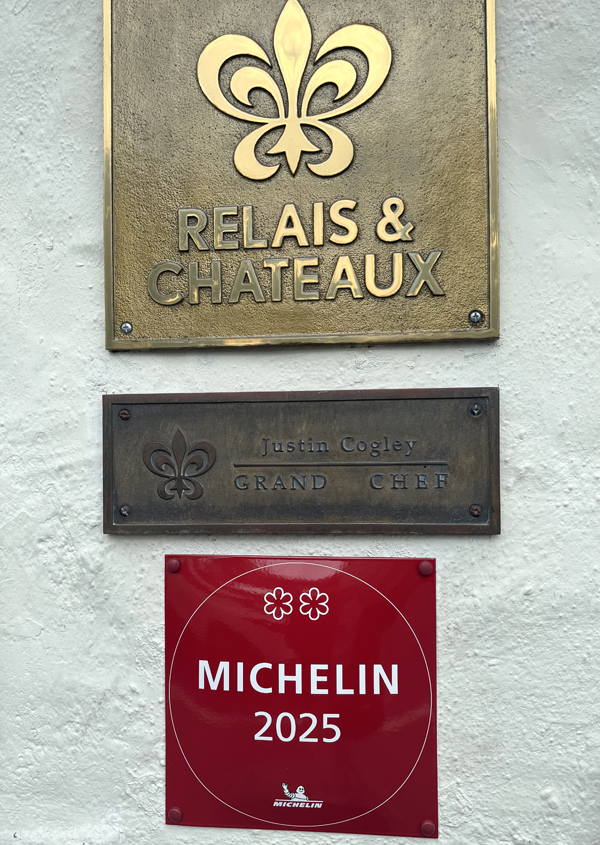
Located in the Relais & Chateaux luxury hotel, L’Auberge Carmel, it is the only Michelin two-starred restaurant in this tiny town of 3,000. In fact, since retaining its one Michelin star since 2019, it was awarded its second star last year.
A lot has changed since I last dined there a dozen years ago. Most notably, jewel box of a dining room always felt intimate but even more so since four tables have been removed, leaving all of five now situated around the perimeter. There are two seatings available, 5 p.m. and 8 p.m. If you choose the early seating as we did, you’ll catch the last light on a fall evening through the wall of draped windows.
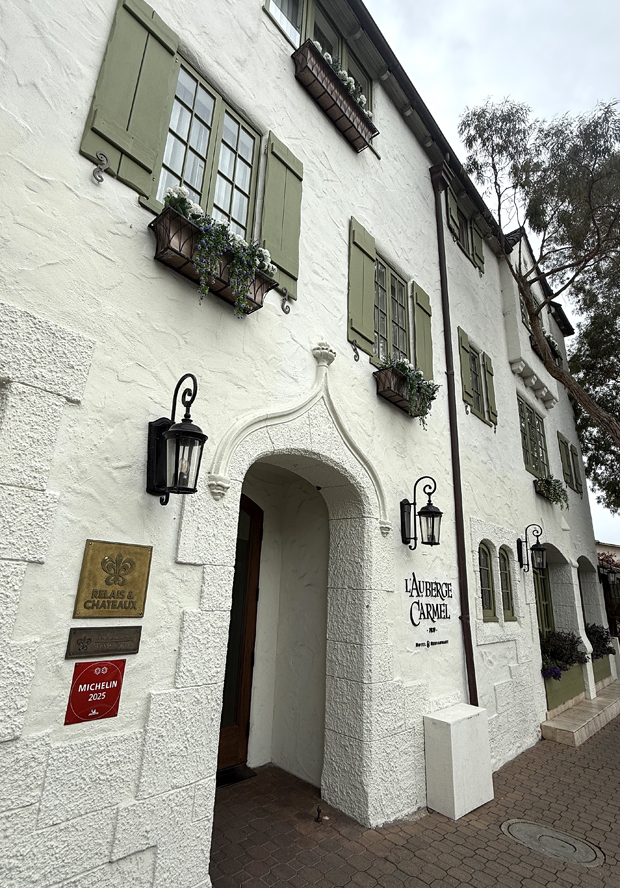
Aubergine at L’Auberge Carmel.Awarded a second Michelin star in 2024.
Executive Chef Justin Cogley remains the constant, a former professional figure skater with “Disney on Ice,” who glides smoothly through the upper echelons of fine dining, having launched his career at none other than Charlie Trotter’s in Chicago.
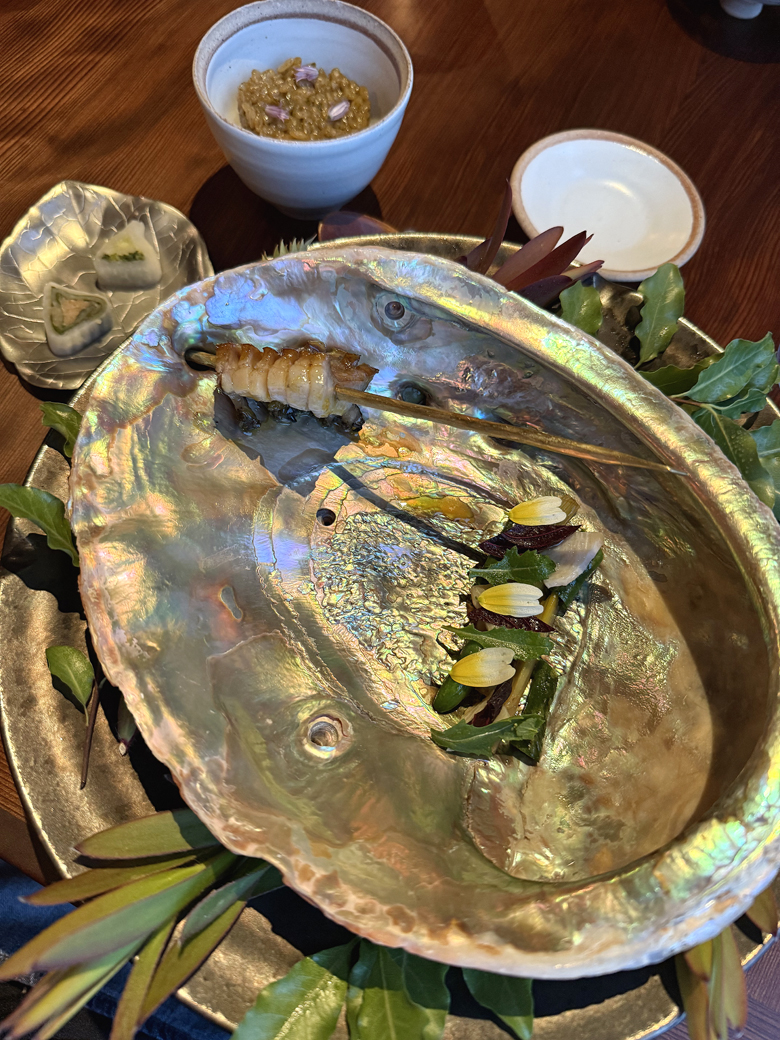
The signature abalone course at Harbor House Inn, which will set the bar for any other abalone dish you enjoy in the future.
From the first time I dined at Harbor House Inn in 2018 before it officially opened to the public to my most recent visit this month, it remains to me the restaurant that most thoroughly embodies a true sense of place.
Maybe it’s partly the secluded setting in tiny Elk, a three hours’ drive north out of congested San Francisco through peaceful winding roads of bucolic vineyards and towering redwoods, that somehow vanquishes any of life’s troubles, worries or stresses. Maybe it’s the view from the property of the rugged coastline overlooking Wharf Rock East Arch, the dramatic rock formation bored through by centuries of powerful, unrelenting Pacific waves. And maybe it’s the vision and execution by Executive Chef Matthew Kammerer and his team, who have gone to great lengths to spotlight ingredients, plateware, and decor that are distinctly of the land and sea there.
It all adds up to terroir personified, creating a truly immersive and transportive experience.
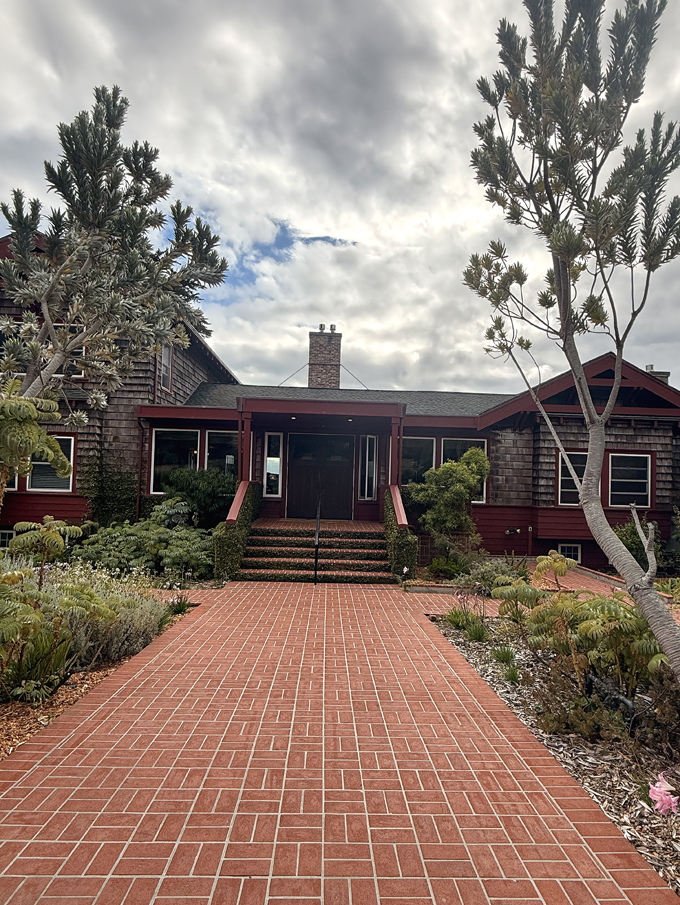
The Harbor House Inn.
Of course, few Michelin two-starred experiences come at a modest price. Harbor House Inn’s tasting menu is $325 per person. If you elect to stay overnight in one of its 11 rooms or cottages, a wise choice given that there are few other accommodations close by, it will run you a minimum of $500 per night. Make the splurge, though, and you’re in for a most memorable occasion.
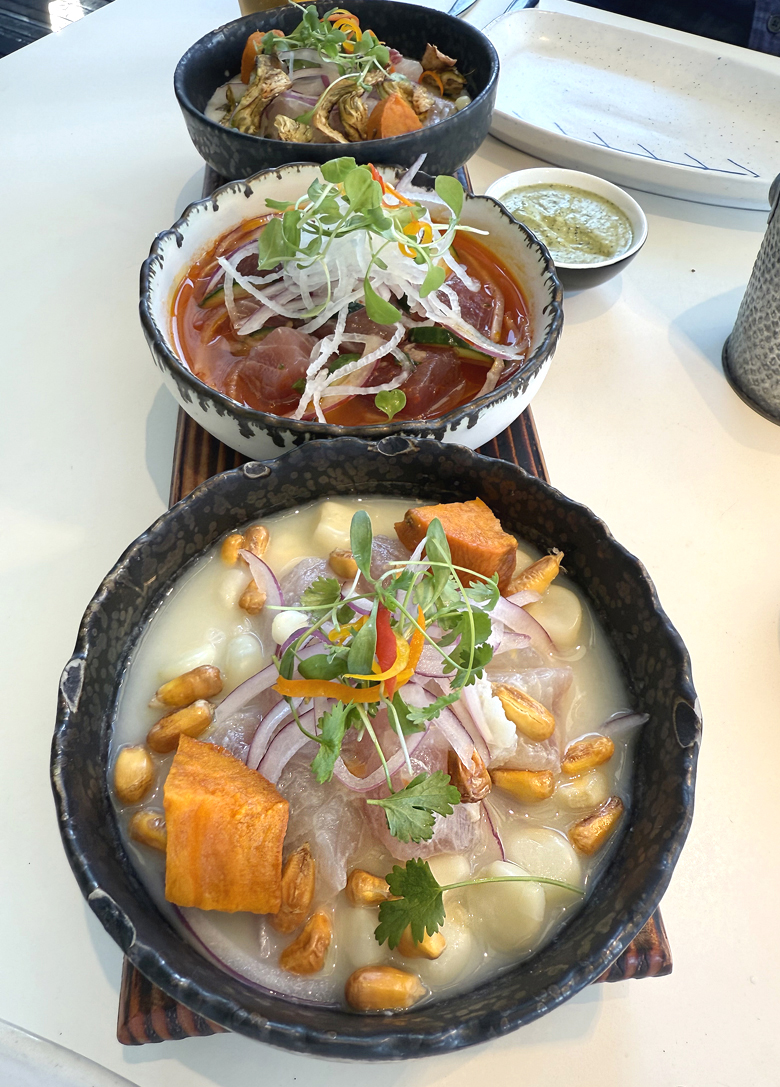
Cebiche tasting (front to back): Clasico, Nikkei, and Victoriano.
On a summer evening when the sun lingers long even in typically foggy San Francisco, there are few better places to dine than outside at La Mar Cocina Peruna.
Located on the Embarcadero waterfront with sweeping views of the Bay, this modern Peruvian restaurant by acclaimed Chef Gaston Acurio just underwent an interior refresh, too. Its Executive Chef Victoriano Lopez also has updated the menu.
I had a chance to check out both when I was invited in as a guest of the restaurant recently.
Opened in 2008, it is one of 10 La Mar restaurants around the world, including the original one in Lima.
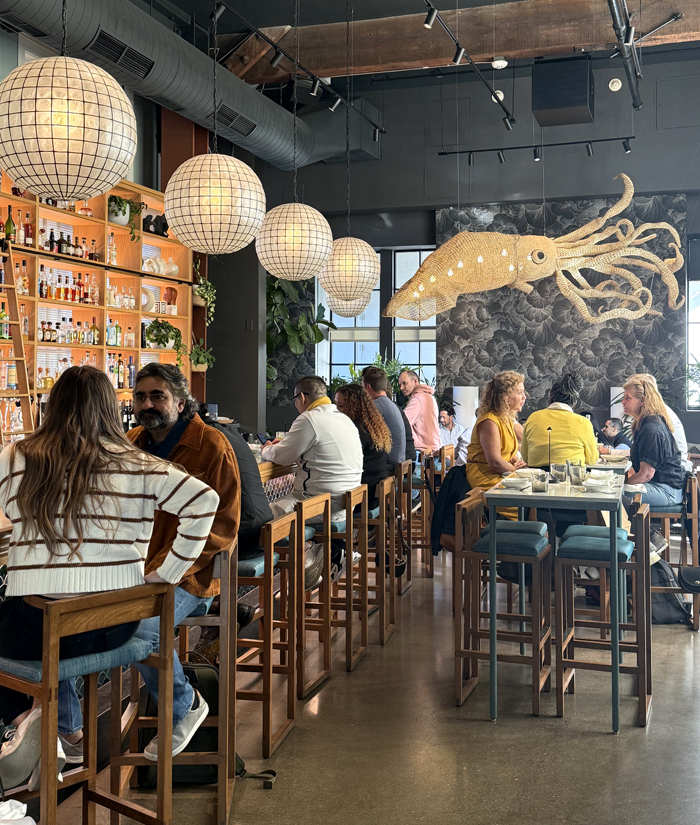
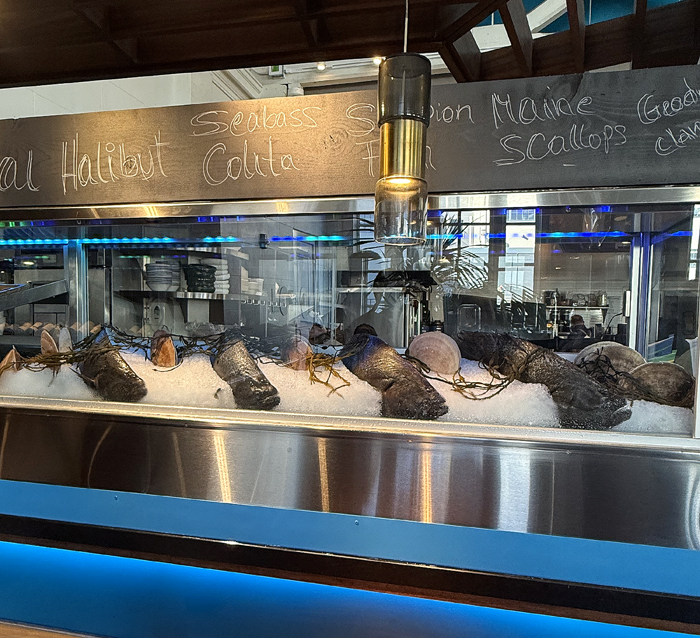
The bar.New fresh seafood display.
The San Francisco one glows in deep indigo hues. The bar features a giant squid art piece hanging from the ceiling. The dining room boasts light fixtures reminiscent of jellyfish, as well as a new display case of fresh seafood.
The covered patio has new planters, glass walls to guard against the wind, and plenty of heaters so the space is comfortable even when the evening chill descends.
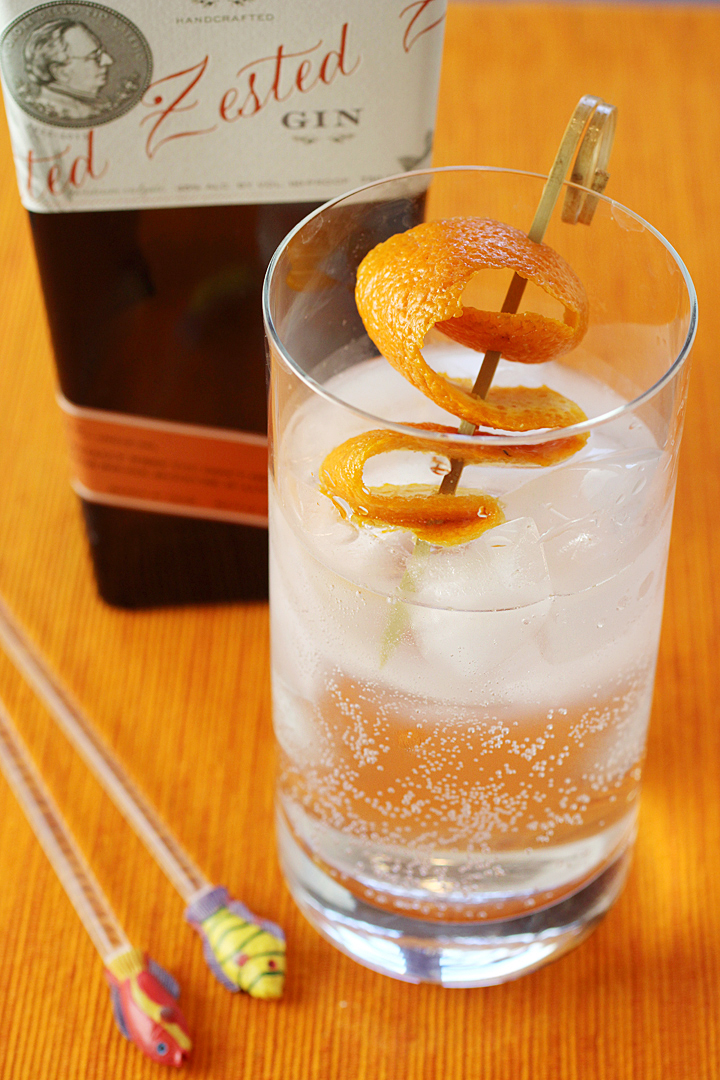
I love a cocktail that has the taste and aroma of orange, and Uncle Val’s Zested Gin ($30) has both in spades.
Twist open the bottle and take a whiff to be floored by the fragrance of bright orange citrus with a hint of clove.
I had a chance to try a sample of this small-batch gin that’s made with bergamot, orange, coriander, barley malt, and, of course, juniper. But don’t worry; for those not too keen on the medicinal taste of juniper, this gin keeps it in balance.
Uncle Val’s is a brand by 3 Badge Beverage Corporation. It was founded by August Sebastiani. Yes, of that Sebastiani family.
In fact, the corporation is run out of an old fire station in Sonoma built in the 1880s by his great-grandfather Samuele Sebastiani, a mason and quarry miner, who went on to start making wine. It’s also where Samuele’s son (August’s grandfather) would go on to become a volunteer firefighter. The corporation is named for the three fire service badges that he earned.
Fourth-generation vintner August bought the old fire station in 2014 that had been vacant for nearly a decade. He established Uncle Val’s Gin to pay tribute to the herbal concoctions that his late-Uncle Zio Valerio (aka Uncle Val) distilled from cuttings from his Tuscan garden.
With its rounded orange taste, the gin is ideal in a Negroni. Or a gin & tonic. Or even just over ice with an orange twist.
Although Uncle Val’s gins are available at several Bay Area stores, you might have to hunt harder specifically for the Zested Gin, which is stocked in fewer places. However, it can be found at Village Market in Oakland and Bottle Barn in Santa Rosa. You can also enjoy at the bar at the Ritz-Carlton in San Francisco and Pearl Hour in Monterey.
Cheers: Each small-batch bottle of gin features a label with one of Uncle Val’s more notable sayings. Mine sported this one: “A closed mouth catches no flies.” Meaning think before you speak — or else pay the price later.
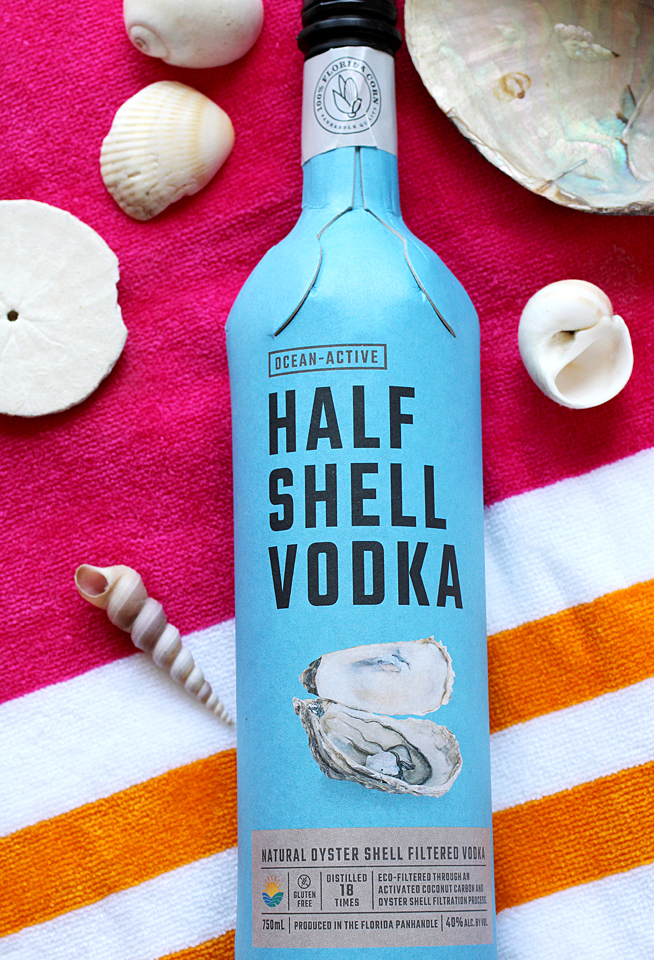
Half Shell Vodka
If you have a tendency toward fumble fingers, you don’t have to worry about mishaps when carrying a bottle of Half Shell Vodka.
Unbreakable and light as can be. That’s Half Shell Vodka.
That’s because this vodka is billed as the first one packaged in a completely recyclable paperboard bottle. Accidentally drop it, and there will be no damage.
In fact, when I received a sample to try, I almost didn’t believe it was inside the mailing box because it felt so incredibly light.
It sports a screw top and a liner in a bottle that’s made of 94 percent recycled paperboard for a much smaller carbon footprint.
The Santa Rosa Beach, FL company distills its vodka 18 times from U.S.-grown corn, then uses reclaimed oyster shells (from bars and restaurants) and activated coconut carbon (think charcoal made from coconut shells) to filter the spirit. But that doesn’t mean you’ll find any lingering shellfish or coconut taste in this vodka. The system is merely used to enhance smoothness and purity.
Indeed, this vodka has a clean taste with a fluid boozy warmth.
Find it for $24.99 at select Whole Foods in Northern and Southern California.
Cheers: Half Shell Vodka runs a “Sip for Sustainability” nonprofit partnership program that helps raise funds for sustainability and conservation efforts nationwide.