Category Archives: Enticing Events

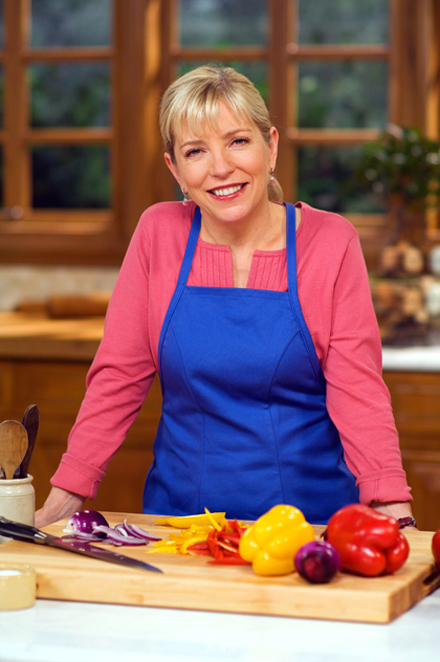
Take Five with Sara Moulton, On Life After the Demise of Gourmet Magazine

These days, Sara Moulton is almost a rarity among TV cooking show stars.

She’s a cook’s cook, a graduate of the prestigious Culinary Institute of America in Hyde Park, NY, who worked on the line at restaurants in Boston, New York and France for seven years, before becoming an instructor at Peter Kump’s New York Cooking School in New York, and finally executive chef of Gourmet magazine, where she worked until it unceremoniously ceased publication on October 2009.

Moulton, who lives in New York with her husband and two children, has been anything but idle since then. Her third cookbook was just published this month, “Sara Moulton’s Everyday Family Dinners” (Simon & Schuster). The book reinterprets what constitutes dinner and provides inventive, healthful fare to wake up that end-of-the-day meal.

You can meet Moulton at three upcoming Northern California events. She’ll do a cooking demo and sign copies of her new book at 11:30 a.m. May 18 at Sign of the Bear in Sonoma. For more information, call (707) 996-3722.

She’ll also do two cooking classes and book signings at Draeger’s markets: 5 p.m. May 18 at Draeger’s at Blackhawk in Danville; and 5 p.m. May 19 at Draeger’s in San Mateo. Tickets to either event are $80 per person.

I had a chance recently to chat with Moulton by phone about her new book, the changing culinary landscape, the shock of being unemployed, and the demise of the magazine we all loved.

Q: How did you find out that Gourmet was going to fold?

A: The magazine was way down in advertising pages, but so were many magazines at Conde Nast. We’d already been told we had to cut back 25 percent of expenses. We were already walking around, thinking, ‘Who’s next?’

We thought we were special — a jewel in the crown. We won all sorts of awards. We’d been going through a rough period, through many publishers, and we were way down in sales staff. We knew it was coming, but didn’t know it was coming.

I’m not mad. I know Conde Nast had to make choices. I found out on a Monday morning, when I was out doing a photo shoot for my cookbook. We were at the farmers market with the photographer and had just gotten started. My cell phone rang at 9:30 a.m. It was my chef de cuisine, calling, and she was crying. I thought somebody had died. She said that they were shutting down the magazine, that there had been a meeting with the staff.

My immediate boss then called to tell me we had to have everything out by Tuesday at 5 p.m. It was quite a scramble.

Q: Where you able to pack up all the things that had been meaningful to you all those years?

A: My husband came to the office and helped me. We packed 35 boxes of books and shipped them home. I gave a bunch to Columbia University, and we built a new bookshelf in my son’s room.

I also took an old copper bowl, with Conde Nast’s permission. It’s from France, from the same cookware store that Julia Child used to buy her cookware from.

It’s a very heavy bowl. At my last restaurant job, I was the chef tourneau (substitute cook), who could work any station necessary. One thing I had to do at times was pastry, which was not my forte at all. We had an apricot souffle on the menu, made with dried California apricots, sugar, lemon juice and egg whites. We used to make the recipe by hand, whipping the egg whites by hand. We’d make seven souffles at a time.

On Saturday night that was my job. I’d have to make four or five batches. This bowl is a dead ringer for that bowl. The apricot souffle finally ran in Gourmet, and I also would teach people at classes how to do it by hand. The first time you whip egg whites or make bread, you should really do it by hand because you get a feel for it more. I didn’t want to leave that bowl behind. I didn’t want someone who didn’t care about it to just grab it and throw it out. It hangs in my kitchen now. I’m looking it as we speak.

Q: Your job at Gourmet was probably every foodie’s fantasy.

A: As the executive chef of the dining room, I cooked meals for the advertisers. We’d wine and dine them. Then, we’d hit them up for advertising. It used to work really well. (laughs). I was making the best food of my life in that dining room. It was a great job.

Q: Do you have a huge stack of Gourmet magazines at home?

Read more

What Goes Into Judging the Pillsbury Bake-Off

For two long days, I had to keep mum about one of the biggest secrets around — the name of the person to whom my fellow 11 judges and I had chosen to award a whopping $1 million.

After all, we had been sequestered in an unmarked room in the Hilton Bonnet Creek Resort in Orlando, Fla. , sworn to secrecy as we deliberated our decision for an entire day.

We had to be escorted to the bathroom if we needed to leave that guarded conference room. We had to sign confidentiality agreements. We were not to talk or compare notes with each other at the start, until the field had been greatly narrowed. There was even a paper shredder in the room to destroy any evidence that wasn’t supposed to see the light of day.

This is what you must do when you are a judge for the nation’s premier home-cooking contest, the 44th Pillsbury Bake-Off.

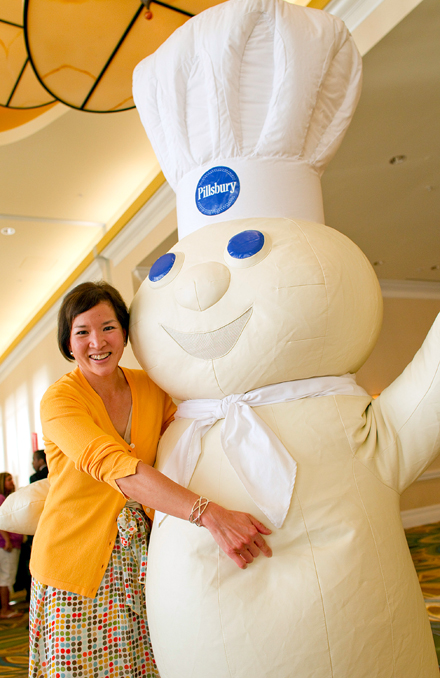
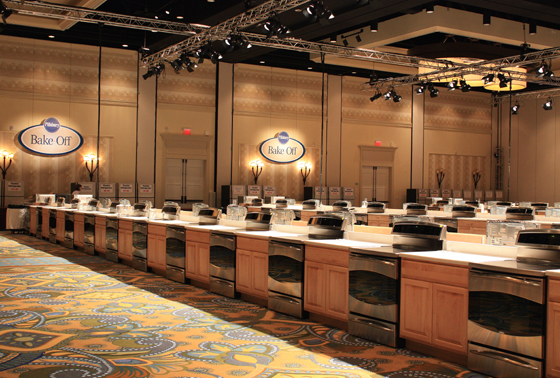
This was my second time as a judge for the iconic contest, in which tens of thousands of home-cooks vie to compete for the grand prize of $1 million by creating an original dish that incorporates at least two Pillsbury or General Mills products. Only 100 finalists are chosen to actually participate in the Bake-Off, where they are flown to Orlando to do battle in an expansive ballroom set up with 100 mini kitchens.

Talk about pressure all around.
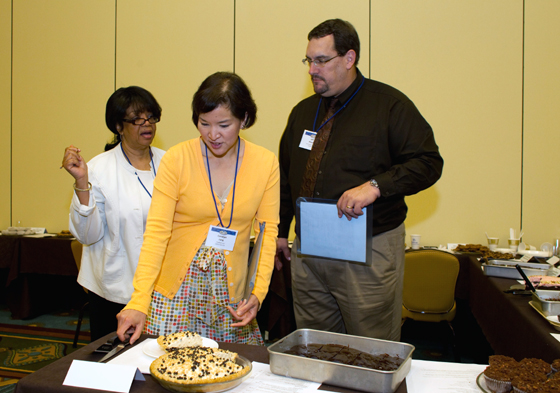
But I was up to the task, as were my fellow judges, who were made up of food writers and supermarket industry folks from around the country. About half of us had been Bake-Off judges before.

All of us had judged many food contests in our career. But it’s rare — if ever — that we have the opportunity to change someone’s life with a prize this substantial. As a result, we took our duties very seriously. We avoided reading anything to do with the Bake-Off for more than a year, as we had been instructed to do. We felt the great responsibility placed upon our palates to make the best decision possible, to choose the most deserving recipe that would uphold this contest’s storied history.

We were divided into four teams comprised of three judges each. Each team would be responsible for selecting the winner of one of four categories: “Breakfast & Brunches,” “Entertaining Appetizers,” “Dinner Made Easy,” and “Sweet Treats.” Each of those category winners would receive $5,000. After that was determined, we would all come together as judges to decide the grand prize winner from amongst those four category winners.

The last time around in 2002, I was asked to judge the desserts category. This time? Yup, you guessed it — I got the “Sweet Treats” category again. I guess the Pillsbury honchos have read my blog and figured out I have a major sweet tooth, huh?

Adding to the buzz this year was the fact that unlike other Bake-Offs, the grand prize winner was not going to be announced the next morning after we had made our decision. Instead, the four category winners would have to wait with bated breath until Wednesday — a whole two days later — when they would appear live on the “Oprah Winfrey Show” in Chicago, and America’s biggest media mogul, herself, would announce the grand prize winner on national television.

How’s that for lip-smacking culinary drama?

At 8 a.m. Monday, after the 100 contestants were safely secluded away at their kitchens in the ballroom so that we could not see them or have any contact with them, we judges were escorted through a nearby dark hallway to another conference room, where we would spend the next nine and a half hours of our lives with no other contact with the outside world. We weren’t allowed to bring our cameras. We weren’t allowed to tweet. We weren’t allowed to make any outgoing calls whatsoever.

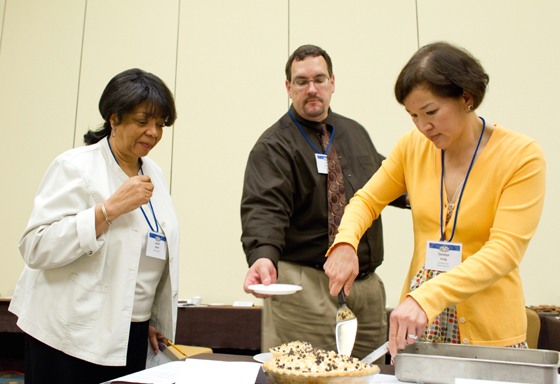
The Pillsbury folks went the distance to make us feel comfortable. After so many years, they have it down pat. At the center of the room were comfy, suede-like couches and easy chairs arranged in a circle and built to hold exactly 12 people. The New York Times, and an assortment of magazines were on the coffee table, in case we needed a break between bites. Platters of pastries, as well as coffee and teas were available in case we needed to warm up our palates before our duties beckoned. And there were piles of cucumber slices, carrot sticks and celery sticks in case we needed to cleanse our palates.

At each corner of the room, each of  four teams was stationed around a u-shaped set of tables  set up to hold the dishes that we were to taste as they came in from the Bake-Off ballroom. Each table also held the recipes for the dishes. But no names or hometowns of the contestants were attached, so that the folks who cooked the dishes would remain a mystery to us.

The contestants had from 8 a.m. to noon to complete their dishes at least twice. One version would go to the judges, the other would be set aside for photographs.

You have no idea which dishes will come in first for judging. It depends on the logistics of the dish, as well as the swiftness of the cook.
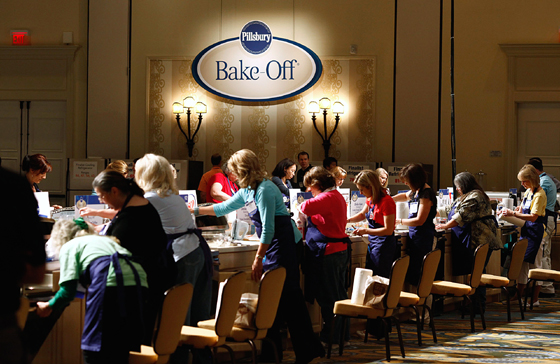
At 9 a.m., nothing had arrived yet for any of us to judge. Each time the doors swung opened, we’d all crane our necks to see if a dish was arriving. But each time, it was only a General Mills honcho entering or leaving the room.

Read more

Kobe Beef and Killer Cabernet Sauvignon Redux — at Signorello Estate

There are many wonderful ways to taste wine in the Napa Valley.

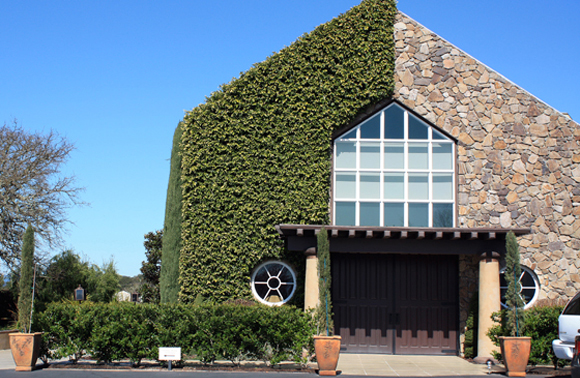
Few are as grand yet intimate as the “Enoteca Signorello” tasting at Signorello Estate on the Silverado Trail.

Raymond E. Signorello, proprietor of the winery that his late-parents established in 1985 on 100 acres of former racehorse-grazing land, wanted to recreate the experience of wine-tasting in Europe. There, wine is often tasted with the winemaker at a table set with food for a more personalized and more relaxed time.

The result is the “Enoteca Signorello” food and wine paired tasting, where guests are seated in a private, light-filled dining room or on the lovely terrace beside the pool overlooking the vineyards, if weather permits. Oliver the dog will probably be on hand to greet you, too.

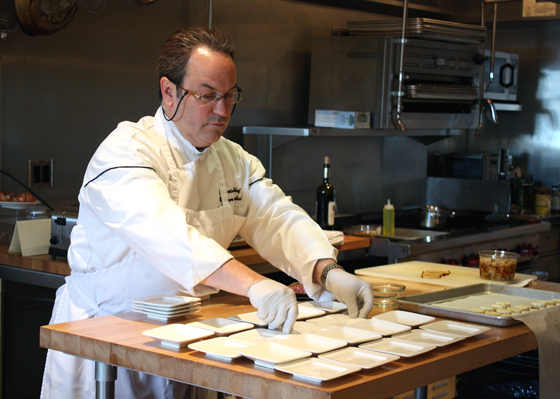
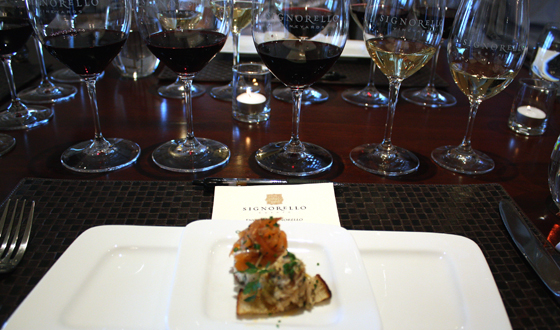
The special 90-minute tastings are by appointment only, 11 a.m. and 2:30 p.m. daily. Price is $65 per person. That might seem pricey. But this is no basket of water crackers that we’re talking about. It’s a flight of five wines, paired with seven, good-sized gourmet treats prepared in the winery’s professional kitchen by a chef.

In March, I was invited as a guest to one of these private tastings, which started being offered a year ago and feature menus that change with the seasons.

You’re welcomed with glasses of the 2008 Seta Estate, a Semillon and Sauvignon Blanc blend that had just the right amount of acidity and buttery-ness; and the 2007 Chardonnay Vielles Vignes Chardonnay, made from the fruit from the original 26-year-old vines planted on the estate.

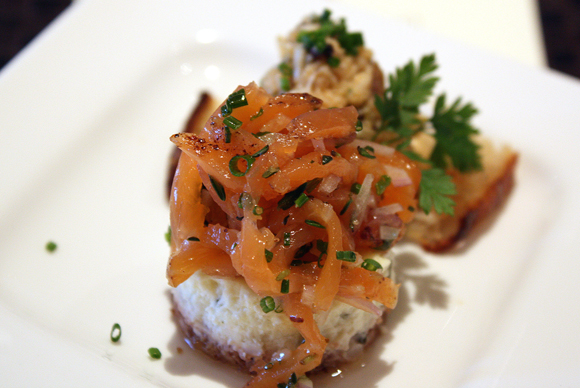
They’re paired with two-bite hors d’oeuvres — a tiny chevre cake topped with julienned salmon cured with star anise and honey; and a crostini of albacore tuna poached in olive oil and dressed with preserved lemons, picholine olives and the fragrant North African ras el hanout spice blend.

Read more

Kobe Beef and Killer Cabernet Sauvignon — at Two South Bay/Peninsula Restaurants

Take some of the richest, most marbled beef around.  Pair it with an inky, full-bodied, Old World-style Napa Valley Cab.

What’s not to like?

Especially when it’s Snake River Farms’ American-style Kobe and Signorello Estate’s 2005 and 2006 Estate Cabarnet Sauvignon with its balance of raspberry, cedar, earth, and tobacco notes.

The two specialty producers have partnered for the past few years to introduce foodies to the luxurious combination of Kobe and Cab. In fact, Signorello even runs a “Kobe & Cabarnet Club,” in which participants receive three shipments a year of Kobe cuts with bottles of Cabernet Sauvignon. Each shipment averages $390.

If that’s a little too rich for your blood, those in the South Bay will be glad to know they can experience the “Kobe & Cab” magic in a slightly more economical way at two local restaurants.

The Grill on the Alley in San Jose is serving a 12-ounce New York Snake River Farms steak seasoned with grilled asparagus ($65) with a bottle of 2005 Signorello Cab ($75)  through at least the end of May.

And Quattro at the Four Seasons Silicon Valley in San Jose is featuring two dishes at lunch and dinner through the end of April: An open-face Snake River Farms tri-tip steak sandwich with porcini gravy, fried artichokes and aioli ($19); and a Snake River Farms rib eye with gigante beans, oven-cured tomatoes, black chanterelles and spinach ($45).

The 2006 Signorello Estate Cabarnet Sauvignon is available there by the glass ($21) or bottle ($85).

I had a chance to find out just how wonderful the meat pairs with the wine when I was a guest at a special kick-off dinner at Quattro last month that spotlighted not only Signorello wines and Snake River Farms’ Kobe beef, but also its incomparable Kurobuta pork.

The Wagyu breed is famous in Japan, where the cattle have been raised in the Kobe region for hundreds of years. Snake Rivers of Boise, Idaho crosses Japanese Wagyu with Black Angus cattle for its American-version of Wagyu beef.

No, Snake River Farms doesn’t massage its cows with sake and feed them beer as the folklore in Japan goes. Instead, the Snake River Farms cows are fed Idaho potatoes, white wheat, corn and alfalfa hay. While most other cows in the United States are brought to market at 16 months, the Snake River ones are fed up until they’re 30 months old, resulting in more flavor and a whole lot more marbling.

Just how good is this stuff? Uber-chefs, Michael Mina, Wolfgang Puck and Thomas Keller are huge fans, especially Keller who buys almost all of the Snake River rib eye caps produced (the extremely marbled muscle around the outside of a center-cut rib-eye steak).

Read more

A Celebration of Lamb and Asparagus

If there are two ingredients that sing of spring, it’s lamb and asparagus.

To celebrate both, the Lark Creek Restaurant Group is partnering with California asparagus growers and lamb ranchers to showcase those ingredients on menus at four of its San Francisco Bay Area restaurants through the end of the month.

Guests also can take home recipes for each dish to recreate them in their own kitchen.

Here are some of the dishes you can enjoy:

*  One Market in downtown San Francisco, walking distance from the Hotel Vitale, will be serving up warm, grilled Zuckerman’s Farm asparagus salad with 62-degree Marin Sun Farms chicken egg; and grilled Sonoma lamb loin chops marinated with espelette chili and garlic.

* LarkCreekSteak, also in downtown San Francisco, steps from the Marriott Marquis, will feature pan-roasted local asparagus with toasted macadamia nuts; and grilled lamb chops with harissa, mint sour cream, and fava beans.

Read more

« Older Entries Recent Entries »