Category Archives: Great Finds

Zanotto’s Monthly Wine Dinners — A Deal If There Ever Was One
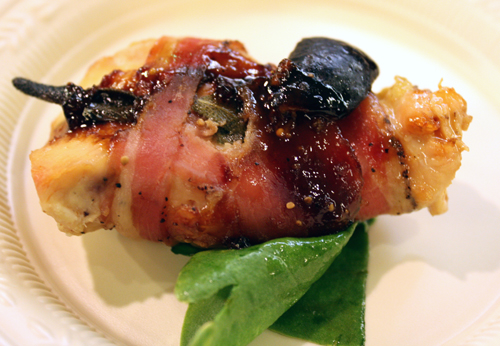
Chicken with sage, figs, and pancetta -- served at a supermarket.

Imagine a six-course dinner with six wine pairings — for all of $35 per person.

You don’t have to don fancy duds to enjoy it, either. But you do have to make reservations early, as it sells out faster than you can uncork a bottle of Chardonnay.

Zanotto’s Family Market in San Jose’s Rose Garden neighborhood may very well have the best wine tasting deal around.

The family-run supermarket, which has been in business since 1967, offers the wine dinner every last Wednesday of each month. Tickets go on sale three weeks before, and usually sell out within the first week. Indeed, since the store started hosting these dinners 30 months ago, 29 have sold out.

“We just wanted to create a casual learning experience with great food and wine,” says store Manager Fred Zanotto.

Wednesday was always the store’s slowest day, Fred Zanotto explains. So, he decided to start holding wine tastings to try to entice more shoppers into the store. They proved so successful that he decided to add dinner to it, too.
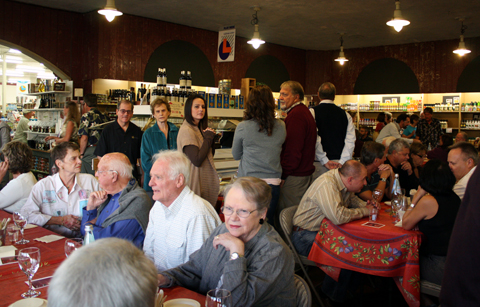
It's almost a sell-out crowd.

Picture a neighborhood block party held inside a grocery store. That’s what this fun, lively dinner is like, where so many folks are regulars, attending each and every one.

Tables are set up inside and out (except for the winter) to hold 237 people (129 in winter). Folks, who have purchased tickets ahead of time at the store or over the phone, start lining up early by the ice cream freezers to get the best pick of seats, which are first-come, first-serve. Reserved seats are only available if you have a party of six or more.

The tables are draped with floral cloths that can be purchased in the store. The food, served family-style, is arrayed on pretty, rustic platters, which also can be purchased at the store. Fred Zanotto’s two sisters-in-law, who normally man the store’s deli, create the food to pair with the wines. Many of the ingredients — you guessed it — can be purchased at the store.

Cutlery and plates are of the plastic variety. And you get only one wine glass. But that just adds to the informal charm of the event.
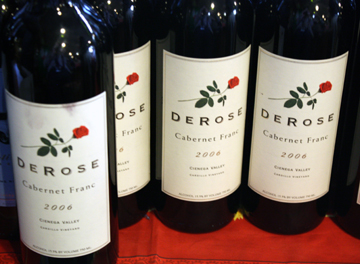
DeRose Vineyards was featured at the September wine dinner.

The wineries featured each month are from all over the world. But six months of the year are dedicated to spotlighting local wineries.

The wine dinner I attended in September featured DeRose Vineyards of Hollister. The winery has 100 acres of vines, including 40 acres that are dry-farmed. Those vines, which get no water, produce intensely fruity wines, says winemaker Pat DeRose.

The wines poured that evening included the Parrone 2007 Sparkling, DeRose Chardonnay 2006, Continental Cabernet, Cabernet Franc, Nick DeRose Sr. Zinfandel 2006, and the Negrette 2006. The latter, made from 115-year-old vines, is such a rarity these days that even in its native France, there are less than 100 acres grown there today. DeRose grows 10 acres that are dry-farmed. The result is a wine bursting with jammy plum and berry flavors, and gentle tannins.

Zanotto’s also provides recipes to take home from each event. Dinner that night was as follows:
Read more

Recession? Not at Poggio

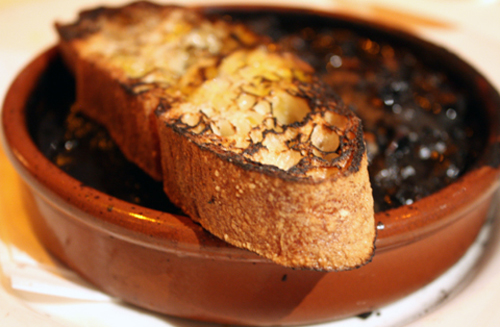
Can you guess what this deep, dark dish is?

My husband and I play this game whenever we go out to eat somewhere new.

If the place is a true delight from food to ambience to price, we will invariably turn to one another and say, “If we lived here, this would be our neighborhood place.”

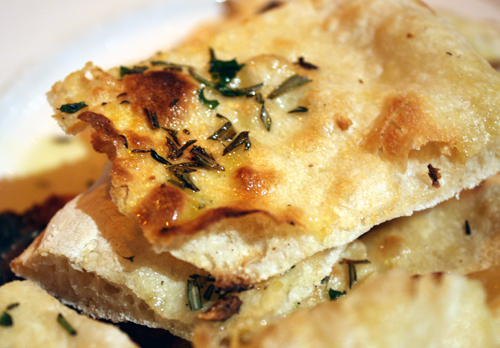
Peter McNee, chef of Poggio trattoria in Sausalito, laughed when I told him we’d already made that declaration about his restaurant from the moment the bread (a special order of just-baked shards of pizza dough, scattered with piney rosemary and drizzled with fruity extra virgin olive oil) was set down at our table. If only we didn’t live some 50 odd miles south, Poggio would definitely be our neighborhood haunt.

Crisp, warm, and delicious fragrant rosemary pizza slab shards.

Turns out he plays that game, too, when he dines out. And so must the throngs of diners crowding the very lively Poggio the recent Saturday night when McNee invited me in to try his dishes. It was my first time at the nearly 6-year-old restaurant. Every seat was taken inside the warm dining room, the bustling bar, and at the outside tables where you can feel the gentle breeze from the Bay.

Seems like a lot of people are making this satisfying Northern Italian restaurant their neighborhood spot.  They’re racking up smaller tabs now, a manager told us. And they are bringing in their own wine more often now to take advantage of the reasonable $20 corkage fee. But recession or no recession, diners continue to flock here.

It’s easy to see why. The cheery sommelier arrives at your table wearing suspenders and armed with the most colorful and memorable stories about the featured wines. Entree prices are moderate, considering the caliber of food and the amount of it. Portions are very generous here. Our half-orders of pasta resembled full-size plates at other establishments.

It’s a place where you can drop in for a Calabria pizza (Calabrian chile roasted pork, gypsy peppers, and picholine olives; $12) or a rustic spit-roasted goat leg with eggplant, and roasted onion and goat cheese gratin ($18).

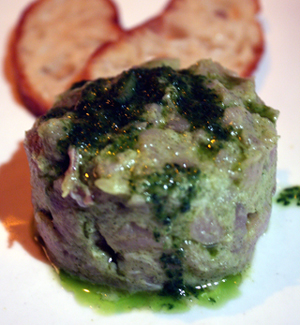
A taste of the sea with albacore crudo.

The menu changes daily. From time to time, McNee also offers week-long specialty menus, including the “Festa de Pesce,” which we got to try the last night it was offered. This festival of seafood featured both cold and warm small-plate preparations of fresh local seafood.

After McNee told us how painstaking the stuffed calamari ($9) was to make, and how many pounds of squid bodies that he, himself, had to hand-stuff with a mixture of sofrito and diced squid tentacles, how could we not order it?

A shallow earthenware dish arrived as black as a Texas oil pool. The plump squid bodies were braised in their own ink. The squid were tender, and the sauce so deep, earthy, and complex that it was hard not to spoon up every drop.

From the “Festa de Pesce” menu, we also tried the local albacore crudo ($8), a mound of cubed buttery tuna with the refreshing hit of chile, lime, and mint.

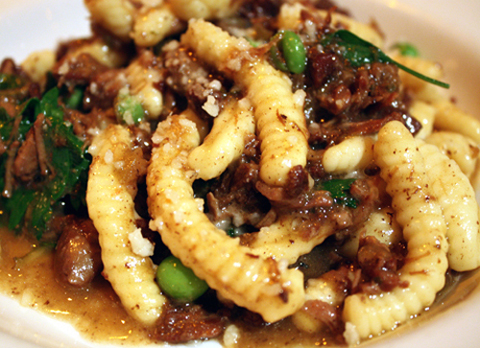
Pasta with lamb

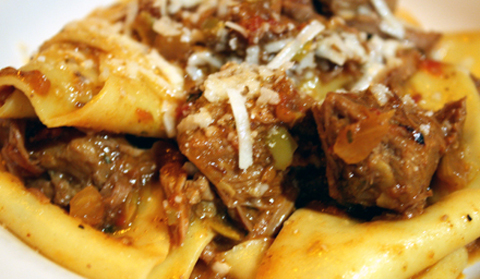
Pasta with veal

The two half-orders of pastas were not only ample in size, but plentiful with meat. The cavatelli with lamb sugo featured ridged, fresh pasta in a hearty, robust sauce. The pappardelle with slow-cooked veal and green olive sugo was a soul-satisfying dish with big chunks of fork-tender meat accented by salty, nutty Pecorino Romano.

Read more

Sensational Sammies

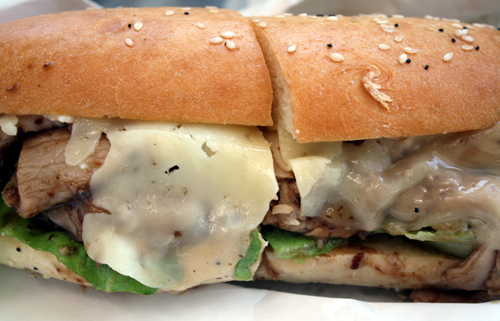
A masterful, melty goodness of a sandwich.

Last week, I finally got around to eating at a revered place in San Francisco I’ve been dying to try.

It’s owned and operated by a most esteemed chef. It garnered a glowing, three-star review in San Francisco Magazine. Oh, and it’s tinier than many people’s walk-in closets.

It is, of course, The Sentinel, the doll-sized, corner sandwich shop South of Market opened a year ago by Dennis Leary, a most talented chef who makes no bones for marching to his own beat.

Long before it became uber hip for high-end chefs to chuck it all to careen around town in blinged -out, gourmet taco trucks, Leary left behind the highly regarded Rubicon restaurant, where he was its highly regarded executive chef, to open a glorified diner named Canteen.

Ah, but the 20-seat Canteen is no dive. It’s a cozy, lively joint decorated with shelves of classic books, a nod to Leary’s Phi Beta Kappa degree in English literature from Wheaton College. With room for only two or three other helpers behind the counter while he cooks, Leary miraculously turns out prix-fixe and a la carte dinners that are nothing short of magical. His Parker House rolls are reason alone to go. As is the warm vanilla souffle that never leaves the menu.

Before heading to Canteen to cook each night, he mans The Sentinel at breakfast and lunch each weekday. I’m sure I’m not the only one wondering if the guy ever sleeps.

I did try snapping a few photos of Leary, who was behind the counter at The Sentinel the afternoon I visited. But the red-headed chef is a whirlwind as he assembles sandwich orders lickety-split, making for some god awful blurry images I didn’t want to inflict on you.

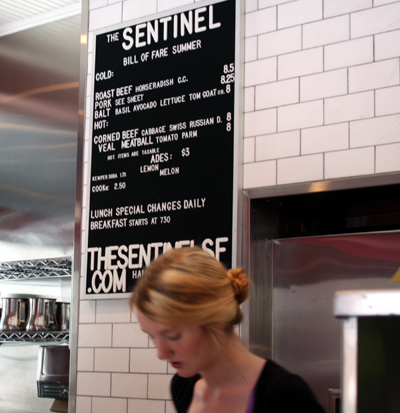
Inside the toy-sized sandwich shop.

The small menu at The Sentinel changes daily. Usually, there are a couple of cold sandwiches, a couple of hot ones, a soup, and one “Daily Special” that comes complete with a side and dessert.

There are two doorways leading into this bustling, take-out cafe that has no seats and really no room at all to linger.

Read more

Preview II: Ad Hoc Pineapple Upside-Down Cake Recipe

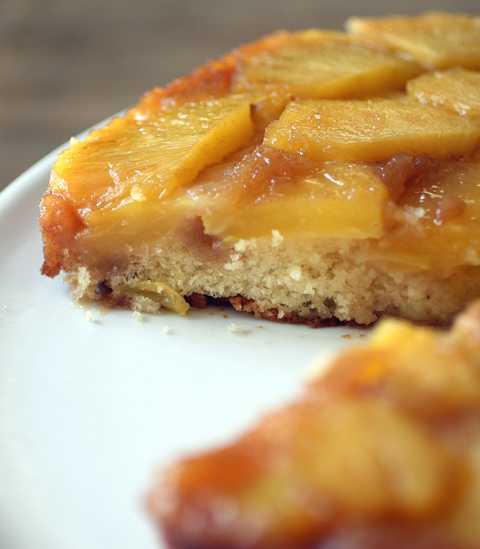
My first attempt at pineapple upside-down cake.

I’ll let you in on a secret: I’ve never made this iconic Americana dessert before.

Sure, I’ve made my share of pineapple compote for glistening slabs of baked ham. I’ve chopped mounds of pineapple for salsa for grilled fish tacos. And of course, I’ve enjoyed plenty of fresh pineapple au naturele.

But pineapple upside-down cake kind of frightened me, I must admit. Maybe it’s because so many recipes call for baking it in a cast-iron skillet that you then have to flip over to invert onto a serving plate. Yeah, flipping over a scorching hot skillet containing molten caramelized syrup (and we all know how cast-iron retains its heat) just seemed like a recipe for not just cake, but third-degree burns to boot.

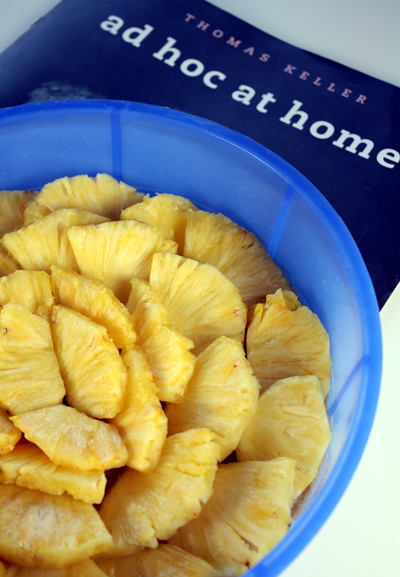
Then along came the promotional brochure in the mail for the upcoming “Ad Hoc At Home” cookbook (Artisan) by Thomas Keller with his rendition of this homespun cake.

The book won’t be out until November. But after trying the fantastic recipe for Ad Hoc’s “Chocolate Chip Cookies” last week, I decided to put my fears aside to attempt Ad Hoc’s “Pineapple Upside-Down Cake.”

A silicone cake pan makes it a breeze.

No cast-iron skillet needed here.

Instead, Keller uses a 9-inch silicone cake pan.

He doesn’t melt and caramelize the sugar and butter in the pan beforehand, either, like many other upside-down cake recipes. Instead, he creates a “schmear” of softened butter, light brown sugar, honey, dark rum, and vanilla that gets spread all over the bottom of the pan.

Then, a light sprinkle of salt goes over the top. Next, quartered rings of fresh pineapple are overlapped in the pan before the cake batter is added.

After baking, the cake rests in the pan for a short while. Then, you invert it onto your serving platter — with no fuss, no bother, and no dialing 911.

Read more

An Ode to Cowgirl Creamery Cottage Cheese

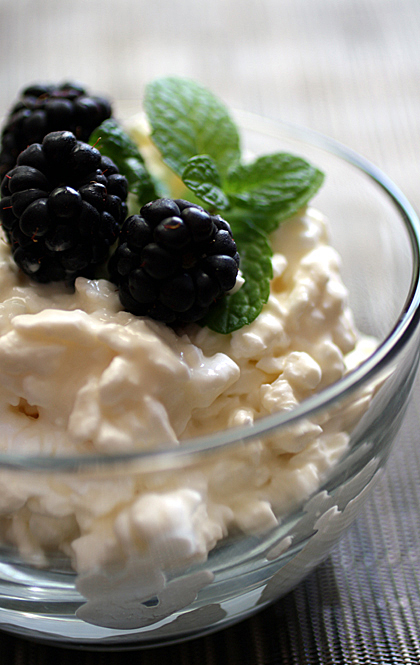
Cottage cheese that will change your mind about cottage cheese.

My early recollections of cottage cheese are not the best of ones.

Like so many of you way back when, I ate it — but not happily.

It was, of course, diet food, associated with canned cling peach halves or bare burger patties alongside a forlorn leaf of iceberg lettuce. We ate the white, creamy curds because they were supposed to be good for us, because we were counting calories, because we wanted to feel virtuous.

We certainly didn’t spoon them into our mouths because we wanted to.

But I do now.

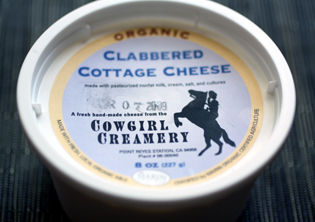
That’s because I’ve discovered a cottage cheese that actually makes me revel in eating cottage cheese. It’s the clabbered cottage cheese crafted by Cowgirl Creamery of Point Reyes Station.

It starts with organic non-fat milk from Marin County’s Straus Family Creamery. Clabbered cream (similar in taste to creme fraiche) is then added. The result is a creamy, rich cottage cheese. Unlike the standard mass-produced ones that have a sort of sour milk-taste to them, Cowgirl Creamery’s has a pure, fresh milky flavor.

Read more

« Older Entries Recent Entries »