Category Archives: Health/Nutrition

Artisan Energy Bars — Say What? Plus Winners of the Food Gal Contest
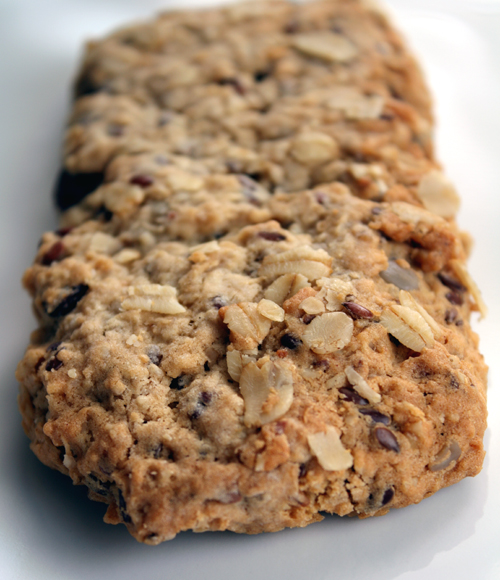
A breakfast bar you'll actually enjoy eating.

Remember those energy bars of yesteryear?

You know, the ones you ate because they were compact and handy on those sweaty, strenuous hikes — not because they tasted any good.

Newark, Calif.-based FullBloom Baking Company will erase those unappetizing memories once and for all.

Company founder Karen Trilevsky has created an individually wrapped Toasted Oatmeal Bar that’s made with 12 organic whole grains, plus tart cherries and raisins. It’s a palate-awakening alternative to other breakfast or energy bars on the market.

It’s almost cookie-like in texture, but more crumbly. The oat flavor and texture really come through in this crunchy, buttery bar. It tastes very much home-made rather than mass-produced.

Each 2.5-ounce bar has 350 calories, 18 grams of fat (8 grams of which are saturated fat), 44 grams of carbohydrates, 6 grams of protein, 210 milligrams of sodium, 35 milligrams of cholesterol, and 44 grams of total carbohydrates.

The Toasted Oatmeal Bar joins the 12-Grain Bar released earlier this year. FullBloom will add two more flavors before the end of the year: Cranberry Almond Bar, and Bacon Cornflake (Oh my!).

The bars retail for about $1.49 each. They are available at Whole Foods, Berkeley Bowl, Cosentino’s, and Peet’s Coffee & Tea.

In addition to her baking endeavors, Trilevsky also started a “Smart Cookes Scholarship” to pay for the college education of promising Hispanic youth in the Bay Area. So far, she’s help pay for 57 kids to attend college.

Her baking facility also is in the process of securing LEED platinum certification for adhering to best environmental practices.
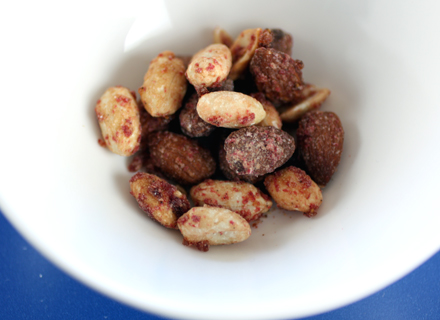
Sahale Snacks nut mix.

And now, without further adieu, I’m happy to announce the winners of the latest Food Gal contest, in which I invited all of you to tell me what your nuttiest cooking experience was.

I say, “winners,” because there were so many good ones once again that I decided to award second- and third-place prizes, too. Those winners will receive a cookbook from my vast collection. The grand prize winner will get four bags (2-ounce each) of Sahale Snacks nut blends, three (4-ounce) glazed nuts packages, and a Sahale Snacks apron.

Here are the winners:
Read more

Beautifull!

Cookies that have no butter in them.

Don’t blink. That isn’t a typo. It’s the name of a new food company in San Francisco that wants to make it easier for you to eat healthful.

Beautifull! opened its flagship store/cafe in San Francisco’s Laurel Village Shopping Center this spring. More locations are planned, including one in Palo Alto early next year.

The stores make prepared foods that are free of hormones, steroids, additives, preservatives, refined sugars, refined grains, butter and cream. A team of chefs and nutritionists have come up with dishes that can be enjoyed in the store, wrapped up to-go, or delivered to your home or office in whatever amounts that suit your needs.

I know you’re thinking, “That sounds way too healthy to taste any good.” Admit it.

Heck, I thought that, too.

But I ate those words, along with some tasty samples that were delivered to my house recently.

Wonderful whole grains, along with fresh, delicious fruits and veggies are staple ingredients in the offerings.

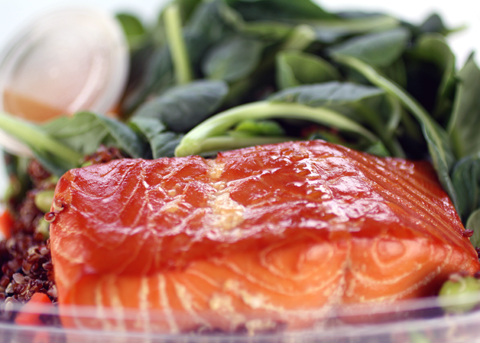
Tea-smoked salmon ready to be toted home.

The “Tea-Smoked Salmon with Red Quinoa & Edamame Salad” (market price) is a signature dish. The salmon, house-smoked over Asian tea leaves, is moist, tender, and yes, wonderfully smoky tasting. It tops Peruvian red quinoa, buttery edamame, carrots, red peppers, and crunchy hijiki seaweed, tossed in a gingery vinaigrette. It’s a dish redolent of Japanese flavors.

The “Chinese Chicken Salad” ($9.99 as an entree salad) also is a taste of Asia, with nutty sesame oil and tangy rice wine vinegar in the Asian honey mustard dressing. The roasted chicken breast was just a tad dry, but that can happen when it’s pre-sliced ahead of time and refrigerated.

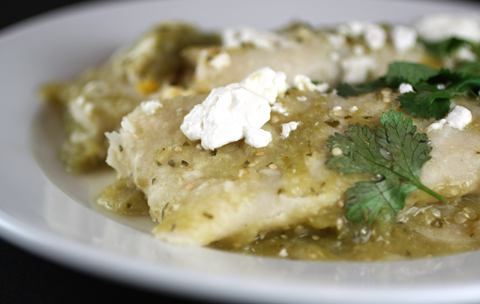
Enchiladas with zesy, spicy salsa verde and creamy feta cheese.

The “Whole Grain & Bean Enchiladas with Salsa Verde” ($7.99 as a prepacked meal) are corn tortillas filled with scrambled free-range eggs, golden quinoa, pinto beans, and yellow pepper, then topped with feta, cilantro, and spicy salsa verde. There was so much flavor going on that I didn’t miss the meat at all in this dish.

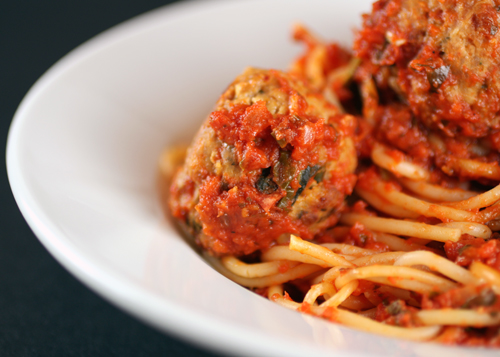
Turkey meatballs with Kamut grain.

Kids will love “Kamut Spaghetti with Turkey Meatballs” ($6.99 a pound). Parents will love how good it is for the wee ones. Lean turkey meat combines with rolled oats, spinach, Dijon mustard and herbs for big, bountiful meatballs atop spaghetti made of Kamut, a grain high in protein and minerals. It all gets tossed with a simple tomato-basil sauce.

Read more

Organics on the Menu at Stanford Hospital

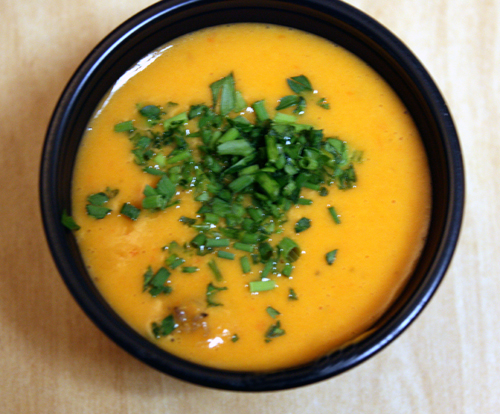
Roasted red pepper soup with goat cheese.

Soup sure does a body good.

Stanford Hospital knows that. And if you’re a foodie ever in need of medical care, you might just want to make sure you end up there, because the renowned hospital has just launched a new all-organic, local, sustainable “Farm Fresh” menu option for inpatients. It’s centered around gourmet soups created in collaboration with Peninsula restaurateur and long-time champion of organics, Jesse Cool.

Right now, the organic option, which started a few weeks ago, is offered only at dinner time to patients on unrestricted diets. But plans are to eventually expand it to patients’ lunches, and to the cafeteria offerings.

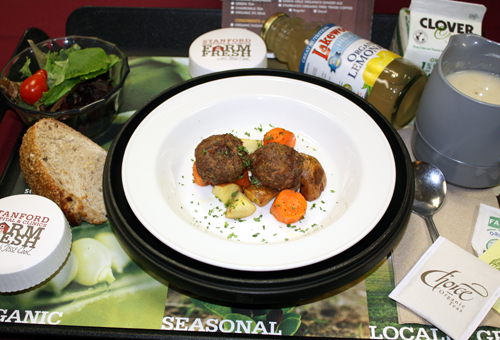
The organic dinner tray for patients comes complete with your choice of soup with grass-fed meatballs.

If you opt for the organic menu, you get your choice of made-from-scratch chicken noodle soup or that day’s local vegetable soup. The latter might be cauliflower soup with rosemary, roasted sweet pepper with goat cheese, roasted tomato with herbs, potato leek, carrot ginger with curry, cream of spinach, or corn with basil and smoked cheddar.

Your tray also arrives with a small organic salad, organic whole grain bread, a dessert of either stuffed baked apple or seasonal fruit with honey yogurt sauce, and a beverage such as organic lemonade, green tea, organic ginger ale, or Starbucks organic free-trade coffee.

Your soup bowl contains your choice of protein — grass-fed meatballs, poached organic chicken, or smoked tofu. Your soup comes separately in a thermos carafe to keep it nice and warm. It gets poured table-side — or in this case, bed-side.

Hospital food never looked so appealing.

So in this dreary economy, in which cash-strapped consumers are buying less organic food, why is Stanford Hospital taking on the potentially added cost of providing an organic menu for patients?

With 450 patients in its hospital at any one time, administrators believe they will be able to negotiate purchasing agreements with local farmers, many within a 200-mile radius of Stanford, so that the organics menu will be cost-effective.

“We believe that part of the healing process for patients involves eating food as fresh as possible, in which nutrients are preserved,” says Shelley Hebert, executive director of public affairs for the hospital. “We also want to educate patients about healthful eating and cooking when they leave the hospital.”

To that end, the soup recipes are being made available on the hospital’s Web site.

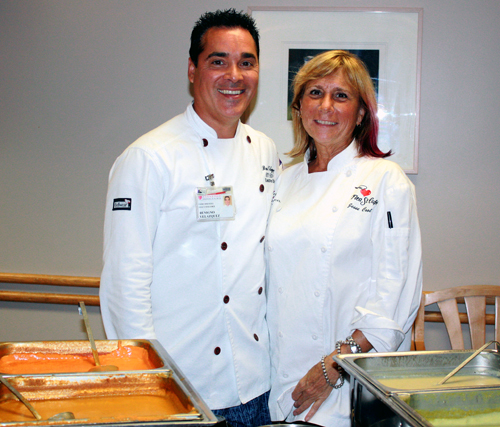
Stanford Hospital Executive Chef Beni Velazquez and Flea Street Cafe restaurateur Jesse Cool.

Cool, who owns Flea Street Cafe in Menlo Park, worked on the soup recipes with the hospital’s Executive Chef Beni Velazquez, a certified instructor with the Culinary Institute of America and a former Ritz-Carlton Hotel chef.

Read more

Take Five with Roy Fong — Educator, Importer, and Connoisseur of Fine Teas

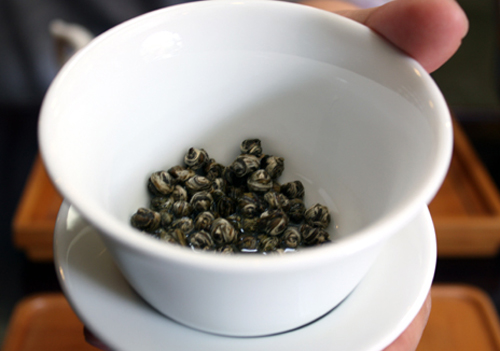
Top quality jasmine tea leaves.

Nobody knows tea quite like Roy Fong.

The 53-year-old entrepreneur opened the first traditional Chinese tea house in San Francisco in 1992. Now, he overseas two Imperial Tea Court locations in the Bay Area — one in Berkeley, and the other in San Francisco’s Ferry Building.

A visit back to his native Hong Kong when he was in his 20s, changed his life. As he wandered around the old tea district there, he knew he had found his destiny. Now, he sells about 300 types and grades of teas, priced at $16 to $480 a pound.

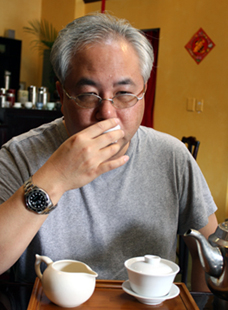
Roy Fong enjoying the fruits of his labor.

His two tea houses also are thought to be the only restaurants in the Bay Area that feature an all-organic, sustainable dim sum menu.

With the exception of a few sauces, everything else on the menu is organic and sustainable. The flour used to make the wrappers and the tea oil used to fry the green onion pancakes are organic. The shrimp is wild. The pork is family-raised and sustainable. Even the tea leaves used to flavor the broth for the won ton soup are organic.

Read more about Fong’s organic dim sum — and other purveyers jumping on that bandwagon — in my story in today’s San Francisco Chronicle Food section.

I had the chance to sit down to lunch with Fong recently at his Berkeley tea house. He poured cups of jasmine tea, the favorite variety of Northern Chinese.

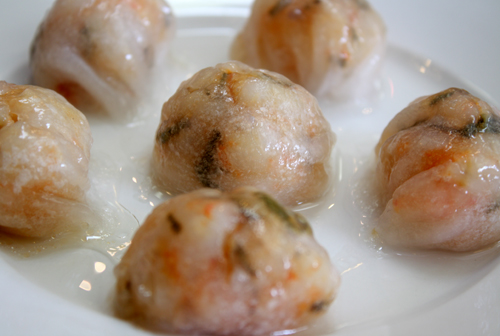
Dumplings made with wild shrimp, organic flour, and organic jasmine tea leaves.

Before pouring water over the rolled-up leaves, he had me take a whiff. The aroma was very floral. It was an indication that the green tea picked in early spring was quite fresh, because jasmine tea takes on a more citrusy fragrance as it ages. Surprise your guests at your next party by pairing jasmine tea with brie cheese. Fong says the two are an exceptional match.

Q: You’ve won quite a loyal following for your organic dim sum, haven’t you?

A: People drive hundreds of miles for it. We have regulars who come from Monterey for lunch all the time.

Q: The wrappers on the shrimp dumplings are so incredibly translucent. How do you do that?

A: You have to control the water temperature, and roll the dough very thin. The water can’t be too warm or too cold.

Q: I’m guessing you won’t tell me the exact temperature?

A: Nope. (laughs)

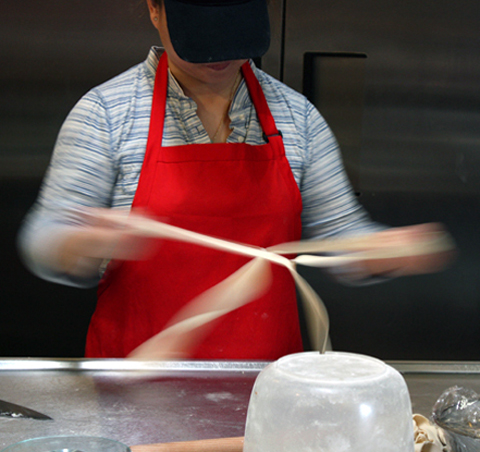
Noodles being pulled to order.

Q: What’s the most popular dish here?

Read more

Sustainable Is…

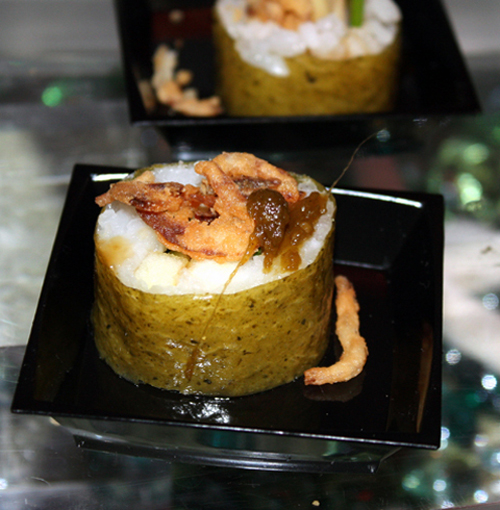
Tracy Griffith's sustainable sushi.

At last week’s eighth annual “Cooking for Solutions” event at the Monterey Bay Aquarium, chefs, winemakers, scientists, purveyers, fishermen, farmers, and food writers came together to learn and discuss  how to better follow a more sustainable path — one that lessens the impact on earth and oceans.

What is sustainable? It comes in all guises. Come see for yourself.

Sustainable is…

Tracy Griffith, sushi chef and sister of actress Melanie, whose seared albacore roll (see photo above) served at the gala showcased a sustainable fish that’s one of the top choices on the aquarium’s “Seafood Watch Guide” and “Sushi Guide.”

Earthbound Farms' organic fro-yo served at its farmstand.

…Carmel Valley’s Earthbound Farm, the pioneer in pre-washed salad greens. With 40,000 acres in California, Arizona, and Mexico, it  now is the largest organic farm in the world. Its farm stand on Carmel Valley Road is open year-round. It just started selling its own organic fro-yo, too.  Slightly tart and lighter in body than Pinkberry, the creamy treat comes in natural honey and a fruit flavor (You can get the two swirled together, too). The day I was there the featured flavor was raspberry.

Chef Thomas Keller.

…Thomas Keller. The acclaimed chef of the French Laundry in Yountville was honored as “Chef of the Year” by the aquarium for his work in promoting fresh, local, and sustainable ingredients through his spectacular four-star cooking.

Keller graciously signed copies of his cookbooks during the event, as fiancee Laura Cunningham, former director of operations for his restaurants, looked on. She wasn’t wearing her Keller-designed engagement ring that night, only because it was being re-sized. Still no word yet on whether the nuptials will take place this year or next.

The jovial Alton Brown.

…the Food Network’s Alton Brown, who was honored as “Educator of the Year” by the aquarium. Brown and his wife plan to set up a foundation to foster sustainable food projects. He’s also received the nod from the Food Network to do several “Good Eats” shows highlighting sustainable seafood.

Tataki Sushi & Sake Bar in San Francisco, the first sustainable sushi bar in North America. Diners are heartily embracing the concept, so much so that the tiny sushi bar now sometimes has a wait of two hours on weekdays.

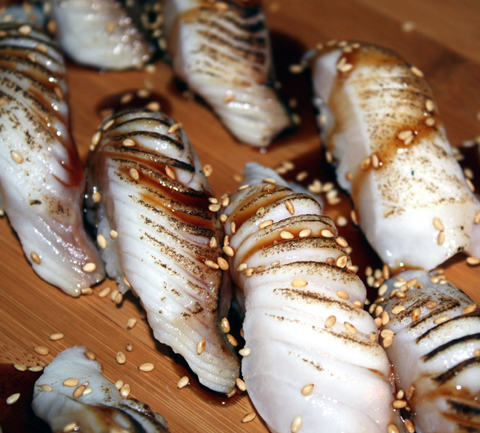
At the “Cooking for Solutions” gala, Tataki’s sushi chefs handed out “faux-nagi” — scored wild sablefish brushed with the traditional sweet soy-rice wine sauce that has the same silky mouth-feel as overfished unagi (eel).

It tastes like unagi, but this is sustainable.

Greenfish Catering, a five-year-old San Jose company that specializes in sustainable sushi platters, bento boxes, and catered events that feature good-for-you and good-for-the-environment ingredients such as farm-raised oysters.

Read more

« Older Entries Recent Entries »