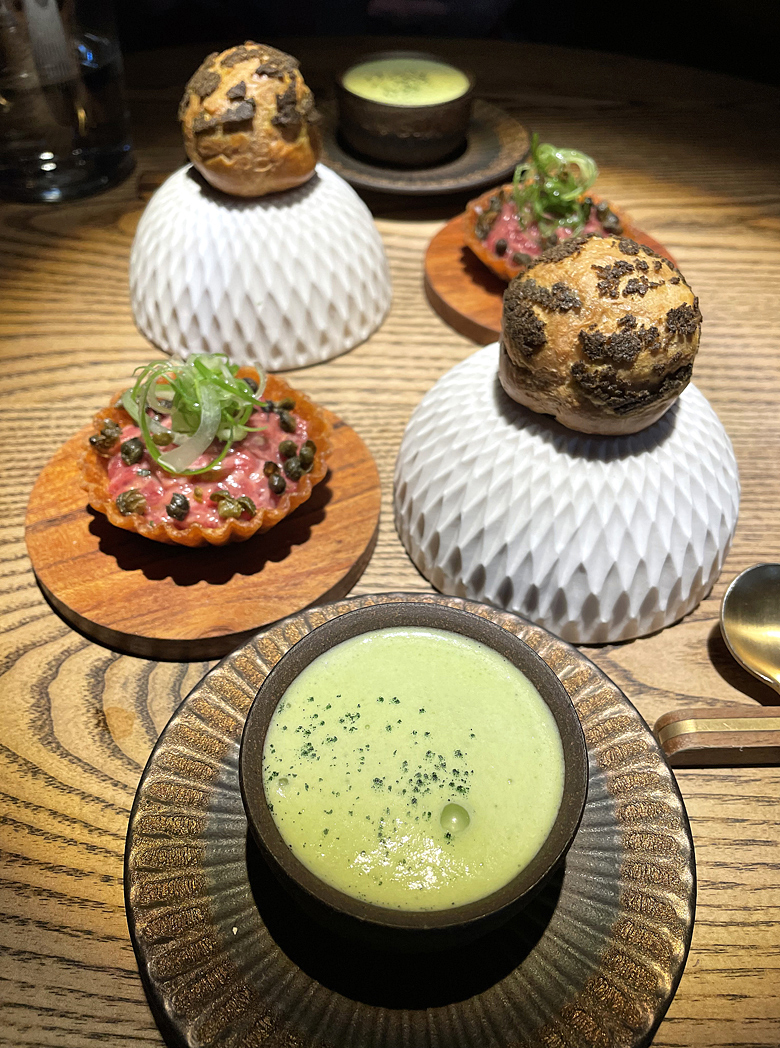
Grilled mackerel with pickled mustard seeds and honey-preserved ramps at Yokai.
Chef Marc Zimmerman was majoring in music engineering in college in Indiana before he decided to scrap that for a career in cooking instead.
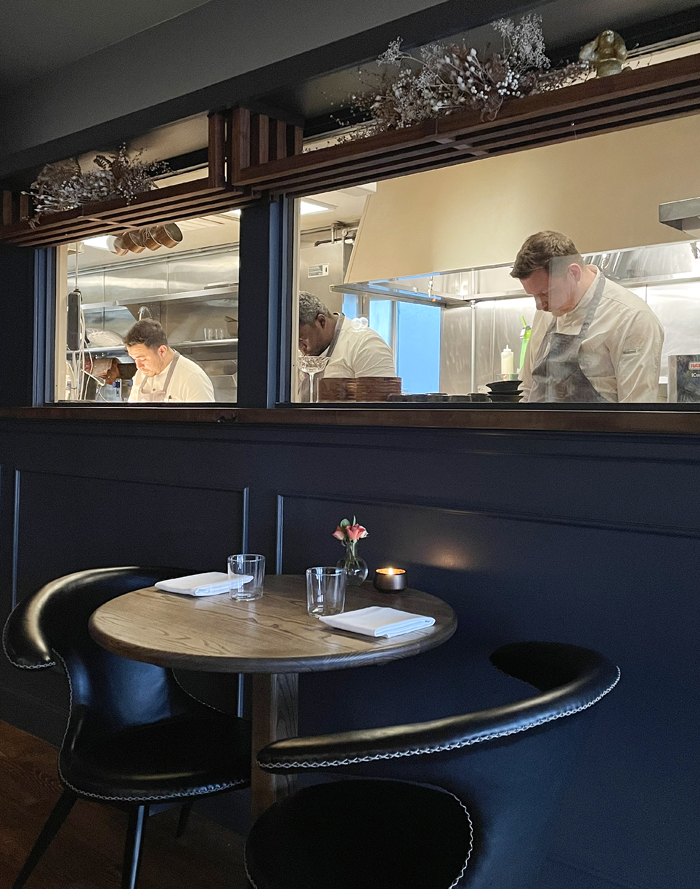
Now, however, he’s managed to combine both those passions into one: Yokai, his second San Francisco restaurant, which opened in September, just four blocks away from Gozu, his first that debuted in 2019.
Located in the SOMA neighborhood, Yokai is named for the Japanese word for “ghosts or spirits,” which is appropriate given its extensive bar program that spotlights Japanese and American spirits.
At the host stand.
The music emphasis is apparent right when you step inside to find the host stand outfitted with two turntables and shelves of vinyl records. You can’t miss the large speakers behind the bar, too. But the music, while lively, is not intrusive, as I found when I dined as a guest of the restaurant last week, when jazz was very much the music of choice on that weeknight.
Need another pumpkin recipe at this time of year? Of course, you do!
A tisket, a tasket.
A teaspoon, a tablespoon.
I’ll be the first to admit that I goofed when I baked these “Triple Pumpkin Crumb Muffins” from Bon Appetit magazine. But luckily, it wasn’t anything as egregious as mistaking salt for sugar or cornstarch for white flour.
Nope, it was misreading “tsp” for “TBL” when it came to adding pumpkin pie spice to the streusel topping. But you know what? I have to say that tripling the amount actually worked out deliciously.
Yes, your streusel will come out darker brown if you use 1 tablespoon of pumpkin pie spice instead of 1 teaspoon, but your muffins will be imbued with even more autumnal warmth and fragrance if you do.
The glorious lamb neck shawarma and fixings at Bavel.
When husband-and-wife chef-owners Ori Menashe and Genevieve Gergis chose Bavel for the name of their celebrated Los Angeles restaurant, they did so because they cherished they way the likely mis-transcribed word, taken from the original Old Testament’s story of Babel, alluded to a time when everything was one.
These days, that may be but a wistful notion. But Bavel gives you a semblance of that hopefulness, as you step through its doors to the cacophony of diners of all walks and ages, clinking glasses, digging into big plates of grilled meats, and using their hands to enjoy puffy pita together with abandon.
The dining room.The patio.
And loud it is, as I found when I dined a couple weeks ago. The chic dining room with its ceiling of cascading leafy vines is especially raucous, and the comfortable front patio, where I dined, is only a few decibels less. It’s like being invited to a rollicking party at its height.
It definitely adds to the anticipation for the superb modern Middle Eastern specialties to come.
The unexpected truffle pasta dish on the kaiseki menu at N/Naka.
Since learning of it from the first season of Netflix’s “Chef’s Table” in 2015, I have been fascinated by the Los Angeles restaurant, N/Naka.
This Michelin two-starred restaurant opened in 2011 to serve kaiseki, the elegant, multi-course Japanese meal spotlighting ingredients at their seasonal peak in a series of specific cooking techniques.
Back then, it was a type of cuisine that was a rarity in the United States. And even more so when it was crafted by a woman, Chef-Owner Niki Nakayama and her wife, Sous Chef Carole Iida-Nakayama, who dared to put their own thrilling contemporary touches on this classic Japanese haute cuisine.
At all of 26 seats, this restaurant is notoriously difficult to book. While I travel to Los Angeles maybe once a year, I’d never managed to plan the trip in advance enough to even try to snag a table there.
Until two weeks ago. That’s when the stars aligned and Lady Luck was on my side, giving me entree to a dining experience that was nothing short of singularly magical.
You see, N/Naka opens its online reservation bookings once a week at 10 a.m. on Sunday for tables a month later. But sign on right at that second, and you’ll likely find all the reservations gone already and your dreams vanquished — just like that.
After experiencing that disappointment a few times, I started searching online for reservation tips. I came upon a thread that advised staying on the booking site for at least an hour after reservations open, because people will click on a specific reservation that gives a 10-minute window to finalize, only to decide they don’t want it after all. The thread also mentioned that tables of 4 or 6 were easier to come by than for 2.
The unassuming, unmarked entrance of this Michelin two-starred restaurant.
So, for more than half an hour, I kept refreshing the page again and again, growing more apprehensive by the minute. A 9 p.m. reservation for 6 people popped up, tempting me to claim it as I figured I could somehow rope a few more people into trekking to Los Angeles with my husband and me. But I hate dining that late, especially for a tasting menu that lasts 3 hours. So, I bit my tongue, and passed on it, wondering if I had just made a huge mistake.
Fly By Jing’s chili crisp and Zhong dumpling sauces are mainstays in my fridge because they are the perfect finish to so many dishes.
So when founder Jing Gao debuted her cookbook, “The Book of Sichuan Chili Crisp” (Ten Speed Press),” I couldn’t wait to leaf through it.
The book, of which I received a review copy, takes its title from the delicious “fly” (hole-in-the-wall) street-food eateries that Gao and her parents would grab a bite to eat at in Chengdu, the capital of China’s Sichuan region.
Her father, a nuclear physics professor with a Chinese visa, moved the family around annually for his job. Sichuan food became the one constant in Gao’s life. And it became her calling after she left the corporate business world to start Baoism, her own restaurant in Shanghai that operated for two years. All the while, she kept refining the condiments that were her cooking touchstones.
After traveling to a natural foods trade show in California, and discovering the dearth of Asian food brands that existed, she launched Fly by Jing in 2018 through a Kickstarter campaign. Today, these popular products are sold in Whole Foods, Target, and Costco.