Take Five With the Food Network’s Alton Brown

Alton Brown dishes on fishy stuff in Monterey

At first thought, the Food Network’s wacky wizard of food, Alton Brown, might seem an unlikely choice to be a host at this past weekend’s “Cooking For Solutions” event at the Monterey Bay Aquarium.

But Brown, an avid scuba diver and father of an 8-year-old daughter, knows full well the challenges we face now and in the future in sustaining the ecosystems of our oceans. At the “Cooking For Solutions” event, which gathered chefs, scientists, and food producers to examine ways to preserve the health of the planet, Brown summed up his philosophy as only he can.

When it comes to seafood, he said, “My motto comes from the side of the old Los Angeles police cars: Serve and Protect.”

I chatted with the energetic, surprisingly frank 46-year-old megastar, whose “Good Eats” show, which he directs and writes most of the scripts for, debuted on the Food Network in 1999. A graduate of both the University of Georgia and the New England Culinary Institute, he now lives in Marietta, Ga. with his wife, DeAnna, and daughter, Zoey. Brown also is the commentator for “Iron Chef America,” host of the “Next Iron Chef,” and star of “Feasting on Asphalt.”  Additionally, he has his own production company, Be Square Production.

He wasn’t always a natural at science. Nor was he always a foodie. In fact, previously he was a cinematographer and video director. You can see his work in R.E.M.’s “The One I Love” video.

Q: So science wasn’t something you were always passionate about?

A: No, not at all. I flunked chemistry twice in high school, mostly because it didn’t matter. It was all numbers and formulas, and ‘let’s cut up a rat.’

Q: So how did you come up with the concept for “Good Eats,” which is all about explaining the science of cooking?

A: I wanted to give people a practicality they could build on. In culinary school, I realized I wasn’t a very good cook. To figure out how to do it better, I realized science was the answer.

Q: When did sustainability become so important to you?

A: When I became a father. I began to relive my life through my daughter when I was that same age of 8 years old. I became so aware that so much had changed. We no longer place much value on our food; we value cheapness.

My Mom grew up very poor. They grew their own food, they had their own chickens. We’ve made it now so that poor people can’t grow food so easily, and they can’t keep chickens. There are all these regulations. We’ve made it so that with poverty in America, there’s no self-respect.

Q: How else did becoming a father change your viewpoints?

Read more


News for Sushi Lovers

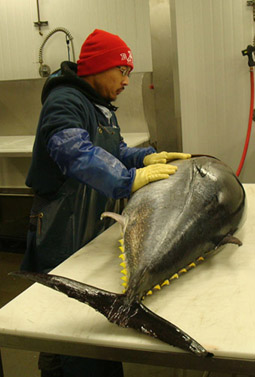
James Shimuzu, IMP Foods\' best fillet person, prepares to cut a Kindai tuna.

If you’re a connoisseur of toro, the richest, silkiest and fattiest part of the belly of a bluefin tuna, you’ll want to know about a new tuna, Kindai, that’s being served at a handful of the Bay Area’s top restaurants, including the French Laundry in Yountville, Manresa in Los Gatos, and the Dining Room at the Ritz-Carlton in San Francisco.

Wild bluefin tuna has been severely overfished in the past decades. But Kindai is the first farmed tuna raised in captivity from eggs. And it’s the result of 32 years of research by Kinki University’s Fisheries Laboratory in Japan.

Only one shipment comes in each week from Japan. And the Bay Area is one of the few places that gets it. The Kindai tuna is distributed in this area by Hayward’s IMP Foods, Inc., which supplies seafood to the Bay Area’s best sushi bars. Read more about Kindai tuna in my story today in the San Francisco Chronicle’s Food section.


Your Pick For the Greenest Restaurant

Through May 31, nominate your choice for the most environmentally friendly restaurant in the Bay Area. Thimmakka, a Berkeley non-profit that has helped Bay Area restaurants go green, is holding its first contest to determine “Who’s the Greenest of Them All.”

Founded in 1998, Thimmakka helps restaurants be more eco-conscous by showing them how to implement at least 60 measures in the areas of water and energy conservation, pollution prevention, and waste reduction. More than 120 restaurants have been certified green by the organization, including Bella Mia in San Jose, Breads of India in Berkeley, Chez Panisse in Berkeley, Dona Tomas in Oakland, Gordon Biersch in San Jose, Sonoma Chicken Coop in San Jose, and Ramblas Tapas Bar in San Francisco.

In all, according to Thimmakka, certified restaurants have generated environmental savings including: 19.4 tons of solid waste diverted from landfill; 10.8 million gallons of water (about 59 Olympic-sized swimming pools) have been saved; and 473,000 pounds of carbon dioxide have been prevented from being released into the atmosphere.

“Food service is responsible for about 16 percent of landfill in California, and 86 percent of that can be diverted by recycling or composting,” said Suparna Vashisht, managing director of Thimmakka, in a statement. “We created this contest to recognize the forward thinking restaurants that have already
taken giant steps to help eliminate waste and to spur on others to join in the movement.”

Nominations for the contest can be submitted here or by faxing to (510) 655-6770. Judges for the contest include Andy Katz, a representative of East Bay Municipal Utility District; and Gil Friend, founder of Natural Logic, Inc., a sustainability consultancy.

Winners will be selected in a number of categories, including “Most Energy Efficient,” “Top Water Steward,” and “Overall Most Green Restaurant” in various Bay Area counties and regions.

Kudos to the Bay Area For Heart Healthiness

If you’re a woman who’s concerned about heart disease, where’s the best place to live to help do your body good?

According to a just-released study by the American Heart Association’s Go Red For Women campaign, the San Francisco-San Jose-Oakland metropolitan area weighs in at No. 3 among the largest metro areas that are best for women’s health. The Bay Area is just behind the No. 2-ranked Washington DC area, and the top-ranked Minneapolis-St. Paul area. The metro area that wins the dubious honor of least heart friendly for women? The Nashville area.

Heart disease remains the No. 1 killer of women nationwide — claiming the lives of 460,000 women per year. Cardiovascular disease also kills far more women than it does men.

The study examined the heart health of the 200 most populous U.S. metro areas. The Bay Area scored the lowest BMI (body mass index) among the large metros, and the best score for healthy eating (thanks to our enviable produce). The Bay Area also had among the best scores for regular exercise, commuting by bicycle or walking, cigarette smoking and diabetes diagnoses.

In general, California has some of the nation’s strongest legislation for smoke-free workplaces and restaurants. The Bay Area’s lowest scores came in the categories of cardiologists per capita, drinking alcohol (well, we are home to so many great wineries), and number of teaching hospitals per capita. The percentage of women having recent routine checkups was also below par.

Here’s how the regions stacked up:

Most Heart Friendly Big Cities for Women
1. Minneapolis-St. Paul-Bloomington
2. Washington-Arlington-Alexandria
3. San Francisco-San Jose-Oakland
4. Denver-Aurora
5. Boston-Cambridge-Quincy
6. Seattle-Tacoma-Bellevue
7. Portland-Vancouver-Beaverton
8. San Diego-Carlsbad-San Marcos
9. Los Angeles-Long Beach-Santa Ana
10. Phoenix-Mesa-Scottsdale

Least Heart Friendly Big Cities for Women
1. Nashville-Davidson-Murfeesboro
2. St. Louis
3. Detroit-Warren-Livonia
4. Pittsburgh
5. Dallas-Fort Worth-Arlington
6. Columbus
7. Cincinnati-Middletown
8. Las Vegas-Paradise
9. Cleveland-Byria-Mentor
10. Indianapolis

Get a free “Go Red Heart Style Guide,” with tips, recipes and a free magazine subscription, by clicking here. Keep your heart healthy by eating nutritionally balanced meals; exercising regularly; and by monitoring your blood pressure, cholesterol, glucose, and weight.

A Marriage of Pasta and More Pasta

My husband, Meat Boy, morphing into Pasta Boy

Husbands.

When my about-to-be husband and I were registering for wedding gifts five years ago, I remember combing through the online catalogues of Williams-Sonoma and Sur La Table for all manner of cooking gadgets I might finally be able to possess in my kitchen.

Good pots and pans. Professional knives. Flatware that actually matched. Gleamingly new baking pans to replace my ancient, beat-up ones. Ahh, it was like the joy of Christmas, only better.

Since we were living in a modest apartment at the time, I tried not to go too crazy because we simply didn’t have the storage space then. But I also tried to heed my friends’ advice to pack my registry with a lot of items to give folks an array of choices when it came to gift-giving.

And then I saw it. It caught my eye and called out to me because I’d never had one or even used one before. It was a pasta machine. Not just any pasta machine, but an attachment to my KitchenAid mixer that would allow me, the carb lover that I am, to make my very own strands of fettuccine.

As I stared at it on my computer screen, I yelled out to my husband, who was in the next room, “Honey, should I put this pasta attachment for the mixer on our registry?”

Him: “A pasta attachment? Are you kidding? We’ll never use it. You know we won’t. It’s just a waste of space.”

Husbands.

Sigh. OK, maybe he wasn’t a killjoy. Maybe he was right. Maybe we’d never really use it. Maybe.

So I clicked on to another page of culinary doodads, leaving the pasta attachment behind.

Fast forward to Christmas last year.

We were at my brother’s and sister-in-law’s house for the holiday. My brother Dale is a marvelous, passionate cook, and on the menu that night, among other things was — you guessed it — homemade spaghetti.

My brother was going to sauce it with good olive oil, crispy bits of bacon, and lovely pungent garlic.

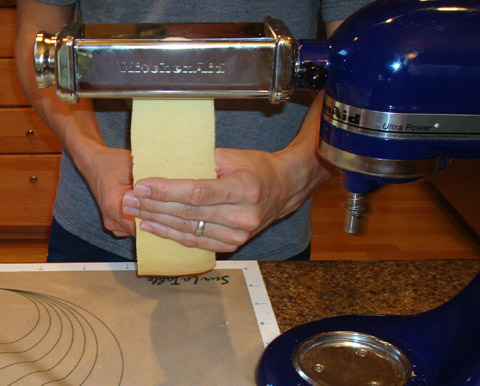
As my brother, Dale, stood poised at the counter beside his KitchenAid mixer, I noticed my husband watching him. Dale combined the ingredients for the dough in the mixer bowl, then gave the dough a brief kneading by hand. Then, he started to feed the dough through the roller attached to the mixer that looked for all the world like an adult Play-Doh pumper machine. The roller flattened the dough effortlessly. Again it went through, and again, each time emerging a little thinner. Then, Dale changed the rollers to a cutting one, and fed the dough pieces through again, as beautiful, long strands pushed out the other end.

My hubby continued to watch my brother doing this. And when my hubby noticed I was watching him as he watched my brother, he said, “Hey, we should get one of those.”

“WHAT?!?” I replied, incredulously, not believing what I had just heard.

“We should get an attachment,” he repeated. “This is so cool!”

I rolled my eyes.

Husbands.

I reminded my hubby of a conversation five years ago. He, of course, did not remember it at all.

Husbands.

And with that, we ordered the attachment online when we got home. And a few weeks later, it arrived on our doorstep.

We took the three attachments out of the box (a roller, a fettuccine cutter, and a spaghetti cutter), read the instructions, and set to work, using the basic pasta recipe included. In went the flour, eggs, water, and olive oil into the bowl to be mixed by the paddle, then the dough hook. I dumped the dough onto a lightly floured counter, and began kneading it until it was smooth and soft.
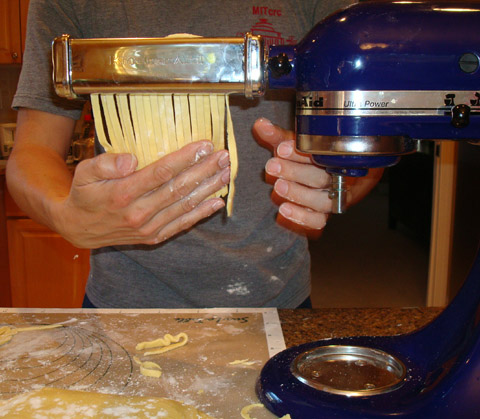
Dinner time is only two minutes away

Then I handed the dough to my husband to have the first honor. Those are his hands in the photos. It took a little practice — some of the first dough pieces through the roller came out looking like abstract birds of a sort. But hubby soon got the hang of it. And soon, he was having the time of his life.

Husbands.

So why go to all the fuss of making your own fresh pasta when you can pick up a container at most any supermarket or use the ever-handy dried form instead?

Because the taste and texture are sublime. Fresh pasta tastes, well, fresh. You can actually taste the rich egg in the noodles, so much so that you can get by with the simplest of sauces because the noodles themselves have so much flavor and character. Moreoever, the texture is not one dimensional like dried, but rather both more chewy and more tender.

Yes, it does take more time to make your own pasta from scratch. But fresh pasta cooks up in a flash, far faster than dried. Throw it into a pot of boiling water, and it’s done in 2 minutes or less.

I like it with this bold tasting 5-hour pork sugo from San Francisco’s wonderful Perbacco restaurant. Yes, it does take a long time to make the sauce (actually longer than the five hours in the name of the recipe). But most of it is idle cooking. Once you have the ground pork, porcini, tomatoes, sage, juniper berries and whole bottle of red wine in the pot, you leave it alone to simmer until it reduces to a rich, thick ragu. The recipe makes enough so that you can freeze half of it to enjoy another time, too.

Making your own fresh pasta is something you should attempt at least once. (We’ve made it three times this year already.) It’s not only a blast, but incredibly satisfying, too.

Don’t believe me?

Just ask — who else — my husband.

Perbacco’s 5-Hour Pork Sugo

Read more

« Older Entries Recent Entries »