A Mackerel Match Made In Heaven

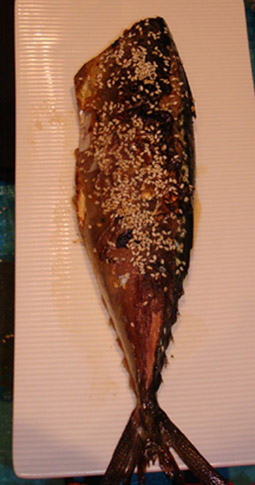
Stuart Brioza's mackerel

My husband can attest to the fact that mackerel is not one of my fave fishes. In fact, usually when I get a slice in an assortment of sushi or sashimi, it always ends up on his plate instead.

Stuart Brioza knows it’s a hard-sell, too, even if mackerel (wild-caught king and Spanish) is one of the best seafood choices on the Monterey Bay Aquarium’s Seafood Watch Guide. Nevertheless, Brioza, the executive chef of Rubicon in San Francisco, made many a convert when he cooked a fabulous honey, soy, and beer broiled mackerel with sesame-lime glaze at the recent “Cooking For Solutions” gala at the aquarium. The usual strong taste of the mackerel was tempered by the marriage of the other sweet, aromatic, and citrusy ingredients. The result was like a less sweet unagi. And it was scrumptious.

Speaking of marriage, Brioza and his longtime girlfriend, Nicole Krasinski, Rubicon’s pastry chef, will finally be tying the knot. The couple, who met 13 years ago in a photography class at De Anza College in Cupertino, will be getting hitched on a friend’s farm in Hilo in September. Krasinski, who’s not fond of cake (say what?), plans on serving their guests exotic citrus tarts instead.

It’s shaping up to be quite a year for Brioza, who grew up in Cupertino and Danville, and Krasinski, who is a Los Gatos native. In the July issue of Food & Wine magazine, the couple will be featured in a story about the peach tree they adopt every year at Mas Masamoto’s renowned peach farm just outside of Fresno. Look for mouth-watering sweet and savory peach recipes.
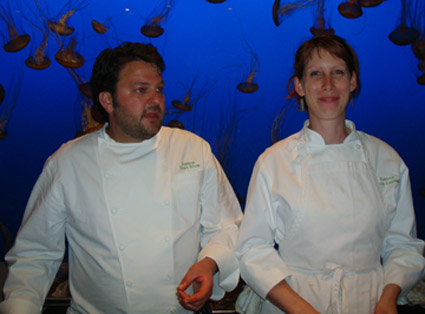
The happy couple in front of the jellyfish exhibit.

And for those of you who love mackerel — and those of you who don’t quite yet — here’s Brioza’s recipe that’s guaranteed to please.

Honey, Soy and Beer Broiled Mackerel with Sesame-Lime Glaze
Read more


Remembering Robert Mondavi

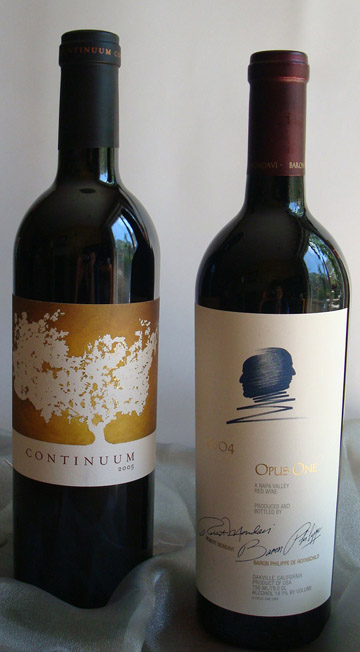
2005 Continuum and 2004 Opus One

Robert Mondavi may be gone now, having sadly passed away May 16 at the age of 94. But this visionary legend always will live on.

The winery that bears his name in the Napa Valley is no longer owned by the Mondavi family, having been sold to the beverage giant, Constellation Brands, four years ago for more than $1 billion. On the right in the photo above is the last vintage of Opus One (the premium Bordeaux-style blend made in a joint venture with Baron Philippe de Rothschild of Chateau Mouton-Rothschild) released before the sale of the business. On the left is the 2005 Continuum, the first release of the first new wine made after the sale with the help of all three generations of Mondavis. Only 1,500 cases were made of this blend of 60 percent Cabernet Sauvignon, 20 percent Petit Verdot, and 20 percent Cabernet Franc.

Mondavi was a man who put California wine on the map; whose tenacity drove him to start his own winery at age 52 after disagreements with his brother, Peter, led to his ouster from the family wine business; and whose philanthrophy was seemingly endless.

In 1996, he and wife Margrit paid $2.1 million to purchase the Napa site for what would become Copia: The American Center for Wine, Food, and the Arts. In 2001, the couple gave $35 million to the University of California at Davis to establish the Robert Mondavi Institute for Wine and Food Science.

Over the years, I had the pleasure of meeting Mondavi at the ground-breaking ceremonies for each of those events. And last November, I, along with a handful of other media, was graciously invited to the Mondavi home in the Napa Valley, where Thomas Keller of the French Laundry and his staff prepared a nine-course dinner and where the 2005 Continuum was poured for the first time.

Over the years, I saw this once vibrant man grow more frail, first relying on a cane, then a wheelchair. But through it all, he remained, as always, the picture of grace and dignity.

When I finally open those two special bottles of wine, I will drink a toast to this man who did so much and meant so much to the growth and reputation of the Napa Valley wine industry. I hope you will remember him, too, anytime you enjoy a bottle that bears the Mondavi name.


Diana Kennedy Coming to Santa Cruz Area

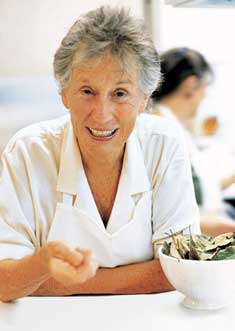
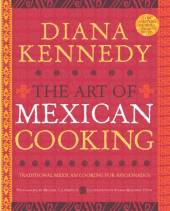
Diana KennedyThe doyenne of Mexican cooking, Diana Kennedy, will be appearing at three events in and around Surf City to celebrate the re-release of her 1989 classic, The Art of Mexican Cooking.

Kennedy has written eight cookbooks, but The Art of Mexican Cooking remains a true favorite with its collection of traditional recipes. Kennedy, who lives in an adobe home in the state of Michoacana, is already working on her next tome, all about the foods of Oaxaca.

May 30, 6 p.m. to 8 p.m., she will host a book-signing at Alma Gifts & Culture, 1705 Mission St. in Santa Cruz. Snacks made from her own recipes will be served. The event is free. Phone is: (831) 425-2562.

May 31 at 9 a.m., Kennedy will conduct a Q&A session at the Aptos Farmers Market at Cabrillo College, 6500 Soquel Dr. in Aptos. Afterwards, she will sign copies of her books, which will be available for purchase.

June 1 at 5:30 p.m.,  she will speak at the Capitola Book Cafe, 1475 – 41st Ave. in Capitola, then do a book-signing. Refreshments, made from her recipes, will be served.

To immerse yourself even more in Kennedy’s life, My Mexico Tours leads tours every August to Kennedy’s home, which include cooking classes taught by the master, herself.

An Evening of Chinese-Indian Cultures and Cuisines

Owner Ranjan Dey and Public Television star chef Martin Yan invite you to an evening at New Delhi restaurant in San Francisco, 6 p.m. to 9 p.m. May 25, to benefit the Compassionate Chefs Cafe.

The menu, prepared by Dey of New Delhi restaurant and Yan, will be served family-style. Dishes include chicken Manchurian with Hakka noodles, Kashmiri lamb kofta, mango float, and milk dumpling in warm cardamom syrup.

Tickets are $125, and all funds will go to the Compassionate Chefs Cafe, a non-profit San Francisco organization that helps children locally and globally. Tickets are available by calling Dey at (415) 816-4068 or emailing him at ranjan@newdelhirestaurant.com

Take Five With the Food Network’s Alton Brown

Alton Brown dishes on fishy stuff in Monterey

At first thought, the Food Network’s wacky wizard of food, Alton Brown, might seem an unlikely choice to be a host at this past weekend’s “Cooking For Solutions” event at the Monterey Bay Aquarium.

But Brown, an avid scuba diver and father of an 8-year-old daughter, knows full well the challenges we face now and in the future in sustaining the ecosystems of our oceans. At the “Cooking For Solutions” event, which gathered chefs, scientists, and food producers to examine ways to preserve the health of the planet, Brown summed up his philosophy as only he can.

When it comes to seafood, he said, “My motto comes from the side of the old Los Angeles police cars: Serve and Protect.”

I chatted with the energetic, surprisingly frank 46-year-old megastar, whose “Good Eats” show, which he directs and writes most of the scripts for, debuted on the Food Network in 1999. A graduate of both the University of Georgia and the New England Culinary Institute, he now lives in Marietta, Ga. with his wife, DeAnna, and daughter, Zoey. Brown also is the commentator for “Iron Chef America,” host of the “Next Iron Chef,” and star of “Feasting on Asphalt.”  Additionally, he has his own production company, Be Square Production.

He wasn’t always a natural at science. Nor was he always a foodie. In fact, previously he was a cinematographer and video director. You can see his work in R.E.M.’s “The One I Love” video.

Q: So science wasn’t something you were always passionate about?

A: No, not at all. I flunked chemistry twice in high school, mostly because it didn’t matter. It was all numbers and formulas, and ‘let’s cut up a rat.’

Q: So how did you come up with the concept for “Good Eats,” which is all about explaining the science of cooking?

A: I wanted to give people a practicality they could build on. In culinary school, I realized I wasn’t a very good cook. To figure out how to do it better, I realized science was the answer.

Q: When did sustainability become so important to you?

A: When I became a father. I began to relive my life through my daughter when I was that same age of 8 years old. I became so aware that so much had changed. We no longer place much value on our food; we value cheapness.

My Mom grew up very poor. They grew their own food, they had their own chickens. We’ve made it now so that poor people can’t grow food so easily, and they can’t keep chickens. There are all these regulations. We’ve made it so that with poverty in America, there’s no self-respect.

Q: How else did becoming a father change your viewpoints?

Read more

« Older Entries Recent Entries »