Monthly Archives: September 2009

Feverish About Fever-Tree’s New Ginger Beer

The taste of hot-sweet fresh ginger in a bubbly beverage.

That’s what I am about this most gingery new bubbly beverage.

It’s made by Fever-Tree, the British maker of premium mixers that are used in libations at renowned El Bulli in Spain and the Fat Duck in the United Kingdom.

The company’s philosophy is simple: Why use sub-par mixers with premium spirits?

So Fever-Tree set out to create artisan ones using all natural ingredients.

Joining its line of Tonic Water, Bitter Lemon, Ginger Ale, Lemonade, and Soda Water is the new Ginger Beer.

Read more

You Won’t Believe How Much Ginger Is In This Scone

Tender, cakey ginger scones to start your day with.

You all know by now that I have a thing for ginger.

Big time.

So when I spied this recipe for “Ginger Scones” in the Los Angeles Times’ food section last year, it was only a matter of time before I made these lovelies.

They tempted me with their 1 cup of diced crystallized ginger, and their 1/2 pound — yes, you read that correctly — of fresh ginger.

Just how much fresh ginger is that exactly? See that pile below? All of that — yes, indeedie — went into making a mere 10 scones.

A whole lotta lovely ginger.

Don’t let that scare you. It may seem like a lot of ginger, but I promise that your throat will not be ablaze. This is no four-alarm bowl of chili. This is far more nuanced and measured. It’s subtle heat that merely tickles.

The recipe comes from Chef Hans Rockenwagner, who bakes these scones at his Rockenwagner Bakery in Los Angeles and 3 Square Cafe + Bakery in Venice.

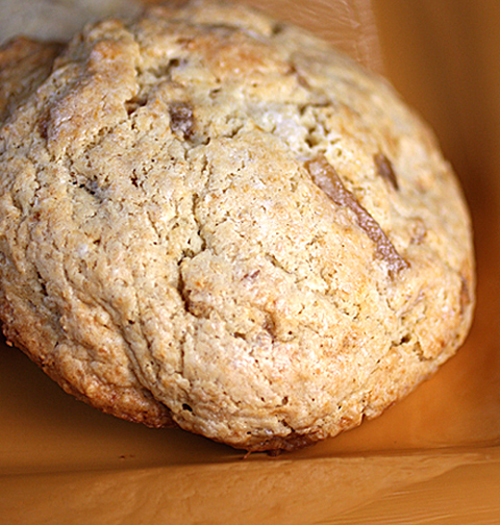
The scones bake up crisp on the outside. The interiors are not crumbly like traditional scones, but more tender, moist and cakey in texture. Bite into one, and you get the sugary-tingling hits of candied ginger immediately, followed by a warm, soothing, noticeable yet surprisingly moderated burn of fresh ginger at the every end.

Read more

Gaga for Gaja

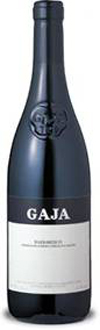
(Image courtesy of Gaja Winery)

No plans for this Sunday night yet?

Head over to Donato Enoteca in Redwood City at 6 p.m. for a just-confirmed dinner event with famed Italian winemaker Gaia Gaja of Gaja Winery.

Located in the small town of  Barbaresco in northwest Italy, the winery has been around since 1859. Known — of course — for its Barbarescos, the winery has been family-run for five generations.

Tomorrow night, single-vineyard Barbarescos and Barolos will be paired with a special Piemontese menu created by Executive Chef Donato Scotti.

The prix fixe will be $45 per person. The restaurant’s regular menu also will be available.

The Gaja wines will be offered by the glass, quarto, mezzo, and bottle, ranging from $25 to $400.

Guests will have the opportunity to purchase a bottle of wine to take home, too.

Read more

The Verdict on Mark Bittman’s Faux Ice Cream

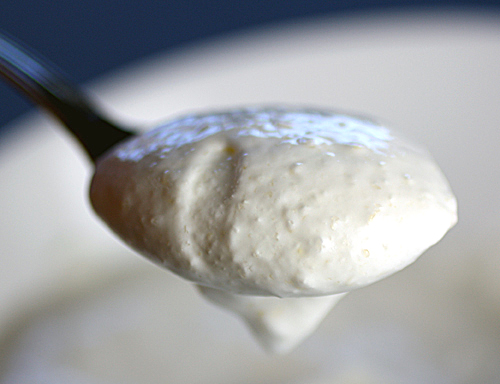
Will this turn into ice cream?

Is it possible to make satisfying ice cream without an ice cream maker, by just using a food processor?

I was curious about that when I spotted the recipe for Ginger Lemon “Ice Cream” in the new cookbook, “Mark Bittman’s Kitchen Express” (Simon & Schuster).

If you’re unfamiliar with this new book by the prolific New York Times food writer, it’s quite unusual. Each recipe amounts to just one paragraph total for ingredients and directions. And a lot of times, the exact amounts for the ingredients is not specified. So you have to guess. It’s his way of showing you how to cook faster, easier, and with more flexibility. But how well does this actually work for most home cooks?

Read more

Cooking with Chef Guillaume at Marche in Menlo Park

Look familiar?

No, that’s not him above.

But Chef Guillaume Bienaime does bear more than a passing resemblance to the Alfredo Linguine character from the movie, “Ratatouille,” especially with the glasses drawn on. You have to love a chef with the playfulness to keep a Pez dispenser like this on a shelf in his bustling professional kitchen.

Below is the real Bienaime, executive chef of Marche restaurant in Menlo Park. And believe me, he doesn’t need a cute talking rat named Remi or anyone else to help him do his job. This 27-year-old chef is a talent, and a giving one at that. Last Sunday, on what was supposed to be his day off when the restaurant is normally closed, he decided instead to teach his first cooking class.
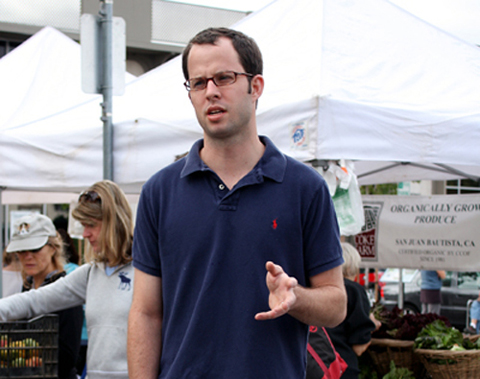
Chef Guillaume Bienaime of Marché at the Menlo Park farmers market.

Marche opened its doors that morning to 16 eager students — most of them regular diners at the restaurant — as well as yours truly and the chef’s Mom to partake in what was the first of four seasonal cooking classes planned annually. And believe me, you will not leave hungry from this $105 class.

We met up with the chef at the nearby Menlo Park farmers market to help gather peppers, corn, peaches, squash, and tomatoes for the dishes we would cook back at the restaurant.

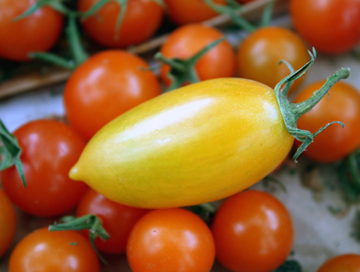
Marche gets all its tomatoes from Baia Nicchia Farm in Sunol, which sells at the Sunday farmers market. Owner Fred Hempel, a geneticist, owns 9 1/2 acres where he grows 30 types of tomatoes, half of them varieties he has created, himself. Indeed, Chef Bienaime is working with Hempel to create a signature “Marche” tomato, resulting from cross-breeding a couple varieties together. It will take two years of tinkering before the tomato will be ready to be grown for the restaurant.
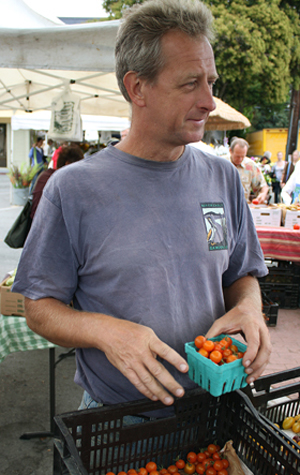
Fred Hempel, geneticist turned tomato grower.

Baia Nicchia Farm's tomatoes.

We carried the provisions back to the restaurant, where we divided up into teams of two or three. The chef explained the dishes we could be cooking that day: Roast Pork Loin a` la Provencal, Summer Squash a` la Grecque, Confit Tomatoes, Summer Corn “Polenta,” Piperade Basquaise, Gratin of Swiss Chard, and Plum & Peach Shortcake.

Chef Bienaime, though, had a special plan for my buddy, Carissa, and I. He was going to have us make Escargots Sommiroise, a traditional dish from Saint-Guilhem Desert in the Langueduoc region, which is snail country. Neither Carissa nor I had ever cooked with snails before, so we were eager to give it a go.
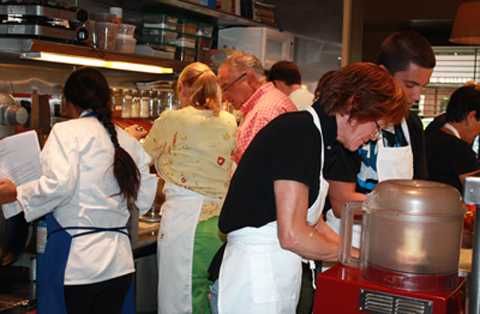
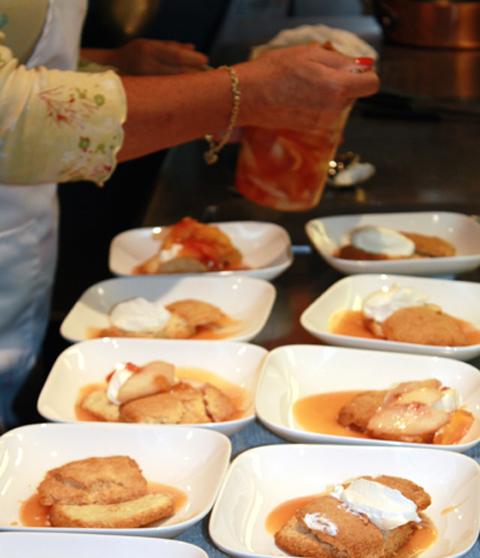
Cooking in Marché's kitchen on a Sunday morning.

Plating the just-baked shortcakes.

We all donned aprons and set to work in the restaurant’s gleaming stainless steel kitchen, grabbing knives, chinoises, copper pots, and food processors. And no, we didn’t escape doing dishes. But we didn’t mind, what with the restaurant’s nifty machine at our disposal. You rinsed off the dishes, piled them into a rack, and slid it all into the machine, where everything would emerge spotless in just three minutes. Why can’t we have one of these at home, we all thought!

At Marche, the garlic is almost always grated into dishes, using a Micrcoplane, rather than chopped or sliced with a knife. Bienaime says he likes how the garlic disappears into a dish this way. Skin on bell peppers is always peeled off, too, even if they are not roasted. The chef does this, he says, because he finds that the peppers are more easily digested this way.
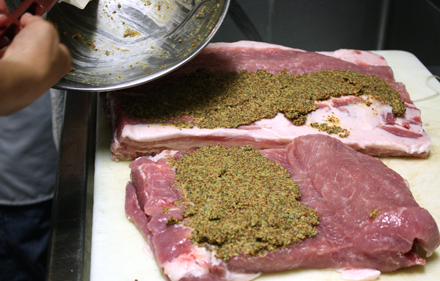
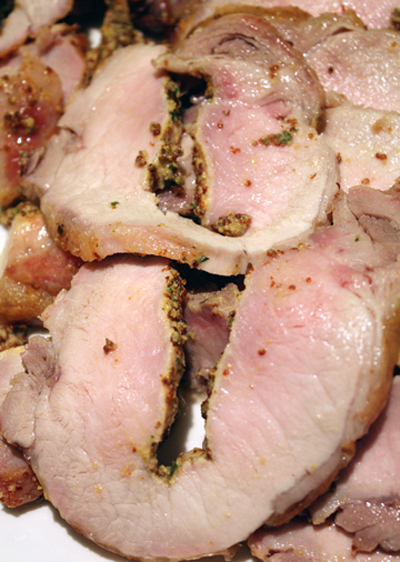
Center cut pork pork loin being smeared with a mixture of grainy mustard, anchovies, garlic, rosemary and thyme.

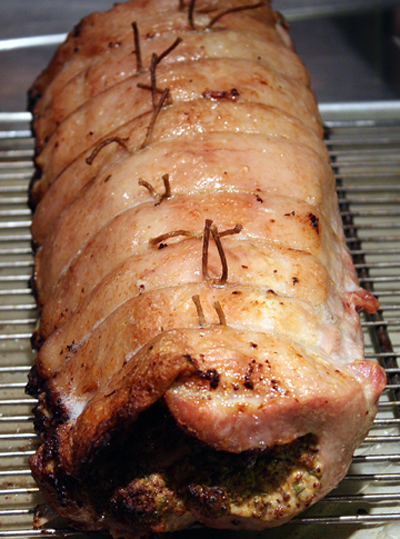
The pork just after it came out of the oven.

Sliced for serving.

All through the kitchen, students worked at shucking corn; peeling tomatoes; blanching herbs; sauteing chanterelles; and slicing open large pork loins to fill with a spread of grainy mustard, anchovy, garlic, rosemary and thyme.

Now and then in the close quarters, someone would call out “Behind you, behind you — hot, hot, hot!” as a simmering pot was ferried from the stove to a counter. There’s major heat generated in a professional kitchen when all the burners and ovens are turned up. So much so, that we all breathed a sigh of relief whenever we had to make a trip to the chilly walk-in to grab an ingredient.

It wasn’t long before the aromas of roasting pork, toasted nuts, and sauteed garlic were making us very, very hungry.

Read more

« Older Entries Recent Entries »