Category Archives: Great Finds

A Trip Down Memory Lane at the New California Academy of Sciences

Soft pork taco is served at the new California Academy of Sciences -- a vast improvement on what once was offered.

As a kid growing up in San Francisco, I happily remember elementary school field trips and teen-age outings to the magical Academy of Sciences in Golden Gate Park.

I recall sitting back in pitch darkness and watching the stars overhead in the Morrison Planetarium, thinking this was the absolute coolest place on Earth. I remember staring at the antelope and cheetah on display in the natural history museum. I remember how I couldn’t take my eyes off the ancient manatee in the Steinhart Aquarium, even if he hardly moved much.

And I remember listlessly eating burgers and fries in the museum cafe that had been left under heat-lamps for god knows how long.

Well, Dorothy, we’re not in that Academy of Sciences any more. Welcome to the revamped, utterly dazzling new California Academy of Sciences that will finally open its doors on Saturday. I was lucky enough to get a sneak preview on Monday night.

The original 1953 museum was the first scientific institution in the West. After being damaged in the 1989 Loma Prieta quake, it was closed. After a $488 million renovation and expansion, the new institution is now the only one in the world to house an aquarium, planetarium, natural history museum, and world-class research and education program under one roof.

Light fills the building designed by a Pulitzer-Prize winning architect.

It was redesigned by Pulitzer-Prize winner Renzo Piano, who also created the Pompidou Center in Paris. Like that fanciful French center, the academy boasts an extensive use of glass, giving it a modern, airy, and organic feel. Designed to be the greenest museum in the world, it is expected to earn a “platinum” rating (the highest possible) by the U.S. Green Building Council.

The living roof.

There is a “living roof” planted with native species, which is expected to reduce storm water runoff by up to 3.6 million gallons of water annually. A glass canopy with 60,000 photo voltaic cells will capture sunlight and is expected to produce up to 10 percent of the building’s needs. Additionally, building walls are insulated with old denim jeans.

The food also has gotten a much needed update, and how. San Francisco culinary legends, Charles Phan (chef-owner of the Slanted Door) and Loretta Keller (chef-owner of Coco500) have partnered to create the casual food-court-like Academy Cafe, and the full-service Moss Room. All the food served will be local, seasonal, and sustainable.

Charles Phan's newest venture, the Academy Cafe.

The cafe is arranged into stations such as “Slow Cooked,” “Steamed,” and “Sizzle.” Think soft tacos filled with juicy, slow-cooked pork; Vietnamese spring rolls; steamed chicken buns; tamales; fish & chips; green papaya salad; and vegetarian paninis.

Read more

Can You Stand Another Cupcake Photo?

Cupcakes from the new Kara's bakery in Palo Alto (clockwise from top: banana, Java, Fleur de Sel)

I had the best intentions. Honest.

But an editor needing a freelance story from me earlier than expected, and an all-around shortage of time derailed those efforts.

You see, I had hoped to go to the new Sprinkles Cupcakes bakery in Palo Alto’s Stanford Shopping Center on Wednesday, the day after it officially opened. Then, I planned to zoom across the road to the 12-day-new Kara’s Cupcakes bakery in the Town & Country Village also in Palo Alto. My plan was to conduct my very own cupcake-war, taste-off to see which bakery had the most irresistible frosting-topped confections. After all, Cupcakes Take the Cake already included a Yelp review comparing the two.

As I rounded the Stanford Shopping Center, it wasn’t hard to spot where the new bakery was on the backside of the mall. The line was the telltale beacon. At 4 p.m. on Wednesday, there were more than 20 people queued up. All of them women. You’d have thought it was a Manolo Blahnik sale, for gosh sakes.

Not having the time or patience on that particular day, I headed to Kara’s instead. And I walked right in. No line. But plenty of cute cupcakes. I chose a banana cupcake with cream cheese frosting, a “Java” (chocolate cupcake with espresso buttercream), and a Fleur de Sel (chocolate cupcake filled with caramel, then topped with ganache frosting and a sprinkle of sea salt). My tab? Just under $10. Gulp.

Read more

A Spirited Visit to St. George Spirits in Alameda

'Water of life' being distilled

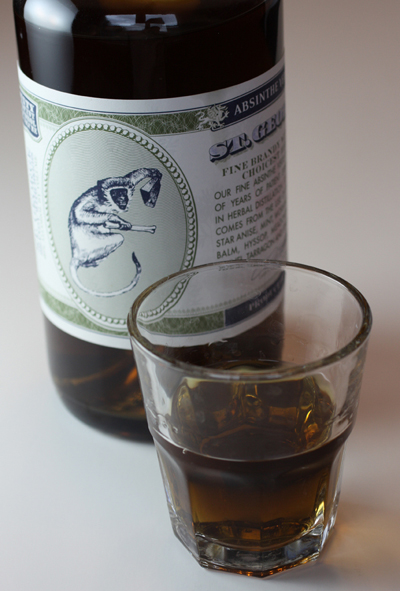
Examining a bottle of St. George Spirits eau de vie gives little hint of all it took to make it.

A clear, colorless liquid, eau de vie is French for “water of life.” It is a brandy distilled from fermented fruit juice. In the case of this Alameda artisan, small-batch spirits maker, each slender 350ml bottle took all of 15 to 20 pounds of fresh, ripe, often organic, fruit to make.

Producing eau de vie is a slow, labor-intensive process. For St. George Spirits founder Jorg Rupf, it’s also an absolute labor of love. And that’s no truer than at this time of year, when summer fruit is at its best and the gleaming copper stills at St. George are in full swing to distill pears, cherries, and raspberries down to potent yet smooth, thrillingly fragrant digestives.

Sixty-five gallon copper stills at St. George Spirits

St. George Spirits is housed in an old airplane hangar on the grounds of the decommissioned Alameda Naval Air Station; hence the moniker of another of its famous spirits made there, Hangar One vodkas.

Aqua Perfecta (eau de vie) was its first product, when Rupf founded the company in 1982. A native of Germany, Rupf was that country’s youngest constitutional law judge at age 28. While on a research sabbatical in Berkeley in the late 1970s, he fell in love with the Bay Area, and its burgeoning farm-to-table philosophy in food and wine.

Those beliefs resonated with Rupf, who was born in Alsace, home to the world’s best-regarded eaux de vie, which were initially made by farmers who were seeking another outlet for their bumper crops of fruit. Indeed, Rupf often helped his grandfather distill the family’s eau de vie.

Transplanted to the Bay Area, Rupf couldn’t believe nobody back then was making hand-crafted eau de vie in this country.

“I figured there were so many Europeans living here that it would be a good market,” he said. “Plus, I was so excited about the quality of fruit here.”

Barlett pears to be turned into Aqua Perfecta Poire William

When it comes to eau de vie, fruit matters. Big time. Rupf sources the best fruit from California, the Pacific Northwest, and Canada. Black cherries don’t have enough intrinsic aromas for him, so he uses pie cherries instead. Bartlett pears sit in huge bins off to one side, waiting for just the precise moment when they turn yellow and perfectly ripe to crush. The flesh of the fruit is used to make eau de vie, as well as the skin, which contains a wealth of aromatics. Rupf explained.

Read more

Amano — Chocolate From A Former Scientist

Amano chocolate bars

Art Pollard is a scientist by training. His specialty is search engines. In fact, his code is on most of our computers, in one form or another.

He’s also a chocoholic. More than 10 years ago, he started studying the science of chocolate. And two years ago, he started sharing his chocolate handiwork with the sweet-tooths of the world.

Thus was born Amano Artisan Chocolate. The name in Italian means both “by hand” and “they love.” It’s Pollard’s way of saying he hopes what he handcrafts will be loved by all who try it. He works with cacao farmers to improve their growing, fermenting and drying techniques. In return, he says he pays them three to four times the going market price — well above “fair trade” level.

He chose Orem, Utah for his factory, believing the high altitude (4,441 feet above sea level) and dry climate have beneficial effects on the chocolate. His 2-ounce bars ($6.95 each) are available online.

I’ll use my patented scale of 1 to 10 lip-smackers, with 1 being the “Bleh, save your money” far end of the spectrum; 5 being the “I’m not sure I’d buy it, but if it was just there, I might nibble some” middle-of-the-road response; and 10 being the “My gawd, I could die now and never be happier, because this is the best thing I’ve ever put in my mouth” supreme ranking.

Read more

Better Than The Gold Standard In Cookies

Chocolate gingersnaps -- Yum! (Photo courtesy of Platine)

Munch, munch, munch

Oh, sorry, I had my mouth full. Chomp, chomp…I can’t stop eating these cookies that arrived in the mail; that’s how good they are.

Platine, the French word for “platinum,” is tres magnifique. These handmade, mail-order cookies from Southern California are the creation of Jamie Cantor, who graduated from the Culinary Institute of America campuses in Hyde Park, NY and St. Helena, CA. She then went on to work for several years at the French Laundry in Yountville, before moving to Los Angeles to start her own bakery.

Decisions, decisions. It's hard to choose only one. (Photo courtesy of Platine)

You can taste the premium ingredients from the first bite. Every cookie is baked to order, so when they arrive on your doorsteps, they still taste very fresh. Choose from rich brownies to chewy cookies such as oatmeal raisin, snickerdoodle, and my fave — chocolate gingersnap. In fact, pardon me, while I sneak another one…crunch, crunch

Read more

« Older Entries Recent Entries »