Category Archives: Recipes (Savory)

Absinthe in Soup; Say What? (Part 2)

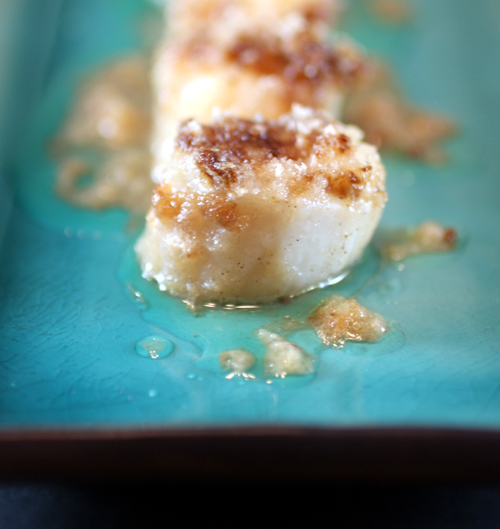
Manhattan scallop chowder with fennel -- with a dash of absinthe.

That was my first thought, too.

But here I had a big bottle of Absinthe Verte and no Pernod in the house when I spied a recent New York Times recipe for Manhattan Bay Scallop Chowder with Fennel.

The easy soup looked wonderful, but called for three tablespoons of Pernod. With its similar anise-flavor, I wondered if I could substitute my absinthe instead. ‘Course, absinthe is way more potent than Pernod, but that’s beside the point, right?

Well, when the nice folks at San Francisco’s Jug Shop got wind of my intentions after I broadcast my culinary plan on various social networking sites, they grew concerned. They told me to proceed with caution before passing “Go.” After all, Pernod is 40 percent alcohol; Absinthe Verte is a whopping 60 percent (120 proof).

So I stirred up my soup pot of crispy bacon, fennel seeds, fennel bulb, garlic, potatoes, plum tomatoes, and clam juice. The recipe called for 1 pound of bay scallops. I used what I had on hand — a 1-pound bag of larger Trader Joe’s wild Japanese scallops (20/30 count; just be sure to remove the tough small muscle on each scallop before using) — which worked beautifully.

Then it came to the moment of truth. I started conservatively, stirring in only 1 tablespoon of absinthe at first, then tasting. Mmm, totally fine, I thought. So I added another tablespoon, and tasted. Again, it didn’t seem too strong at all. So I added the final tablespoon.

The soup had tasted as if it was missing something before I added the spirit. But once that was incorporated, the absinthe really brought all the flavors together, and heightened the fennel taste.

This light, bright chowder was briny, anise-like, and sublty sweet from the tender scallops. The Green Fairy had done good.

Manhattan Bay Scallop Chowder with Fennel

Read more

Meyer Lemons — The Salty

The beginnings of preserved lemons.

I owe a debt of gratitude to Moroccan cooking expert Kitty Morse.

After all, she’s the one who taught me just how easy it is to make my own preserved lemons.

How easy?

So easy that you don’t even need a real recipe for it.

I took a cooking class at Draeger’s years ago that Morse taught. It was there that she turned me on to the endless wonders of preserved lemons.

They cost a tidy sum if you buy them already made in jars in fancy gourmet stores. They cost mere pennies if you make them yourself, especially if you have your own lemon tree.

I always use Meyer lemons just because I love the floral, complex, and less puckery taste that they have. But I also know that Mourad Lahlou, the Marrakech-born chef-owner of Aziza in San Francisco, likes both Meyers and Eurekas, but for different uses. At a cooking demonstration late last year at the Culinary Institute of America’s Greystone Campus in St. Helena, Lahlou said he favors the more delicate preserved Meyer lemons in salads, but preserved Eurekas in long-cooked stews because the rind is thicker and doesn’t break down so much.

Day One: Packing the lemons into the jar.

Whatever lemon variety you choose, I guarantee you will have a fascinating time making preserved lemons. If you have kids, they’ll have fun watching the lemons do their thing, too. Think of it as your own little science experiment.

Week 2: The lemons are softening, and exuding their juice.

Indeed, the first time I wrote about making preserved lemons years ago in the San Jose Mercury News, I admitted I couldn’t stop looking at my lemons as they transformed themselves. I wasn’t the only one. Many readers wrote back after making their own batch, confessing that if they woke up in the middle of the night, they’d sneak a peek at their lemons. Morse even laughed that my lemons had become my pets.

Read more

Stew Sensation

Fennel stars in this awesome stew.

This is without a doubt one of the best stews ever.

Since it was published four years ago in Gourmet magazine, I’ve made this “Braised Pork with Orange and Fennel” at least annually, if not twice or thrice a winter. It’s the one stew I can’t wait to make once the weather turns the least bit chilly.

Moreover, it’s the stew that created a sensation when I wrote about it a year or so ago in the San Jose Mercury News Food section. Readers wrote to tell me how much they loved the flavors of orange zest, fresh ginger, soy sauce, cinnamon, and anise seeds. A friend even recalled that women friends at her gym were all gabbing non-stop about how divine the dish was.

Who can blame them? The pork shoulder cubes cook up tender alongside slices of fennel in a sauce that’s hauntingly part Asian and part Italian. Serve it over plain steamed rice or, as I do, over soft, spoonable polenta cooked with plenty of Parmigiana.

The presentation is pure rustic comfort. The taste is a savory sensation. It’s homey enough for family; chic enough for company. And it’s a straightforward recipe that cooks up mostly unattended, so it can be easily whipped together even on a weeknight if you find yourself with a little extra time on your hands.

I’ve already made it once this winter. Try it, and there’s no doubt, you’ll be making it again and again, too.

Braised Pork with Orange and Fennel

Read more

Her Majesty’s Secret Flour

Italian doppio zero flour

That’s ”00” to you.

And yes, you can shake it or stir it, but you might get very messy in the process.

Sorry about the James Bond 007 pun, but I couldn’t resist. Doppio zero flour is also known as “OO” flour. The numbers refer to the grade of flour. The “00” is the finest milled available.

I was induced to hunt it down after making the pizza dough recipe in the “A16 Food+ Wine” (Ten Speed Press) cookbook by Nate Appleman and Shelley Lindgren. The first time I made it, I used all-purpose flour. It turned out incredible. But of course, wondering if a good thing could be made even better, I was curious if “00” would produce an even more spectacular dough, since A16 restaurant uses that regularly for its pasta and pizza doughs

While in Wine Country recently, I happened to find bags of Italian doppio zero at Sunshine Foods Market in St. Helena. I loaded up on it.

The “00” flour is very light and powdery to the touch. Following the A16 recipe, I mixed the “00” flour with a smidgen of yeast dissolved in water, olive oil, and salt. I covered the bowl and put it in the fridge for two days to ferment and slowly rise.

A16 pizza dough made with doppio zero.

When I pulled out the dough, I noticed it was stickier than the one I had made with all-purpose flour. It might be that the “00” is so fine, you need more of it. But because the recipe gives the flour measurement only in cups, not in grams, it’s hard to tell.

This dough also was more elastic. Indeed, it was easy to stretch the dough very thinly so that the pizza baked up with a very crisp center.

Before putting the pizza on a baking stone in the oven, I layered on my own combination of paper-thin slivers of garlic, truffle cheese, and fresh basil leaves. When it emerged blistered and golden from the oven, I draped prosciutto over it.

Pizza topped with garlic, basil, truffle cheese, and prosciutto.

It was one mighty fine pizza. I can’t say that the “00” flour imparted any more taste necessarily to the pizza. But it made the dough a pleasure to work with, and perhaps even crispier.

Read more

Memories of Dried Shiitakes, Sweet Chinese Sausage, and Sticky Rice

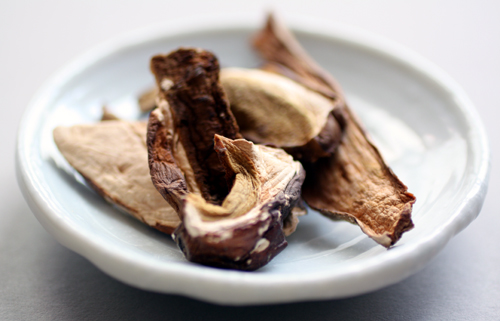
Dried shiitakes -- a must-have ingredient for Thanksgiving sticky rice.

For my brother Dale and I, Chinese sticky rice has been both the hallmark and the bane of the Thanksgivings each of us has hosted over the years.

This traditional dish of glutinous rice studded with salty dried shrimp, slices of fatty Chinese sausage, earthy shiitakes, and crunchy bits of water chestnuts has been a staple at our family’s Thanksgivings since I can remember.

But the sticky rice also has proved, well, a sticking point. You see, try as we might, for years he and I could never make sticky rice that proved up to snuff for our Mom.

My late-Mom took pride in all that she did, and was quite the perfectionist. When she sewed, if a stitch was at all crooked, she’d rip it out and start over. When I used to sew as a teenager, I was less fastidious. I remember times when an inner seam might turn out a little less than straight, and I’d tell her, “Nobody will ever see it.” She’d give me that look, which basically said, “Yes, but you will know it’s crooked. You will know you did not do it as best you could.” All it took was that look, and the next thing I knew, I’d be ripping out the thread to redo it.

Of course, with a rice cooker full of steaming sticky rice cooking away, it’s a little harder to rip things out and start over.

Still, even as a child, I remember my Mom anxious over the outcome of the sticky rice. It was always made in the big rice cooker, not the smaller one we used for everyday meals. She’d peer into the rice cooker now and then to stir the contents or to monitor its progress. She’d fret if it wasn’t cooking as fast as it should. She’d sigh if it started sticking on the bottom of the inner pot.

Who knew rice could be so nerve-wracking?

Read more

« Older Entries Recent Entries »