Category Archives: Great Finds

Top 10 Eats of 2009

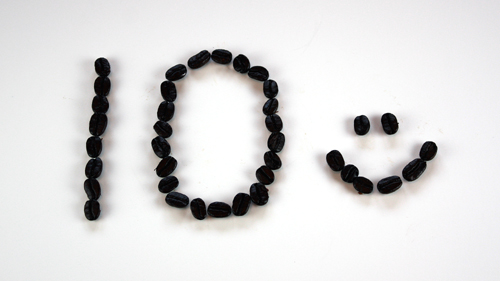
My Top 10 eats that make me smile. (And yes, those are coffee beans.)

Some people like to look back at the year to ponder, scrutinize and revel in their accomplishments.

I like to look back at the year to relive moments in time that I can’t forget because, well, they just tasted so darned good.

Yes, here’s my list of the top 10 dishes I had in 2009.

Oh, it was hard to narrow it down to just 10, believe me. I hemmed and hawed about which would make the cut and which wouldn’t because there were so many bites over the past 12 months that I truly savored.

In the end, I decided to limit it to the meals I ate out, rather than cooked at home. The dishes that made the list were ones that I still savor in my memory, again and again. They’re ones that I would rush out to eat once more in a heart beat. They are — in a word — unforgettable.

Here they are, in no particular order:

Read more

Handmade Fleurir Chocolates

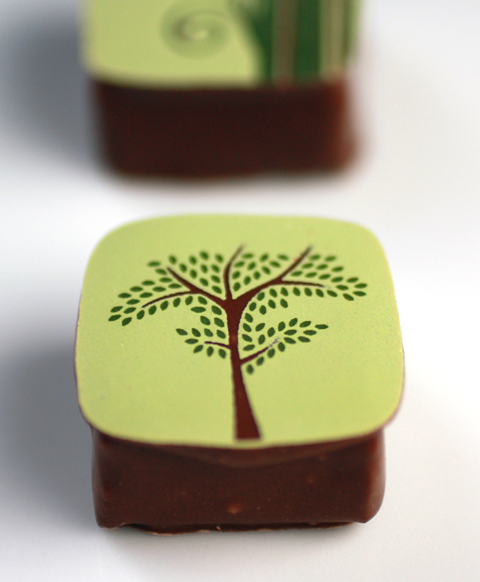
Grand Marnier Orange Blossom bonbon from Fleurir chocolatier.

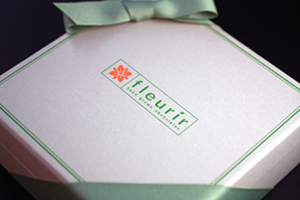
The name of this Hartfield, VA chocolatier, Fleurir, literally means “to bloom.” And there’s no doubt a craving for these tiny artisan chocolates will sprout after just one bite.

Twenty-five-year-old Robert Ludlow started the business in April with his 23-year-old fiancee, Ashley Hubbard. Ludlow, who earned a grand diplome from Le Cordon Bleu in Sydney, Australia, uses fresh cream and butter in these handmade chocolates that come in such intriguing flavors as Coconut Lime, Carrot Cake, and Lavender Shiraz.

The elegant box.

The couple recently sent me a sample to try. A 4-piece box is $8, a 9-piece is $18, and a 25-piece one is $48. The chocolates are available at select locations in the Washington, DC-area or on the chocolate company’s Web site.

So, how do they taste?

I’ll use my patented scale of 1 to 10 lip-smackers, with 1 being the “Bleh, save your money” far end of the spectrum; 5 being the “I’m not sure I’d buy it, but if it was just there, I might nibble some” middle-of-the-road response; and 10 being the “My gawd, I could die now and never be happier, because this is the best thing I’ve ever put in my mouth” supreme ranking.

Read more

The Art of Hoshigaki

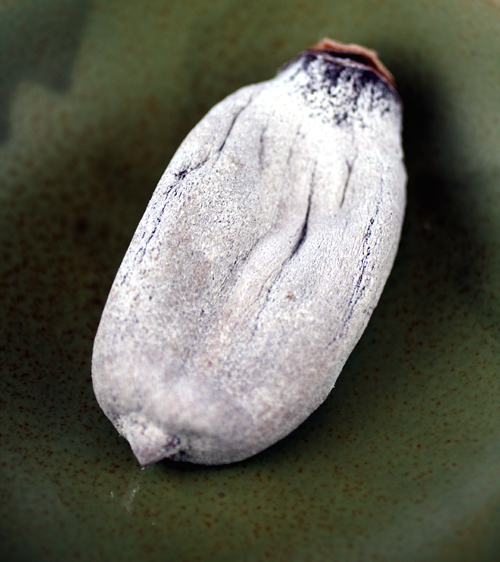
Hoshigaki -- a persimmon dried in the traditional Japanese method.

As chef of Pizzeria Picco in Larkspur, Restaurant Picco in Larkspur and Bix in San Francisco, Chef Bruce Hill has a flair for creating stylish Italian and New American food.

He also has a thing for massaging fruit.

Before you raise your eyebrows too high at that, just know that it involves the ancient and quite labor-intensive Japanese tradition of preserving persimmons.

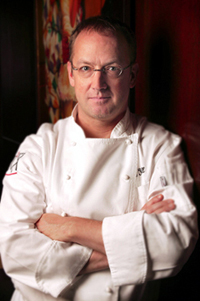
Chef Bruce Hill. (Photo courtesy of the chef)

Hill has been making the dried persimmons, known as hoshigaki, for the past four years, ever since he was inspired to give it a try by the lovely sight of all the bright orange persimmons at his local farmers market.

He doesn’t use the hoshigaki at his restaurants or sell them. He just makes them for fun to give to family and friends. And when he asked me if I would like to try some, I jumped at the chance.

Hill employs the traditional method of making them, which requires that the persimmons be peeled by hand, then hung by string for several weeks. During that time, he gives them regular massages to help break up the flesh and to help maintain their uniform shape. The rub-downs also help smooth the exterior to retard mold. After about six weeks of this pampering, a white powdery bloom naturally appears on the fruit, signaling that they’re ready to be enjoyed.

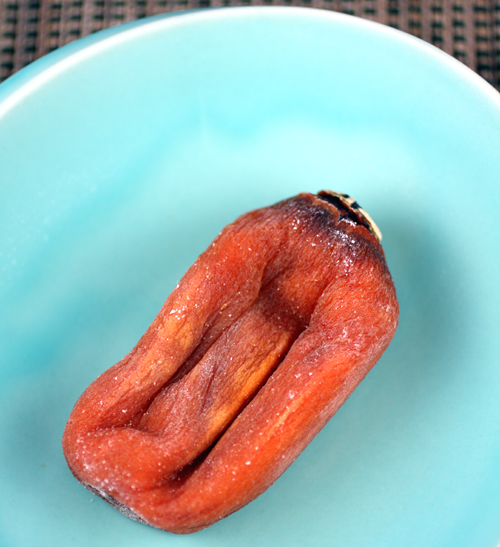
A younger version of the dried persimmon that still has its orange color.

He sent me two kinds of hoshigaki, each made of the Hachiya variety of persimmon, so that I could get an idea of the transformation process.

Read more

A Taste of Beringer

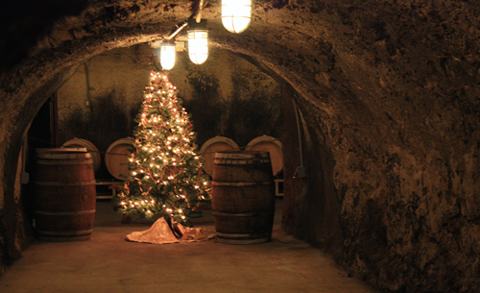
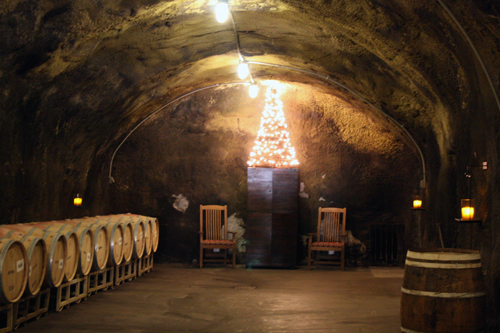
The warm glow of a Christmas tree lights the way inside the ancient Beringer Vineyards wine caves.

I’ve been on many a wine-tasting tour in the Napa Valley.

But recently, I had the pleasure of enjoying a very special one.

Just what made it so memorable? It was the fact that my 22-year-old niece tagged along with me for what was not only her first trip to Napa, but her first time touring a winery.

Noodle Niece, as she so requested to be called because of her fondness for udon, ramen and all things pasta, developed a growing curiosity about wine after spending a college semester studying in France. Since her parents are not vino drinkers, my husband (aka Meat Boy) and I decided it was our duty to introduce her to the delights of the Napa Valley.

What a fun time it was, too. There’s something wondrous about getting to experience the familiar anew again. And there’s something downright delightful about catching a glimpse as someone’s face changes from nonchalance to “Wow!” when they discover tastes they’ve never had before.
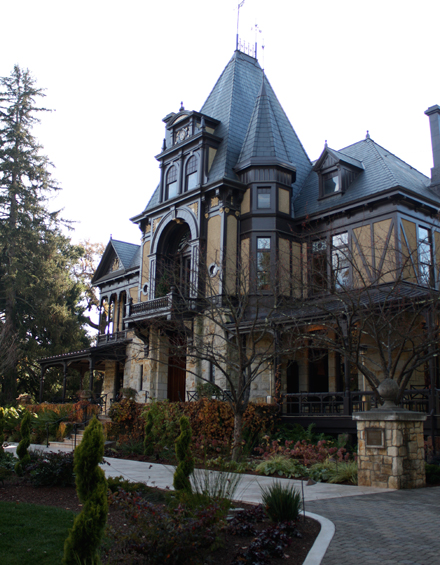
The glam Rhine House at Beringer.

With Meat Boy the designated driver, Noodle Niece and I piled into the car on a sunny but chilly afternoon for the drive to Napa to visit Beringer Vineyards. Meat Boy’s good friend, who works for Beringer, had arranged for us to enjoy a private tour and tasting (normally $35 per person).

We thought Noodle Niece would find Beringer especially interesting, because it is the oldest continuously operating winery in the Napa Valley and is designated a Historic District on the National Register of Historic Places. Indeed, Beringer even continued to operate legally during Prohibition, according to our cordial guide, Michael. Apparently, a lot of doctors and priests were using Beringer wine back then for medicinal and religious purposes. Uh-huh.
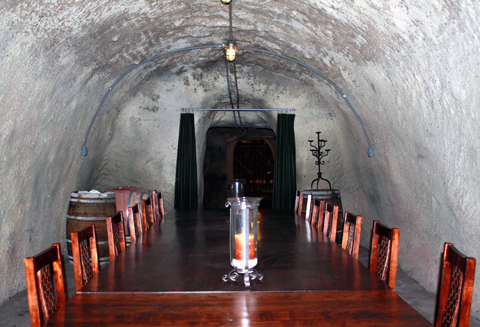
Private dining room inside the cave.

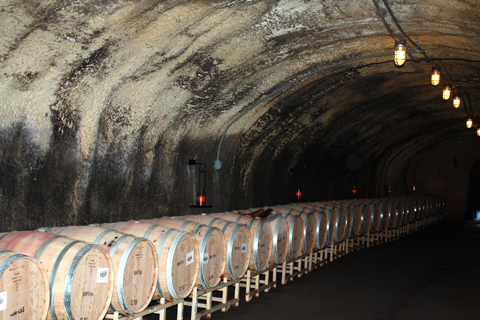
Barrels being aged.

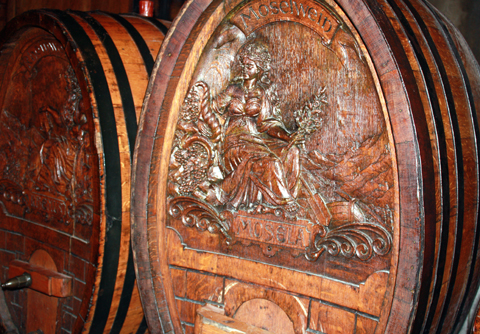
One-of-a-kind, hand-carved barrels.

Another Christmas tree decorates the caves.

Established in 1876, Beringer also boasts an extraordinary 1,200 linear feet of aging caves that naturally help keep the wines at 58 to 60 degrees year-round with a humidity level of 75 to 80 percent. The caves were hand-chiseled by Chinese laborers who also built the Trans-Continental Railroad. Look closely, and you’ll see the actual pick marks.

Read more

Gawking at Goat Cheese

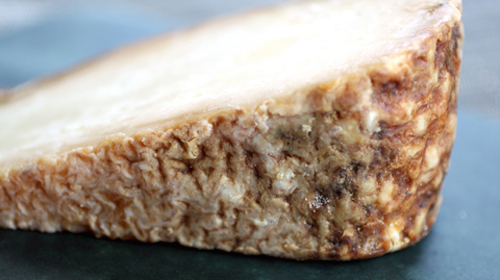
The unusual rind on Capricious goat cheese.

Take a close look at this rind. Come on. Closer, closer.

How can you not gawk at a cheese with an exterior that’s almost burlap-like in color and texture?

Have you ever seen the likes of this before? I know I haven’t.

Capricious is the name of this wondrous goat cheese.

And I have cookbook authors Mark Scarbrough and Bruce Weinstein of the RealFoodHasCurves blog to thank for this discovery.

The duo were in San Francisco earlier this year, when they stumbled upon this glorious cheese sold at the Cowgirl Creamery shop in the Ferry Building that’s made by Achadinha Cheese Company of Petaluma.

The milk for the cheese comes from the Pacheco Family Goat Dairy that’s been around since 1953. Five years ago, owners Donna and Jim Pacheco, started making cheese, too, from the milk from their 1,400-goat herd. After Mark and Bruce raved about it to me, the Pachecos were kind enough to send me a small sample of the cheese to try.

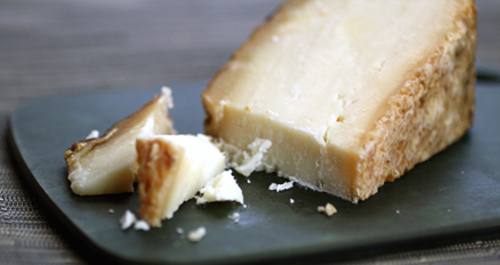
A different kind of goat cheese -- dry, crumbly and aged.

The Capricious sells for $29.95 a pound. That may sound pricey, but not when you realize all the love and work that’s gone into it.

The cheese is completely handmade and hand-rolled. Each wheel is turned daily to endure even mold coverage, then washed and rubbed down with olive oil to protect the interior of the cheese as it ages anywhere from three to 10 months, depending upon the time of year and the amount of butter fat in the goats milk.

Read more

« Older Entries Recent Entries »