Category Archives: Recipes (Savory)

Just the Two of Us

A taste of old and new.

I remember the worn Formica table, and not much else.

It was one of many such tables at a hole-in-the-wall restaurant in San Francisco’s Chinatown, the kind with bare wooden chairs beside it, and brusque, Chinese-speaking waiters in white shirts and black vests who came by to take your order in a snap.

I was barely grammar school age then, possibly even younger.

I remember that place because my Dad would take me there. Just the two of us.

I’m not sure why my Mom and older brothers are absent from these memories. Maybe these father-daughter excursions happened when my Dad had days off from work. Maybe we’d end up picking up take-out for the rest of the family afterward. I wish I could recall.

What I do remember is how excited I always was whenever he brought me to this particular restaurant. You see, it wasn’t like any other restaurant in Chinatown. You could enjoy your standard Chinese food there, of course, but you also could order “American” food. At that age, that was a real treat to me then. And apparently to my Dad, as well.

My Dad would sometimes order a plate of Chinese beef stew, savoring the chewy tendon pieces most of all. Or he would sometimes have the same thing that I did. A creature of habit at that young age, I always went for the same dish: veal cutlet. It came with a gob of mashed potatoes, and a pile of those heated up, homogeneous looking frozen peas and carrots.

It was the cutlet I was most thrilled by, of course. There was just something special about that thin, tender slab, all perfectly crispy and golden brown sitting in the spotlight on that plate. I happily ate one fork-full after another, until it was all gone, and I’d have to wait until my Dad brought me back to that restaurant to enjoy it again. You see, it was the only place I ever ate that dish. My parents never cooked it at home. And I never ordered it anywhere else. Not even as an adult.

Then, a copy of “Relaxed Cooking with Curtis Stone” (Clarkson Potter) arrived in my mail. As I leafed through the cookbook by the host of TLC’s “Take Home Chef,” one photo in particular stopped me. There it was — a veal cutlet all crispy and golden looking like yesteryear.

Read more

Spanish Flavors

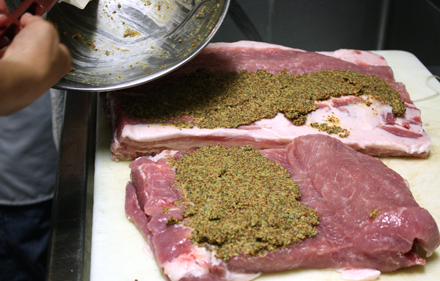
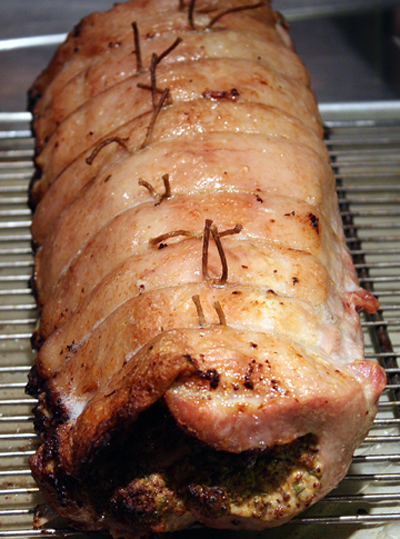
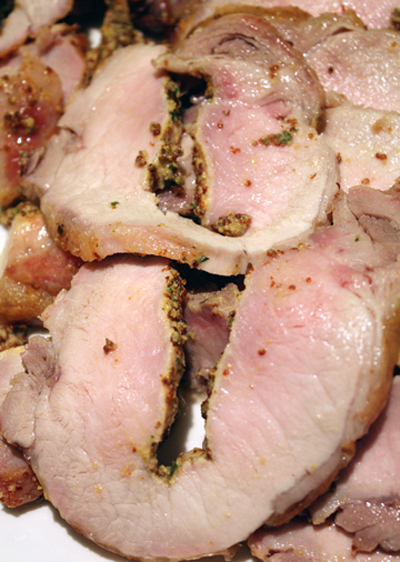
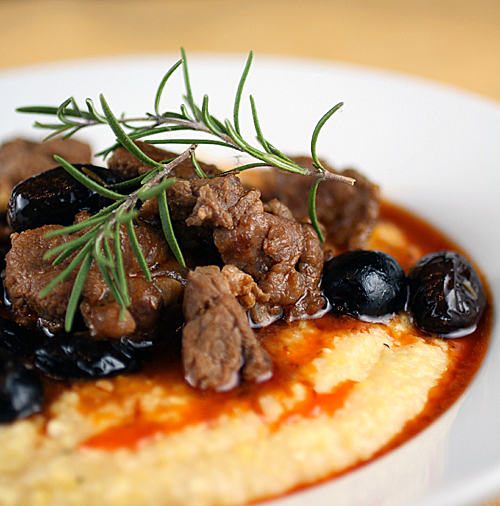
Tender pork flavored with rosemary, white wine, and pomegranate juice.

Antonio Banderas. Penelope Cruz. The architecture of Antoni Gaudi.

Sangria. Cava. Tapas. And melt-in-your-mouth Iberico ham.

I love all things Spanish.

When I spied the new “One Pot Spanish” (Sellers Publishing) cookbook by Spanish cooking authority Penelope Casas, it brought back delectable memories of my trip to Spain long ago, when I got my fill of seafood paella, briny olives, and bracing gazpacho.

Read more

Nature’s Most Magnificent Cocktail Nibbles

You'll end up eating these by the bowl-full. That's how good they are.

That bowl of blistered, tender peppers above?

Yup, those skinny, dark green beauties are nature’s best cocktail snacks.

These pimientos de Padron are grown by East Palo Alto’s Happy Quail Farms.

I was first turned on to them eight years ago when I wrote a story about them for the San Jose Mercury News Food section. Farmer David Winsberg, whom I fondly call Dr. Pepper for obvious reasons, grows a cornucopia of exotic peppers on his network of backyards and other rented properties in East Palo Alto.

He’s probably most famous for his Padron peppers, though. They are one of the oldest non-hybrid peppers around and were supposedly brought back from the New World to Spain by Christopher Columbus. Named for the town of Padron in northwest Spain, the peppers are a treasured delicacy found in tapas bars around the region during the summer, when they are harvested.

They have a mild grassy, sweet flavor. Cooked, they’re downright juicy in your mouth.

Pimientos de Padron -- before cooking.

Winsberg started growing them in 1998 after a friend of friend brought him back some seeds from Spain. Now, you’ll find Happy Quail Farms’ Padron peppers on Bay Area restaurant menus, as well as for sale at the San Francisco Ferry Building farmers’ market on Saturdays, the Palo Alto downtown farmers’ market on Saturdays, the Menlo Park downtown farmers’ market on Sundays. Deeper into summer, when production is at full steam, you’ll find Happy Quail Farms at additional farmers’ markets. Check the farms’ Web site for more information.

Read more

Precious Pintxos

Pimente d'Espelette

As a long-time food writer, I’ve found myself in some enviable positions over the years.

One of my fondest memories is the time a few years ago when I was invited to Chef Gerald Hirigoyen’s Marin County house for lunch. It was a gathering of just three other food writers. We all hung out in the kitchen as the charming Basque chef cooked us lunch in honor of his friend’s new cookbook.

Oh, the friend in question? That would be New York four-star Chef Eric Ripert of Le Bernardin. And the other cooks in the kitchen that afternoon? Laurent Gras, who went on to open his acclaimed L2O in Chicago; and Laurent Manrique, chef-partner of the Aqua Restaurant Group in San Francisco.

It’s hard not to feel a little star-struck in that company, especially when Ripert hands you a warm croque monsieur (done his way with salmon instead of ham) that he just made in a frying pan at the stove. But as we all sat down at the kitchen table to eat, chit-chat, and share laughs, it was as comfortable as any gathering of old friends could be.

Therein lies the beauty of Hirigoyen’s hospitality and cooking that permeates his San Francisco restaurants, Piperade and Bocadillos. Both are infused with warmth and soul throughout.

His new cookbook is no exception. “Pintxos: Small Plates in the Basque Tradition” (Ten Speed Press) by Hirigoyen and co-author Lisa Weiss is filled with recipes for small plates that pack a lot of gusto. They are mostly Basque-inspired, but a few also feature the Cal-Asian flavors Hirigoyen has grown to love. Pintxos (the Basque version of Spanish tapas) make for perfect, casual party food.

Many of the recipes call for piment d’Espelette, a dried red chile powder from the Basque French region. The chiles, grown only in and around the town of Espelette, have a smoky, complex flavor and a subtle kick. Hirigoyen imports his own that’s sold under the Igo Foods brand. I picked up a 1-ounce container ($16) at the Spanish Table in Berkeley.

The piperade before pureeing.

I decided to try making his “Chicken Thighs with Spicy Basque ‘Ketchup’.” You make a piperade first (a stew of sweet peppers and onions) that gets pureed in a blender and seasoned with more piment d’Espelette.

Read more

Longing for Pungent Dried Fish

Steamed pork hash with salted fish served over Chinese sticky rice.

Sometimes you never know what you’ll end up missing.

For me, it turned out to be — of all things — a most humble Cantonese dish of steamed ground pork, strewn with finely julienned ginger and copious amounts of preserved, pungent mackerel.

Yes, stinky, salted fish is what I longed for. Who would have thought?

This steamed pork hash or cake, otherwise known as hom yu jing jiu yok bang, was not something I missed at first. Not when my Mom had a stroke, limiting her ability to cook this dish and so many others I had grown up with. And not even years later, when my Mom passed away, and this home-style dish faded into memory.

It was only a year after her death, when I happened to be at Asia Village, a hole-in-the-wall Chinese restaurant in Sunnyvale, when I saw the dish on the menu and decided to order it for old time’s sake.

It came to the table, looking a lot like what my Mom used to make — a 1-inch-thick pressed round patty of ground pork, topped with a couple small pieces of salted fish, all floating in its own lovely juices.

It was tender, a bit briny, incredibly succulent, and the perfect foil for plain, fluffy rice. One taste is all it took to make me sigh wistfully.

I’m not the only one. I started asking my Chinese-American friends if they remembered this dish. All did fondly from their childhood, but almost all of them had not eaten it in years. They didn’t cook it now, having never learned how to make this basic dish. And they didn’t eat it when they went out, because of its scarcity on menus.

“It’s classic Cantonese comfort food. It was truly one of my favorites growing up,” says Chinese cooking expert and cookbook author Grace Young, who grew up in San Francisco and now lives in New York. “Steamed pork cake dishes are seldom found in restaurants. I think they are so simple to make that when people go to a restaurant they want to eat dishes that are too complicated to make at home.”

It’s a family-meal dish beloved by both the Cantonese and the Hakka, neighbors in Southern China, according to Bay Area food writer, Linda Lau Anusasananan, who is writing a book on Hakka cuisine.

“It combines pork, preserved ingredients, and strong seasonings — all main elements in Hakka cooking,” she says. “I love the dish for its simplicity.”

If I wanted to enjoy hom yu jing jiu yok bang regularly, I realized I would have to learn how to make it myself. The key would be finding just the right fish to use. That turned out to be far easier said than done.

Read more

« Older Entries Recent Entries »