Category Archives: Thomas Keller/French Laundry/Et Al

Momofuku Chef David Chang Visits Kepler’s
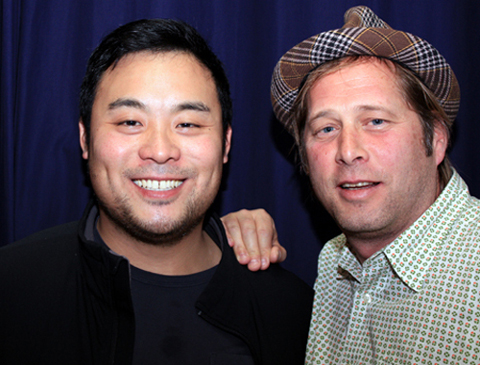
Chefs David Chang (left) and David Kinch (right) at Kepler's earlier today.

No figs were in attendance at this afternoon’s book signing at Kepler’s book store in Menlo Park with David Chang, superstar chef of New York’s insanely popular Momofuku restaurants.

Nope, but there were about three dozen folks eager to get their copies of the new “Momofuku” cookbook signed by the always no-hold-barred chef, who appeared with his co-author, New York Times writer Peter Meehan.

As you probably recall, Chang had caused a ruckus last month when he reportedly said on stage at the New York Food & Wine Festival: “F*****g every restaurant in San Francisco is just serving figs on a plate. Do something with your food.”

That comment has dogged him ever since, especially as he embarked on his book tour, which took him this week to — ahem — San Francisco.

At Kepler’s, he was met with a good-natured crowd, more eager to hear him dish on his unbelievably successful career than about the aforementioned slandered fruit.

Chang’s good friend, esteemed Chef David Kinch of Manresa in Los Gatos, introduced him at the event. Kinch recalled how he used to eat at Momofuku Noodle Bar when it was then Chang’s only restaurant.

“He took a simple dish of ramen and elevated it,” Kinch said. “It was revelatory.”

The proudly potty-mouthed Chang kept the cursing to a minimum today. Maybe because the stage was only a few feet away from the children’s reading section — or not — he uttered no f-bombs and only one mere “a**hole.”

Other noteworthy Chang-isms from the event:

On “Fig-Gate”:

“I got myself into a media mess. I was not drunk. I was coherent. But maybe it shed some light on a touchy subject in the Bay Area. I was at the farmers market today (Ferry Building one in San Francisco), and I didn’t want to look at anything because I was so upset. I don’t think the Bay Area is the culinary capital of the world. I don’t think New York is, either. People don’t know I come to San Francisco 10 times a year. I love San Francisco. For whatever reason, San Francisco doesn’t have the diversity food-wise. Neither does New York or DC and every other city that has the ability to do something great. Why shouldn’t we have the most progressive cuisine here?”

On which city is doing it right:

“San Sebastian. And a number of other cities in Spain.”

On opening his original Momofuku Noodle Bar:

“It was so small, I wasn’t even sure we could fit a bathroom in it. Our first exhaust system sucked up all the A/C. Our customers would be sweating to death. In the winter, we didn’t have enough amps to turn the heater on, so we just turned up all our burners so the guests wouldn’t freeze.”

“When you limit what you have, you limit what you can do. We couldn’t break down a full pig. We tried. We tried to do it one day on top of the bar. It didn’t work so well.”

“It’s the Crayola Crayon box analogy. Some chefs can use the 120-crayon box. They’re that skilled. We, at the time, needed the 6-color one.”

“When I first opened, I got a penalty from the New York State Tax Department because I hadn’t been paying sales tax. I didn’t even know what sales tax was. That’s how stupid I was. I didn’t know we had to pay it.”

Read more

Michelin Guide Gears Up to Tackle the South Bay

Jean-Luc Naret, director of the Michelin Guides. (Photo courtesy of Michelin)

As the new 2010 Michelin Guide San Francisco goes on sale today with its discriminating picks for the top Bay Area restaurants, South Bay chefs would be wise to keep their eyes peeled for those sneaky inspectors coming their way.

With the 2011 guide, Michelin plans to expand its coverage of the South Bay, according to Jean-Luc Naret, director of the guides, whom I spoke with by phone yesterday.

“To be honest, the first year of the guide we went as far as Los Gatos only because of Manresa,” Naret says of the first San Francisco guide that came out four years ago. “We want to expand that coverage. I can’t say how far south we will go yet. It all depends on the restaurants we find.”

This year, Silicon Valley was represented by Chez TJ in Mountain View, Plumed Horse in Saratoga, and the Village Pub in Woodside, each of which garnered a coveted one-star rating. Trevese in Los Gatos, also received one star, but closed a month ago.

In the new 2010 guide, which retails for $17.99, the East Bay received a closer look this time around, with the inclusion of restaurants in Walnut Creek, Emeryville and Lafayette.

All in all, there are 110 more restaurants than last year’s guide.

But some things have stayed the same. The French Laundry in Yountville remains the only three-star restaurant. It is one of only 80 three-star restaurants in the world, Naret says.

Three stars, which mean “exceptional cuisine, worth a special journey,” is the highest rating Michelin awards. Two stars mean “excellent cuisine, worth a detour.” One star is “a very good restaurant in its category.”

This year’s top-rated restaurants are:

Read more

Coffee That Aims to Brew World Change

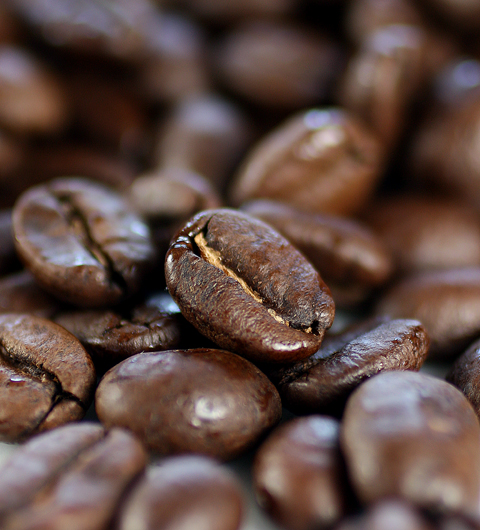
Coffee that could help better the lives of women in Zimbabwe.

Who knew a cup of Joe could hold the promise of bettering the lives of women in one of the most impoverished countries in the world?

But that’s what San Rafael-based Equator Coffees’ new “Chido’s Blend” aims to do.

The coffee, a blend of three African beans, is named for Chido Govero, a 23-year-old woman from Zimbabwe, who was relegated to an orphanage after her mother died of AIDS. At age 12, this bright, young girl was discovered by a scientist with the ZERI Foundation, an organization dedicated to using science to come up with sustainable solutions to world problems. The scientist helped mentor Govero, teaching her how to analyze tissue cultures of local, wild mushrooms.

Govero and her colleagues at the university discovered that these incredibly nutritious mushrooms might hold the key to helping stricken communities better feed themselves. Zimbabwe, a landlocked African nation the size of Montana, has been plundered by a controversial land redistribution campaign that has crippled domestic food production. A quarter of the population suffers from AIDS. The country also has more orphans per capita than any nation in the world. Girls, especially, face significant dangers in this climate of scarcity.

Who knew a bag of coffee could hold such promise?

Now, Govero is teaching girls to find native mushrooms in their local areas, and to cultivate them for food and income. In this way, she hopes to give them jobs and a brighter future.

The mushrooms are cultivated using mulch composed of discarded organic materials, including husks from coffee beans. The mushrooms also provide more than food for humans. Their spores transform mulch into fiber-rich feed, which can be fed to goats and other livestock. In turn, the animal manure is composted for raising additional crops. Additionally, the mulch prevents emissions of methane, a powerful greenhouse gas, by utilizing the agriculture waste from coffee production. The end result is a remarkable ecosystem.

You may be familiar with Equator Coffees because they are served at the French Laundry, Bouchon Bistro, and Bouchon Bakery. What you might not know is that it’s also a woman-owned company known for its commitment to social responsibility.

Read more

Take Five With Timothy Hollingsworth, the New Chef De Cuisine at the French Laundry

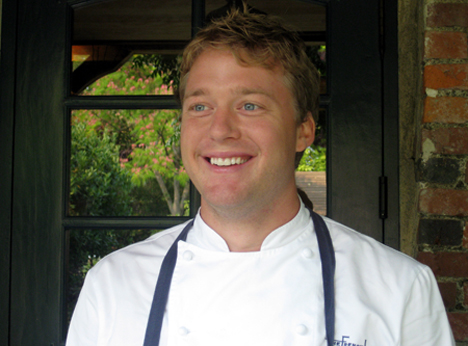
The French Laundry's new chef de cuisine. (Photo courtesy of the French Laundry)

Placerville, Calif.-native Timothy Hollingsworth may have grown up surfing the waves at Bolinas and Ocean beaches. But now, the self-taught chef is in for the ride of his life on a veritable culinary tsunami as the new chef de cuisine of the one and only French Laundry in Yountville.

The esteemed restaurant, which has won every accolade imaginable, just celebrated its 15h anniversary last month, too. Hollingsworth, who has been with the French Laundry for seven years, stepped into the top toque role this month with the departure of predecessor Corey Lee, who left to open his own restaurant.

If the 29-year-old Hollingsworth is feeling the weight of that responsibility pressing on his young shoulders, he’s not letting on. Hollingsworth, who learned his craft apprenticing in celebrated European kitchens, including one manned by bad-boy chef, Gordon Ramsay, is used to being under pressure. Earlier this year, he competed in the prestigious Bocuse d’Or, the Olympics of cooking, where he placed sixth out of 24 chef teams from around the globe.

The esteemed French Laundry in Yountville. (Photo courtesy of Deborah Jones)

During a recent hiatus before resuming work at the French Laundry, Hollingsworth was kind enough to do an interview via email.

Normally, I prefer conducting interviews in person or over the phone, because it’s more difficult for someone to sidestep questions once you have them engaged in conversation. What kind of questions, you wonder? Oh, ones such as “Timothy, did Gordon Ramsay ever call you a ‘stupid donkey’ when you worked for him?’ ” (No comment.) And “Will you be in charge of cooking the dinner for the wedding of Thomas Keller and Laura Cunningham?” (No comment.)

Oh well, you have to give a Food Gal credit for trying, right?

Here’s what he did answer:

Read more

The Dish on Heirloom Veggies and Culinary Luminaries at SF Chefs Food Wine Extravaganza

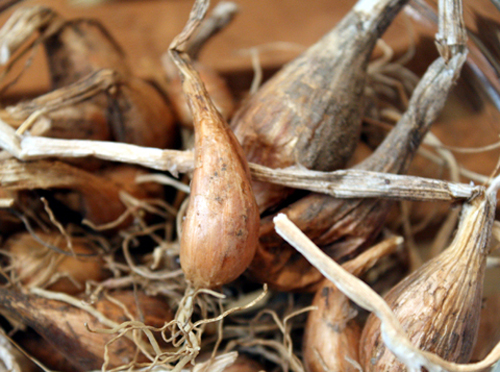
Rare gray shallots.

If you’ve ever needed proof of the value of saving and preserving heirloom seeds, just take a close look at the photo above.

That, my friend, is what a real, wild shallot looks like. It’s not big and purple, and encased in an easily removed papery shell like the commercially grown ones found at the supermarket here. No, this true shallot known as a gray shallot is much smaller and much more gnarly looking. You have to work to get at it, too, because its outer shell is quite hard to penetrate.

But your efforts are richly rewarded in the end with its beguiling fragrance and flavor that’s like that of a fine truffle.

Now, aren’t you just itching to get your hands on one? Unfortunately, it’s grown only in France now. Like so many varieties of heirloom produce (ones that have been propagated for at least 50 years and are not hybrids), they fell out of popularity after World War II, when our food became much more homogenized and industrialized. But nowadays, chefs and small-scale farmers are rediscovering these heritage fruits and vegetables, and finding inspiration in the stories and flavors they hold.

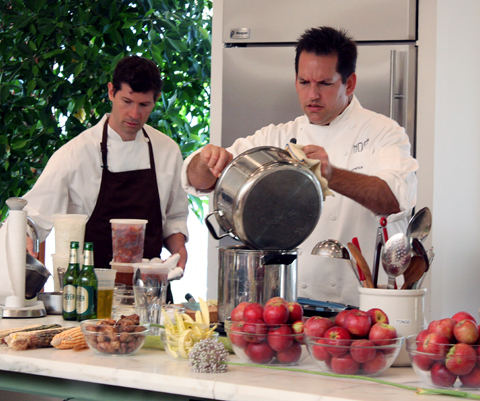
That was the theme of a Sunday cooking seminar at the SF Chefs Food Wine extravaganza in San Francisco, hosted by Chef Daniel Patterson of Coi in San Francisco, Laurence Jossel of Nopa in San Francisco, and Craig Lindquist, a Sonoma seed preservationist.

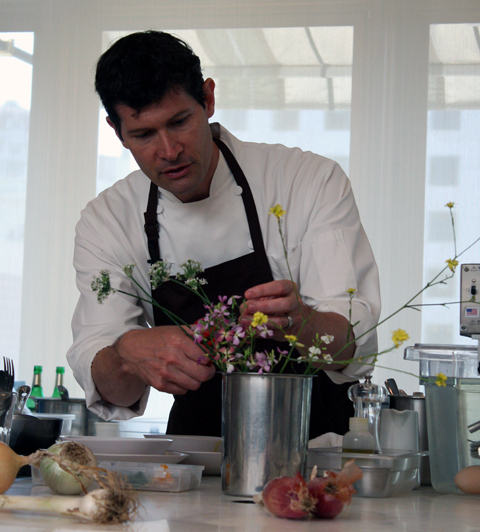
Chef Daniel Patterson of Coi snips edible wild flowers for his heirloom potato dish.

“These old varieties were woven into people’s lives,” Patterson says. “You used to save the seeds of the plants you liked. Over time, the plants adapted to where they were grown, so they took on the flavor characteristics of the place. We’ve lost a lot of that now.”

Chef Laurence Jossel of Nopa prepares pork chile with heirloom smoked peppers.

Flavor is front and center with these imperfect looking, finicky growing heirlooms. They may win no beauty contests, but they will win you over with their taste. One spoonful of Jossel’s bold pork chile, made with heirloom peppers that were dried and smoked, will make you a convert. One sip of Patterson’s onion soup with Parmigiana foam, will leave you wondering how it could taste so sweet from just onions and no added sugar.

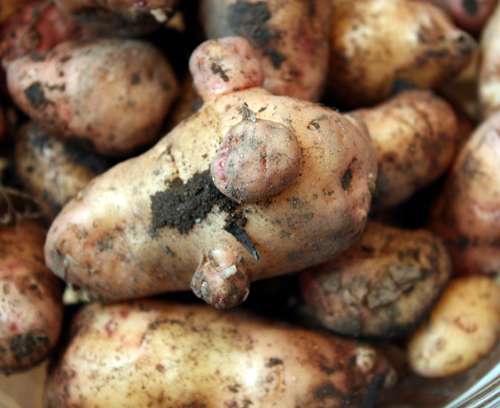
Rose Finn fingerling potatoes.

This Rose Finn potato was grown in England in the 1700s. It was the favorite potato of organic gardening pioneer Alan Chadwick, who supposedly smuggled it back to Santa Cruz, where he grew them, Lindquist says. Nowadays, you can find them occasionally for sale at the Ferry Plaza Farmers Market, or served in season at the venerable Chez Panisse in Berkeley.

This fingerling potato fell out of favor because of its little bumps (secondary growth sites), Lindquist says. Consumers want uniform, pretty looking potatoes, not ones with little nubs all over them.

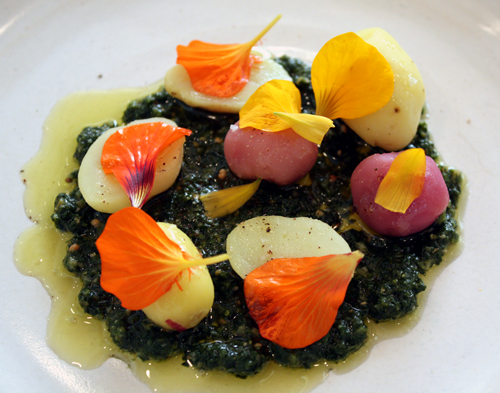
Patterson can’t get enough of potatoes like this, though. He loves their creamy, almost sweet flavor. He steams them, then serves them with salsa verde and edible blooms, or just a little drizzle of olive oil and sea salt.

Patterson's new potatoes with salsa verde and edible flowers.

“Maintaining diversity is very important,” Lindquist says. “These products have unique flavors. And heirlooms give us an experience we just don’t get elsewhere.”

Find out more about heirloom seeds at Seed Savers Exchange, a non-profit dedicated to saving and sharing them.

Chefs Charles Phan (left), Thomas Keller (center), and Douglas Keane (right).

Big-name chefs were also on the marquee at another session of SF Chefs Food Wine on Sunday. Indeed, they don’t come much bigger than Thomas Keller of the French Laundry in Yountville, Douglas Keane of Cyrus in Healdsburg, and Charles Phan of the Slanted Door in San Francisco.

Read more

« Older Entries Recent Entries »