A Visit to the 26th Annual Chefs’ Holidays in Yosemite

Yosemite in winter.

YOSEMITE NATIONAL PARK, CA — Imagine hiking, snowshoeing and skiing, then dining on creative fare from celeb chefs — all in a breathtakingly spectacular setting.

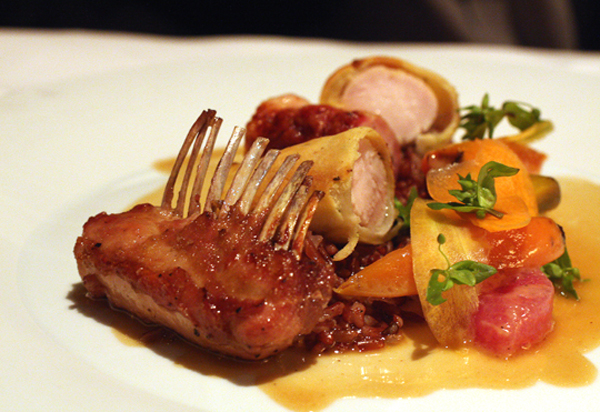
That’s what Yosemite National Park is all about in the winter, when its “Chefs’ Holidays” takes place at the historic Ahwahnee Hotel, now through Feb. 4. Marking its 26th year, the event features 29 prominent chefs from around the country.

Three chefs are featured per session, which includes a “Meet the Chefs” reception, three cooking demonstrations, a five-course gala dinner with wines in the grand Ahwahnee dining room, and a tour of the hotel’s massive kitchen.

And what a hotel it is. Opened in 1927 with a concrete and steel frame designed to withstand fire, it cost $1.25 million to build or the equivalent of $19 million in today’s dollars. During a year of construction, costs grew and the project had to be scaled back. The building went from a planned 10 stories to seven. Although the kitchen had already been built, the dining room was reduced to a third of its original size to about 300 seats, as opposed to the original 1,000. As a result, the kitchen is actually 200 square feet larger than the main dining room.

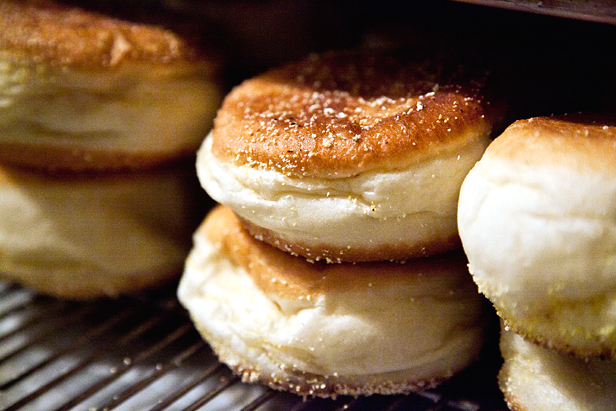
All bread is made in-house. The starter for the sourdough dates back to the 1890s.

A large copper mixing bowl, original to the hotel kitchen.

An original ice box, used before modern-day refrigeration. In the summer, huge blocks of ice had to be sent via railroad from San Francisco.

Yours truly was lucky enough to be invited as a guest to the second of the eight sessions planned. This one, held during the second week of January, featured chefs Michael Tusk of Quince in San Francisco; Jesse Cool of Flea St. Cafe in Menlo Park; and Colin Ambrose of Estia’s Little Kitchen in Sag Harbor, NY.

Read more


Minute Marmalade

Jam from the microwave.

Want to make jam when you’re, um, in a jam for time?

This no-fuss, no-mess, no-time-at-all recipe allows you to do just that — with help from your microwave.

My good friend and fellow Bay Area food writer Beth Hensperger has just come out with her latest cookbook, “Not Your Mother’s Microwave Cookbook” (Harvard Common Press) that will have you looking at this common appliance in a whole new way.

Let’s face it — most of us use our microwave oven primarily for reheating leftovers. But it can do so much more, as evidenced by Hensperger’s book. Roast peanuts? Yup. Toast coconut? For sure. Dry fresh pasta? You bet. Dry fresh herbs? But, of course.

You’ll even find a microwave version of my Dad’s “Foil-Wrapped Chicken” in the book, of which I just received a review copy. Only, this version is safe for the microwave because it uses parchment paper instead.

All it takes is two Meyer lemons, one orange, some sugar and some corn syrup.

Her microwave “Orange Marmalade” takes just minutes to make. You can even turn it into “Meyer Lemon-Orange Marmalade” as I did, and add fresh chopped thyme for a twist. This easy recipe is a boon to those who have citrus trees in their yards and are trying to find new ways to use that bounty at this time of year.

Read more

Food Gal Giveaway — For Anyone Who’s Ever Been Mystified In Asian Markets

A handy app for anyone who shops at an Asian market.

Yes, that includes me.

I can tell you horror stories about circling the aisles at my local Asian market until I was dizzy to try to locate shaoxing wine, which is never stocked where you’d think it would be. Or the time I actually sweet-talked a fellow Chinese-American customer into helping me find just the right preserved fish from the countless jarred and bagged varieties available in the store.

Now, help is only an iPhone or iPad touch away with “Asian Ingredients 101” by my friend and fellow Bay Area blogger, Pat Tanumihardja.

All about oyster sauce.The handy-dandy app is a comprehensive guide to East Asian, Southeast Asian and South Asian ingredients that is sure to come in handy whenever you shop at an Asian market or travel to Asia.

Find info on 100 different ingredients, including spices, herbs and sauces. Along with photos, you’ll find the common names for the ingredients in different languages, as well as where to find the ingredients in the stores. You’ll also learn tips for selecting the best ingredients and what to use them for.

Contest: Now, one lucky Food Gal reader will get a chance to win the app, as well as a copy of Tanumihardja’s  “The Asian Grandmothers Cookbook” (Sasquatch), filled with wonderful stories and recipes passed down from generations.

The contest is open only to those in the continental United States. Deadline to enter is midnight PST Jan. 22. The winner will be announced Jan. 24.

How to win? Just tell me the Asian ingredient you can’t live without and the one you’d be happy to never see again, and why. The most memorable response wins.

Here’s my own answer:

Read more

No Dill-y-Dallying to This Dish

Turmeric adds color, while dill or curry leaves add the pow.

Dill is like cilantro’s twin brother — either people hate the poor guy or adore him. There’s no in-between.

The feathery-leafed herb with the assertive flavor is all too often forgotten, too. Unless we’re making gravlax or pickling veggies, it’s not often an herb we have on hand.

That’s a shame because dill’s distinctiveness can lend a dish real punch.

See for yourself by making “Malaysian-Style Stir-Fried Turmeric Shrimp.”

The recipe is from “Stir-Frying to the Sky’s Edge” (Simon & Schuster) by Chinese cooking authority, Grace Young.

The dish was created by Mei Chau, a former restaurateur in New York, who was born in Malaysia and is of Hakka descent.

Read more

« Older Entries Recent Entries »