Inside the Cafe at Facebook Headquarters

Employees of Facebook eat THIS for lunch.

Black mission figs with Serrano ham. Tiny beef meatballs with pine nuts and sweet yellow peaches. Tender braised rabbit with moscatel, cinnamon, and fresh cherries. And rich chocolate roulade cake shot through with rum.

That was only a small portion of my incredible Spanish lunch last week at the Palo Alto headquarters of Facebook. After all, social networking — and creating the tools to do it — sure does work up a hefty appetite. No one knows that better than Josef Desimone, Facebook’s “culinary overlord.” And yes, that is his real title.

The energetic, fast-talking, 40-year-old chef invited me to come for lunch to see how his kitchen staff of 50 turns out 2,300 meals a day for more than 800 Facebook employees. Breakfast, lunch, dinner, and snacks are provided to this hungry crew — all of it for free. Make friends with someone at Facebook, and you, too, can partake of the scrumptious offerings that change daily, as employees are allowed to bring guests to dine.

Facebook's ''culinary overlord.''

The food, by this former chef of Cafe de la Presse in San Francisco, is so delicious and of such high-quality, it rivals that of restaurants where you’d have to pay a pretty penny to eat. Kathleen Loughlin, a Facebook communications person, jokes that the food is so irresistible that she’s had to frequent the gym more since Desimone came on board a year ago. Job applicants are always invited to come interview near lunch time, too, Loughlin says, because Facebook is well aware that its cafe is a monster recruiting tool.

If Google set the bar for gourmet cafeterias on Silicon Valley high-tech corporate campuses, then Facebook is aiming to push it even higher. Desimone has the cred to do it, too. Back in the day, he was the second sous chef hired at Google by the search engine giant’s famous original executive chef, Charlie Ayers. It was Desimone who designed the layout for the kitchens at Google in Mountain View, and who did the same for Facebook, when it moved into its S. California Avenue building three months ago after outgrowing its 10 buildings scattered around downtown Palo Alto.

“I’d do the Pepsi Challenge with them any day,” Desimone says about Google’s culinary program. “Google was good, but all the original chefs are gone now. And I got my pick of the litter. Eighty percent of my staff came from Google. We work our asses off here. But we have fun doing it.”

Indeed, they do.

One of Hawaii’s most well known chefs, Sam Choy, has cooked here. Charles Phan of the Slanted Door in San Francisco, is scheduled to drop by later this year to do the same. So is New Orleans legend, Paul Prudhomme. They don’t get paid to do so. They just want to do it, because they’re friends with Desimone.

A tapa of rustic bread drizzled with dark chocolate, olive oil, and sea salt.

Marinated Idiazabal cheese with rosemary.

Squash blossoms for Castilian-style zucchini with eggplant and tomatoes.

Meals are structured around cultural or global themes, which change not only daily, but between lunch and dinner. For instance, lunch might be a southern barbecue, while dinner might center around Cuban food. Desimone mixes it all up, never repeating the exact same menu again. He’s so organized that he can tell you what is on the menu for June of next year and which chef is in charge of it.

Employees can make requests. Someone once asked for an all-chocolate menu. Desimone complied with a “Willy Wonka Menu” of chocolate ravioli with pepper ricotta, lamb with a chocolate rub, and mole, of course. Then there was the tribute to “The Simpsons” TV show, which featured deep-fried pork chop in honor of Homer Simpson, and brown rice in an homage to his straight-laced daughter, Lisa.

“We’ll take on any challenge,” Desimone says. “If someone asks me to do their mom’s chicken and dumplings recipe, I’ll do it.”

Read more


Plain and Simple

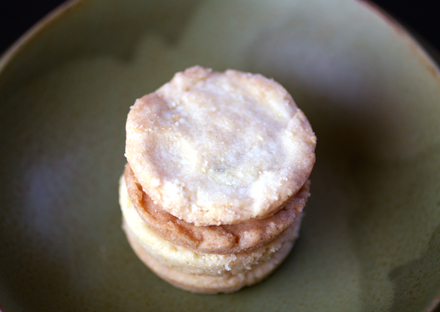
Meet a crispy sesame biscotti named Regina.

Regina is not a glamour puss.

She’s not decked out in the latest and greatest. She’s not trendy in the least. And her sweetness is subtle, almost mysteriously elusive.

Regina is a classic Sicilian cookie, timeless and always welcome at any occasion.

“Biscotti Regina” is from “The Modern Baker” (DK Publishing) by Nick Malgieri, former executive pastry chef of Windows on the World in New York.

It’s a biscotti that is not sliced and baked for a second time. Instead, the dough is rolled into a rope, then cut into cylinders, each of which is dipped into an egg wash, followed by a good dunking into a bowl of white sesame seeds until thoroughly coated.

The biscotti bake just once, and emerge crisp, with a whisper of vanilla and just the merest hint of sweetness. It’s a cookie that’s perfect at the end of a meal with coffee or a sweet dessert wine, or as an afternoon pick-me-up with a relaxing cup of tea.

Read more


Filet Mignon — Bison-Style

My new favorite filet mignon isn't made of beef.

As a kid frequenting Sizzler with my parents (yes, the Food Gal did haunt that establishment back in the day), my Dad would always order a filet mignon for me.

Because it was smaller than the other cuts on the menu, it was the perfect size for a smaller eater. It was always tender, too, a good choice for a kid who didn’t like chewing too much.

As I got older, and started cutting back on the amount of red meat I ate, filet mignon still popped up in my diet, but much less frequently. As my taste buds changed, I started enjoying it less, too, because it was always a little lacking in the flavor department, if you know what I mean.

Enter filet mignon made from bison. (Not to be confused with buffalo, which are a whole different species, even though the two terms are commonly used interchangeably.)

Before Northern Europeans settled North America, there were upwards of 70 million bison on the continent. But by 1889, after overzealous slaughtering, less than 1,000 bison remained. In 1905, the American Bison Society was formed to protect the animals from extinction. Today, thanks to efforts from ranchers, bison number more than 350,000.

Two such bison ranchers are Ken Klemm and Peter Thieriot, otherwise known as the Buffalo Guys (see what I mean about interchangeable terms?). Their herd of about 500 bison graze in northwest Kansas. They also contract with other ranchers in Kansas, Colorado, Wyoming, Nebraska, and Montana. Together, they sell ramge-raised, hormone-free, antibiotic-free bison meat in stores nationwide and on the Web.

Leaner than beef, buffalo meat even has fewer calories and less fat (including saturated) than skinless chicken breast. It also has more iron than beef, pork or chicken.

Read more

A Feather In Its Cap for the Plumed Horse

Caviar, ahi, quail egg, and a crispy arch of brioche.

The first time my husband and I dined at the Plumed Horse, shortly after its new owners unveiled its multi-million-dollar rennovation in 2007, our reactions were immediate: We were astonished to experience this level of high-dining in the sleepy village of Saratoga.

Don’t get me wrong. This town has long had a few quite lovely restaurants that stood out from the pack for their ambitious cuisine and service. They have true elegance, in an understated, quiet manner.

Contrast that to the supremely glamorous surroundings of the Plumed Horse, which could be beamed up and set down in Manhattan or San Francisco or Los Angeles, and fit in quite comfortably. The once rustic restaurant, originally opened in 1952, received the makeover of all makeovers two years ago. It also got a most skilled chef in Peter Armellino, a former chef de cuisine of Aqua in San Francisco.

The wine cellar is a stunner with floor-to-ceiling glass walls and shelves that hold 1,800 bottles. Even the floor is made of glass. Step onto it, and you’ll feel as if you’re floating in mid-air. Peer down to find two more stories of wine below.

From the soaring ceilings in the main dining room hang blown-glass, fiber-optic chandeliers that periodically change color from lime green to fuchsia. Three grand carts roll through the dining room, one holding champagnes, another cheeses, and the last, an assortment of aperitifs.

Like so many restaurants in this difficult year, the Plumed Horse saw a drop in business. But when we were invited in for dinner at the end of July, the dining room was buzzing on a Friday night. Our server happily reported that business had tripled in the past couple of weeks for some unexplained reason. He surmised that maybe people were just tired of scrimping and saving, and finally decided it was high-time to treat themselves a little.

The Plumed Horse is a fine choice to do that, too. Armellino’s food is the epitome of seasonal sophistication. The 41-year-old chef even grows his own herbs and citrus on the property, tucked away in flower boxes and a lower-level yard. There’s lemon grass, purple basil, Thai basil, tarragon, dill, thyme, and bay, as well as Meyer lemon, avocado, Mandarin orange, kaffir lime, and yuzu trees.

He gets tomatoes from a friend who dry farms them with little water so their flavors concentrate and become extremely intense. Figs come from a server’s tree. Another server grows a special type of Mandarin that looks like a kumquat, but with thinner skin. Armellino turns them into marmalade that he serves with foie gras.

“I’ve been a city boy for 20 years,” Armellino says. “To have the opportunity to grow things like this here, I just felt like it was my job to take advantage of it. How can you compare picking thyme out of the ground that’s been warmed in the sun to thyme grown in a hot house? There is no comparison.”

Kumamoto oyster with pressed caviar.

For dinner, order either a la carte or the chef’s tasting menu ($125 per person, with wine pairing an additional $70).

We opted for the latter, which began with an amuse of a Kumamoto oyster on the half shell with a blanket of pressed caviar.

Read more

The Mother of All Burgers

A burger so flavorful, you won't know what hit you.

Sure, there are fancier burgers. There are even more expensive burgers.

But Snake River Farms American Style Kobe Beef burger patties are pretty hard to beat.

And this is coming from a Food Gal who is not typically much of a Burger Gal, either.

The huge, 1/2-pound patties are made of American-style Kobe — Japanese Wagyu cows that have been crossed with American Black Angus ones. If you’ve ever experienced the over-the-top, fatty heaven known as Kobe beef, then you have an inkling of what these burgers are like.

If fat indeed equates flavor, these burgers are exploding with both. Take a deep breath and let me fill you in. Each of these patties alone has 750 calories — 610 of those from fat. Yowza! Indeed, each patty has more than 104 percent of a person’s daily recommended allotment of fat, and 126 percent of your daily value of saturated fat. Lordy, that’s a true case of too much information, if there ever was one.

It would be an understatement to say that you probably can’t eat these burgers too often — and still live to tell about it. But boy, what a treat at least once.

Read more

« Older Entries Recent Entries »