Category Archives: Chefs

Ensnared by Zare at Fly Trap in San Francisco
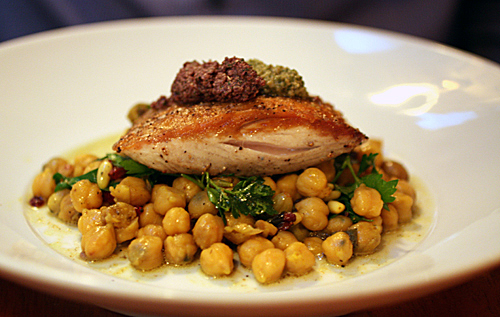
Mahi Mahi on a bed of wicked good chickpeas.

It’s not every day that a chef threatens to come kidnap you if you don’t make it to his restaurant soon.

But that’s just what Chef-Owner Hoss Zare of Zare at Fly Trap in San Francisco did to me.

In the nicest of ways, of course.

Fiercely proud of his South of Market establishment that he returned to cook at last year, after having been the chef there also in the early 1990s, Zare invited me to come taste his punchy Mediterranean cuisine.

Born in Iran of Turkish heritage, Zare is a self-trained chef with a big personality and playful sense of humor (both de facto requirements needed to kidnap a food writer, after all). Previously, he’s cooked at Restaurant Ecco in San Francisco, and Aromi in San Francisco. He also ran his own restaurants, Zare in the mid-1990s in San Francisco, Bistro Zare in the late-1990s in San Francisco, and Zare Napa in Wine Country, from 2005-2007.

Zare at Fly Trap is as colorful as the chef. Deep red walls, a pressed tin ceiling, and a profusion of old botanical prints hanging everywhere, lend a casual, artsy warmth.

The innovative cocktails ($10 each) are hard to resist. I sipped a “Minted Memory,” a highball filled with gin, Pimm’s No. 1, lemon, and Iranian minted vinegar syrup. It was tangy, citrusy, refreshing, and yes, quite memorable. My hubby opted for the “Absinthe Frappe,” made with Kubler Absinthe, Orgeat, and lemon. One sip was enough to wake the dead, but then if you’ve ever had absinthe, you know how powerful the anise-flavored liquor can be. Sip it slowly and bask in the powerful warmth it envelopes you in.
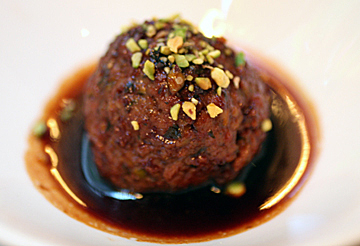
A signature pistachio meatball in a powerful pomegranate sauce.

Dinner started with pistachio meatballs ($12), so tender, and floating in a pool of  harissa-honey-pomegranate glaze. The flavor of the meatballs, themselves, got lost in the sauce. But if you love big, big flavors, you’ll enjoy the earthy, fruity, tart, syrupy sauce that is definitely a mouth-full.
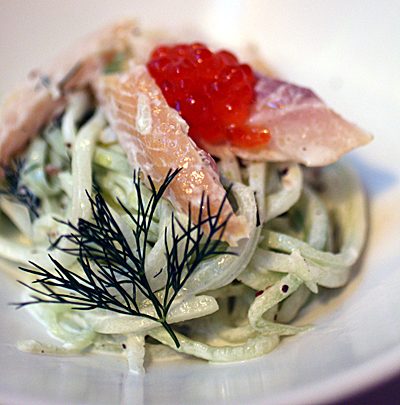
Smoked trout atop noodles made of cucumber.

Smoked trout ($11) gets a twist with a bed of “linguini” that are really thin, delicate strands of cucumber tossed with dill creme fraiche and topped with glistening orange trout roe. Truly, a lovely dish.
Read more

Take Five With Poleng Lounge Chef Tim Luym — Or “Mosquito” To Those In the Know

Chef Tim Luym in his shoebox-sized kitchen at Poleng Lounge.

For awhile, it looked like the inside of a tiny cubicle was where Tim Luym would make his mark.

After all, the 30-year-old Filipino-American had majored in marketing and programming at Santa Clara University, before going to work at nearby Applied Materials.

But seeing the movie,” Office Space,” the comedy satirizing workers who loathe their three-walled existences, changed all that. Luym saw his life flash before him. He realized it was not a life he wanted. So he decided to turn his back on that, and follow his heart — and stomach — by enrolling at San Francisco’s California Culinary Academy instead.

An externship landed him at Charles Nob Hill in San Francisco, where he cooked on the line with acclaimed Chef Melissa Perello. When she moved to the Fifth Floor in San Francisco, he followed her.

In 2006, Lyum and a group of investors — none of whom had ever operated a restaurant before — got together to open what was supposed to be a lively night club that merely served a little bit of food.

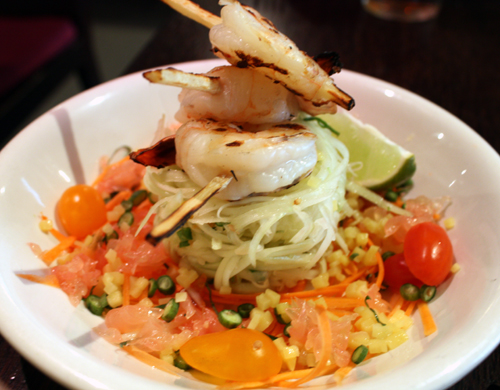
Papaya salad with sugarcane shrimp.

That place was Poleng Lounge, which nowadays has become known far and wide for Luym’s vibrant, daring take on modern Southeast Asian street food in dishes such as bone marrow with crispy coconut bread, and addicting crispy adobo wings.

Recently, I chatted with him about his quirky nickname, the enormous impact a three-star review from the San Francisco Chronicle can have on a fledgling restaurant, and how he’d like to reintroduce Chris Cosentino to a certain Filipino delicacy the Incanto chef once gagged on.

Q: So when Poleng Lounge opened, it was really envisioned to be a club, not necessarily a restaurant?

A: The whole concept was that it was a club. We had to serve food because of the liquor license. We were an Asian-themed bar, so it was only natural that we did Asian bar food. We opened with a menu of only seven items.

Some nights we only had seven people come in. I would go to the market every morning, and figure out how much to buy, based on how many people we thought might walk in. After awhile, we realized there was no way we could sustain ourselves at the pace we were going. We opened in May, and we realized in August that we were probably going to be closed by December. We would run out of cash flow.

Then, out of left field, we got three stars in the Chronicle. I was just the cook. I didn’t know about media and all that stuff. I didn’t grasp what it meant. When the review came out, a public relations agency told us, ‘You better get ready. You’re going to be busy!’

On a weekend, we were used to doing maybe 20 covers. That Sunday night after the review came out, we quadrupled in business. We had all kinds of people come in — young, old, and people who had traveled from all over the Bay Area. It was shocking, and a blessing. To this day, I don’t understand it. I know a lot of talented chefs and can’t figure out, ‘Why us?’

Q: When Poleng Lounge first opened, you weren’t even able to pay yourself a salary. So you ended up cooking on the side for the dental fraternity at the University of California at San Francisco to earn extra cash?

A: That was my income while opening the restaurant. It was a means to an end. About 20 people lived in the house. I did this for a year and a half. I’d do themed nights. When it was “Mediterranean Night,” I’d make couscous with lamb or beef, and Greek salad with feta. When it was “Italian Night,” I’d make Caesar salad, linguine vongole, and tiramisu. Some of them had never had this kind of food before. It was all stuff that I liked to eat.

Once the restaurant got busy, though, I had less time. I started having to repeat menus. The worst was when I did a Macy’s cooking challenge. I was so busy that I called a pizza place to deliver to the fraternity. But I must have given the wrong address, because the pizza never showed up. The next day, they were like, ‘Man, we have to talk!’ And I knew I couldn’t do it any longer.

Q: So, being Asian myself, I must ask you the infamous Asian parental question. Did your parents think you were crazy when, after graduating from an expensive, private university and landing a job in high-tech, you told them you wanted to become a cook instead?

Read more

Restaurant Doings & Foodie Happenings

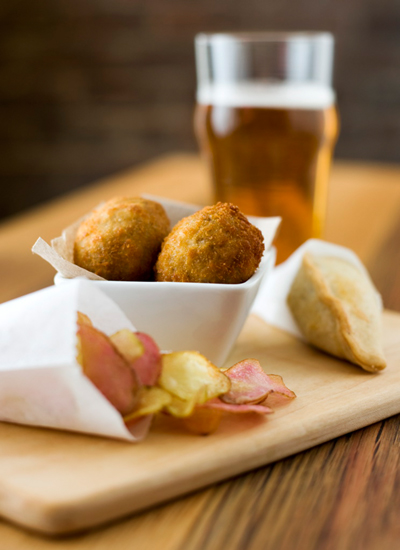
Scottish eggs, crisps, and pasty of the day at Martins West Pub. (Photo courtesy of Martins West Pub)

* A century-old Redwood City Alhambra building, once housing a saloon that apparently Wyatt Earp frequented, has been tranformed into Martins West Pub.

How’s that for apropos?

Executive Chef Michael Dotson, formerly of PlumpJack Cafe in Squaw Valley, turns out honest-to-goodness British gastropub eats, including herb-crusted marrow bones with kumquat and celery salad ($8), fish & chips with peat-smoked fries ($12), and brioche-crusted black cod ($22).

Pastry Chef Kelly Fields, formerly of Restaurant August in New Orleans, offers playful desserts such as Devonshire cream tartlet with strawberries, elderflower and long pepper; and chocolate “rillettes” with Scottish heather ice cream, peanuts, and sugared brioche.

Devonshire cream tart with strawberries. (Photo courtesy of Martins West Pub)

* If you haven’t noticed already, Tanglewood in San Jose’s Santana Row has closed its doors. Left Bank Brasseries, which operated Tanglewood, is expected to open LB Steak in its place in June. It will be Santana Row’s first steakhouse.

Blame the economy, as well as construction on a new mixed-use building right next door, which made crowds stay away, says company CEO Richard Miyashiro.

“Tanglewood started out as a high-end restaurant and could not survive without a transformation,” he says.

When LB Steak opens, look for signature dishes such as braised pork belly with five spices and Coca Cola glaze; and a 20-ounce Porterhouse.

* For 11 days beginning June 3, enjoy the City Bites” promotion in downtown San Jose. Twenty-six downtown restaurants will feature three-course dinners for $20, $30, or $40.

The event kicks off June 3 when participating restaurants will offer sample bites for free or for a charge of $3.

Among the participating restaurants are 19 Market, A.P. Stump’s, and Paolo’s restaurant.

* Similarly, San Francisco kicks off its eighth annual “Dine About Town” promotion, June 1-15.

Participating restaurants will offer three courses at lunch for $21.95 and at dinner for $34.95. Participating restaurants include Absinthe Brasserie & Bar, B44, Luce, and Poleng Lounge.

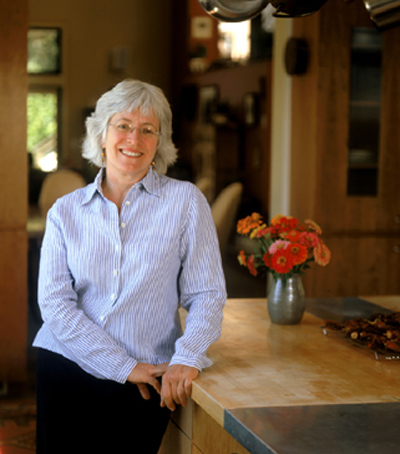
Napa Valley Chef Cindy Pawlcyn (Photo courtesy of Steven Rothfeld)

* May 30 from 2 p.m. to 5 p.m., sip fine varietals at the fifth annual “Ultimate Blind Date” wine tasting event at Flora Springs Winery in St. Helena.

More than 60 of St. Helena’s best wineries will be pouring their finest. For those who want to put their palates on the line, there will be a fun blind-tasting challenge in which you can win a cellar-full of St. Helena wines (valued at more than $2,000). All the participating wineries will pour one wine blind. If you venture any kind of guess at all about the wine, you’ll be entered into a drawing to win the prize.

Napa Valley restaurateur Cindy Pawlcyn, who owns Go Fish, Mustards, and Cindy’s Backstreet Kitchen, will offer up food to nosh along with the wines.

She’ll also sign copies of her new cookbook, “Cindy Pawlcyn’s Appetizers” (Ten Speed Press), which will be available for a 50 percent discount at the event.

Tickets are $60. For more information, call (707) 963-6045. A portion of proceeds will be donated to St. Helena’s Work Connection, a non-profit providing assistance and work placement to vineyard and migrant workers.

* It’s cherry time and there’s no better time to celebrate the joys of everyone’s favorite pitted fruit than 9:30 a.m. to 5 p.m., May 30-31 at C.J. Olson’s fruit stand in Sunnyvale.

Read more

Michael Mina’s Swanky New San Francisco Bar/Restaurant

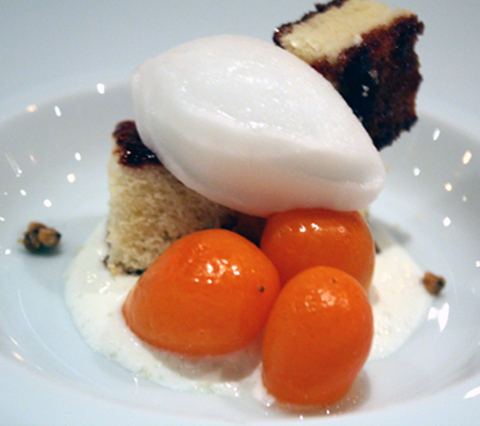
Kumquat confiture.

Times may be tough, but don’t tell that to Chef-Restaurateur Michael Mina.

Barely open a month, his new RN74 wine bar/restaurant in the new Millennium Tower in San Francisco is packing in the crowds.

On a recent Tuesday night, when I was invited to check out the scene for myself, a lively after-work crowd was enjoying wine and food at the bar. You know a place has got a vibe going when celeb Chef Todd English even drops by that evening to hang out at the bar with an attractive, dark-haired woman.

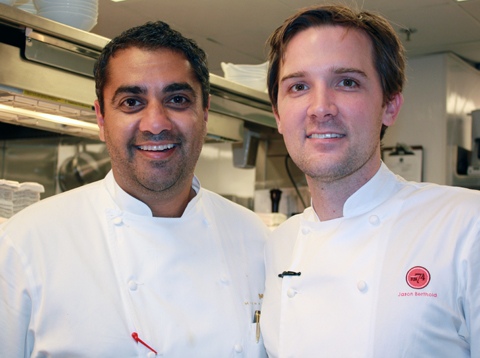
Chefs Michael Mina and Jason Berthold.

Transportation is a big theme in this new $4.5 million restaurant. First, the restaurant is on the ground floor of a new condominium tower right next to the old Transbay Terminal. Second, the restaurant is named after the highway that runs through Burgundy’s Cote d’Or. Lastly, the interior evokes an old train station reinvented in a hipper, more modern way.

Wine Director Rajat Parr has longed dreamed of opening a wine bar, one that would capture the feeling of magical discovery he encountered the first time traveling through Burgundy. Antique metal lanterns hang from the ceiling near the entrance. Bathrooms have piped in French conversations.

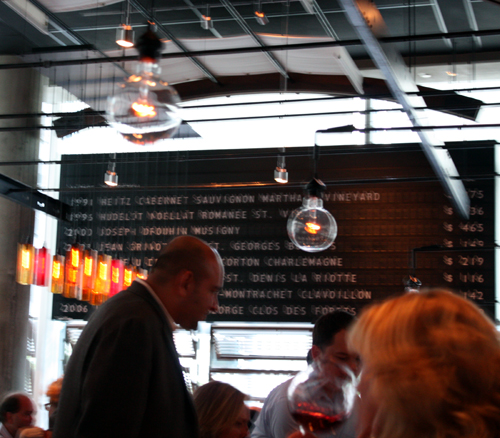
Wine Director Rajat Parr stands before the custom-made wine flip-board.

The centerpiece is a custom-made flip board like the ones you see at train stations that tell the arrival/departure times. Only this one lists wines where only one bottle remains in stock at the restaurant. If someone buys it, the board flips to erase the wine selection. How cool is that?

Executive Chef Jason Berthold is a perfect match for Parr. Berthold, who was sous chef at the French Laundry in Yountville and helped open Per Se in New York, also makes his own wine under the Courier label. Parr, who attended the Culinary Institute of America at Hyde Park, makes wine under his Parr Selection label.

Clean, pure flavors with sometimes unexpected ingredient combinations characterize Berthold’s culinary style.

Read more

Sustainable Is…

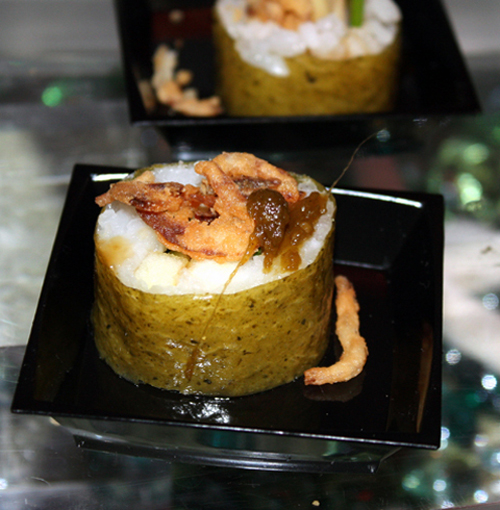
Tracy Griffith's sustainable sushi.

At last week’s eighth annual “Cooking for Solutions” event at the Monterey Bay Aquarium, chefs, winemakers, scientists, purveyers, fishermen, farmers, and food writers came together to learn and discuss  how to better follow a more sustainable path — one that lessens the impact on earth and oceans.

What is sustainable? It comes in all guises. Come see for yourself.

Sustainable is…

Tracy Griffith, sushi chef and sister of actress Melanie, whose seared albacore roll (see photo above) served at the gala showcased a sustainable fish that’s one of the top choices on the aquarium’s “Seafood Watch Guide” and “Sushi Guide.”

Earthbound Farms' organic fro-yo served at its farmstand.

…Carmel Valley’s Earthbound Farm, the pioneer in pre-washed salad greens. With 40,000 acres in California, Arizona, and Mexico, it  now is the largest organic farm in the world. Its farm stand on Carmel Valley Road is open year-round. It just started selling its own organic fro-yo, too.  Slightly tart and lighter in body than Pinkberry, the creamy treat comes in natural honey and a fruit flavor (You can get the two swirled together, too). The day I was there the featured flavor was raspberry.

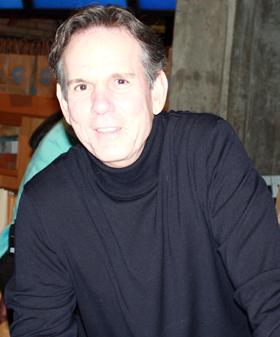
Chef Thomas Keller.

…Thomas Keller. The acclaimed chef of the French Laundry in Yountville was honored as “Chef of the Year” by the aquarium for his work in promoting fresh, local, and sustainable ingredients through his spectacular four-star cooking.

Keller graciously signed copies of his cookbooks during the event, as fiancee Laura Cunningham, former director of operations for his restaurants, looked on. She wasn’t wearing her Keller-designed engagement ring that night, only because it was being re-sized. Still no word yet on whether the nuptials will take place this year or next.

The jovial Alton Brown.

…the Food Network’s Alton Brown, who was honored as “Educator of the Year” by the aquarium. Brown and his wife plan to set up a foundation to foster sustainable food projects. He’s also received the nod from the Food Network to do several “Good Eats” shows highlighting sustainable seafood.

Tataki Sushi & Sake Bar in San Francisco, the first sustainable sushi bar in North America. Diners are heartily embracing the concept, so much so that the tiny sushi bar now sometimes has a wait of two hours on weekdays.

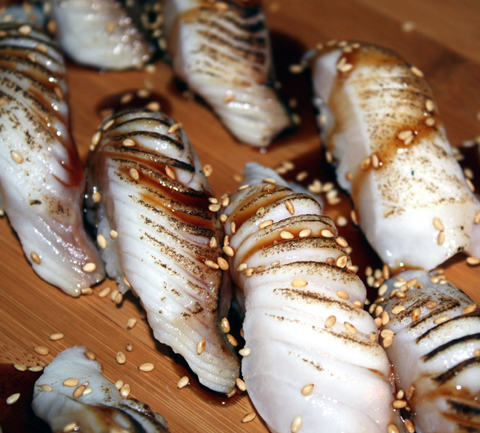
At the “Cooking for Solutions” gala, Tataki’s sushi chefs handed out “faux-nagi” — scored wild sablefish brushed with the traditional sweet soy-rice wine sauce that has the same silky mouth-feel as overfished unagi (eel).

It tastes like unagi, but this is sustainable.

Greenfish Catering, a five-year-old San Jose company that specializes in sustainable sushi platters, bento boxes, and catered events that feature good-for-you and good-for-the-environment ingredients such as farm-raised oysters.

Read more

« Older Entries Recent Entries »