Still Worth the Ride Up to the Fifth Floor

Like jewels on a plate, oysters served five ways at the Fifth Floor.

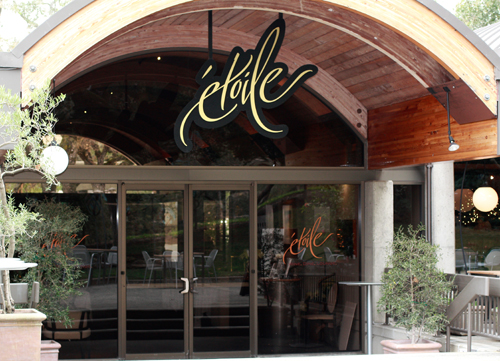
In a decade, the always chic Fifth Floor restaurant in the Hotel Palomar in downtown San Francisco has had an impressive roster of top-tier chefs rotate through.

George Morrone, Laurent Gras, Laurent Manrique, Melissa Perello, Jennie Lorenzo and now, David Bazirgan, who also claims the 2011 mantle of “hottest chef in America” by Eater.

Each has put their own stamp on this sumptuous dining room with its soft, white leather chairs; floor-to-ceiling, glass-fronted wine cellar; and terrace herb garden that can be viewed from tables by the windows.

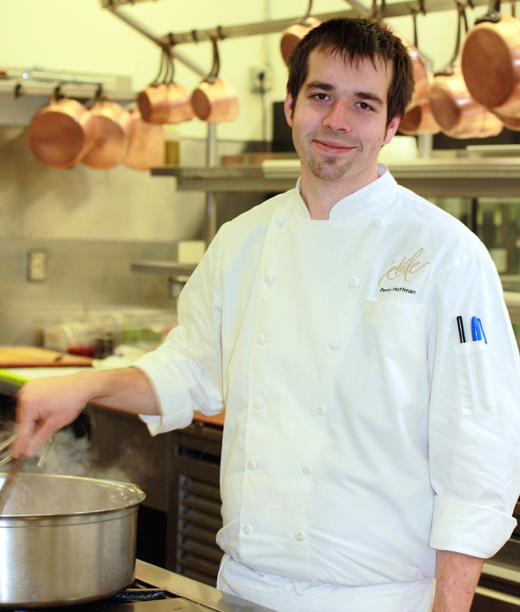
Now comes Massachusetts-native, Bazirgan, who took over this year, following his stint as executive chef at Chez Papa Resto in San Francisco, and five years as chef de cuisine at No. 9 Park in Boston.

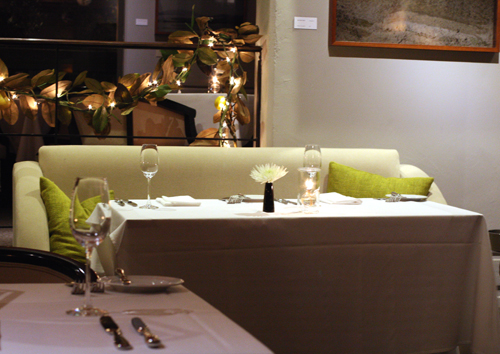
The dining room, where you always feel glam.

The table setting.

Recently, I had a chance to experience his cooking, when I was invited to be a guest of the restaurant.

The food remains as elegant to look at as always, and perhaps more accessible in some ways and a bit less precious.

Unlike so many other restaurants, if you order the chef’s tasting menu here, the entire table doesn’t have to commit to that option. Instead, I went with the $85 tasting menu with the accompanying $50 wine pairing, while my husband ordered a la carte.

Scallop ceviche amuse bouche.

An amuse in a Chinese soup spoon arrived first, holding a bracing bite of scallop ceviche with a hit of espelette pepper.

Read more


Take Five with Chef Grant Achatz, on His New Memoir Chronicling His Brave Battle Against Tongue Cancer

Grant Achatz's new book. (Photo courtesy of Penguin)

Next is the prophetic name of the new restaurant expected to open this spring in Chicago by acclaimed chef, Grant Achatz, of the James Beard Award-winning, Michelin three-starred Alinea.

Like his first Chicago ground-breaking sanctum to molecular gastronomy, Next also will challenge and provoke the definition of what a restaurant is by completely reinventing itself every three months with period-themed menus and decor, along with an audacious non-refundable ticketing system as the only option to snag a table there.

It’s bold. It’s daring. And it’s a miracle that it’s even possible.

After all, if you know Achatz’s story, you already realize that the odds were stacked against him far higher than the city’s iconic Sears Tower when he was diagnosed with tongue cancer four years ago at age 32. By the time it was caught, his squamous cell carcinoma was at stage 4. There is no stage 5.

Doctors told this chef and father of two young sons that he would die a painful death in mere months if he didn’t undergo radical surgery to remove his tongue and part of his jaw, which would leave him disfigured, unable to talk and without the ability to taste. Despite conventional thinking, Achatz decided to gamble on an alternative, experimental and brutal treatment of intensive, targeted chemotherapy and radiation that ended up saving his life.

His stunning story is recounted in his new memoir, “Life, on the Line: A Chef’s Story of Chasing Greatness, Facing Death, and Redefining the Way We Eat” (Penguin), which debuts March 3.

You can meet Achatz on March 17 in San Francisco, when he and his business partner and co-writer, Nick Kokonas will be signing copies of the book at 12:30 p.m. at Book Passage in the Ferry Building. Later that day, 5 p.m. to 6 p.m., they will also sign books at Omnivore in San Francisco. The talk they will hold afterward at Omnivore sold out days after it was announced.

Last week, I had a chance to talk by phone with Achatz on what it was like to reveal so much about himself in this book; his relationship with rival Chicago chef, Charlie Trotter; and his feelings on who might portray him in the feature film-version of his memoir, which may be directed, surprisingly, by David Dobkin of “Wedding Crashers” fame.

Q: Has your sense of taste returned fully now?

A: I believe so. Taste is a funny thing, though. If you go to an ophthalmologist, they can tell if your eyes aren’t working correctly. They can give you a prescription for glasses or contacts. Same with hearing. But taste is something you can’t measure.

To me, at least in my memory, my tasting ability is the same as it was pre-cancer. I would even argue that certain aspects resulting from the treatment helped me to taste better now. It doesn’t have to do with the physiology of it. It’s the mental thing. It’s learning what taste is and how it’s composed.

My ability to taste came back in pieces. I was down to under 130 pounds and I never used to drink coffee with sugar in it. But I did then to get calories. I’d put three giant tablespoons of sugar in my coffee. One day, I took a sip and I could actually taste the sugar. Up to that point, I couldn’t taste sweet at all. Then, three months later, I’d drink my coffee and say, ‘Damn, this coffee tastes bitter.’ And so, I could taste bitterness again. Having tastes come back in stages like that really teaches you about how they all relate to one another as they come together on the palate and function in relation to one another. It was a very informative process. I wouldn’t recommend it, though. (laughs) But it works for me.

Alinea's hazelnut yogurt, curry saffron, freeze-dried corn in edible tube. (Photo courtesy of Penguin)

Q: How did your fight against cancer change you as a person and as a chef? Do you look at life differently now?

A: It does make you look at life differently. You have to make fundamental decisions. Different people handle things differently. Some people might say, ‘I need to reprioritize my life, spend more time with loved ones, and work less.’ When you face mortality, you undergo a self-evaluation of your life. I’m pretty happy with my life. I didn’t feel like I had to change anything. How lucky am I to get to go to work for 14-16 hours a day to do something I love? I probably do focus more now on my two young boys. And I make a more time now for relatives, and for my girlfriend. But on a whole, I really didn’t change anything.

I don’t think it made me more driven. My trajectory pre-cancer was such that I think I would be exactly what I am now even if the cancer had never happened.

Q: Did you ever think, ‘Why me?’

A: I had maybe a couple moments of that. But it was not a consistent feeling.

In the book, I reveal how I was sitting on the couch with my mother and she started to cry and I started to cry. She asked me what was wrong. And I thought, ‘What’s wrong??!’ I guess you could call it self-pity. I guess it was then that I thought it was unfair, that I was too young for all of this, that this was supposed to happen to old people. There was a sense of helplessness. That was my low point. I did nothing to deserve this. I wasn’t a chain-smoker; I wasn’t an alcoholic. So, I did ask myself, ‘Why me?’ It was probably only twice. That time with my mother and then when I was sitting with Heather (Sperling, his girlfriend who is the editor of the Tasting Table Chicago e-newsletter) after the diagnosis. I felt bad for her and for my boys.

Q: In the book, you state that your experience in working at the French Laundry in Yountville as a young cook essentially helped save your life. Can you expound on that?

Read more


Food Gal Ticket Giveaway and Foodie Happenings

(Image courtesy of Paso Robles Wine Country)

Win tickets to the Los Angeles Grand Tasting Tour

Taste wines from more than 40 Paso Robles wineries and nosh on gourmet bites at the glam 2011 Los Angeles Grand Tasting Tour, 6:30 p.m. to 8:30 p.m. March 2 at the Virbiana.

Tickets are $60 each. A portion of the proceeds will benefit the Alzheimer’s Association of Southern California.

Because the Food Gal has so many loyal readers who live in or travel regularly to the Los Angeles area, I’m happy to announce that I’ll be giving away three pairs of tickets to the event.

Contest: Entries should be limited to those who will be in Los Angeles on the day of the event, March 2. Contest runs through midnight PST Feb. 26. Winners will be announced Feb. 28.

How to win?

Tell me one of your favorite eats in Los Angeles and why I should try it the next time I’m there.

Here’s my own answer to that question:

“Do you love Chinese dumplings? And specifically, do you love xiao long bao, otherwise known as “soup dumplings”? Then, make a beeline pronto for Din Tai Fung in Arcadia for the very best dumplings you will ever have. I have Pulitzer Prize-winning, Los Angeles food writer Jonathan Gold to thank for telling me about this place. Here, the wrappers are the thinnest ever and so fragile you have to be careful picking them up with your chopsticks, lest you puncture them accidentally. They are tender, juicy, brothy and plain amazing. How good are they? So good that my husband and I ate there twice in three days last year. Until recently, its two Arcadia branches were the only ones outside of Asia. But Pacific Northwest foodies are sure to be rejoicing now that one just opened in Seattle.”

Winner of the Last Contest: In the most recent Food Gal contest, I asked you to tell me your favorite thing to eat back in school. The top three answers will win an annual membership to Blackboard Eats.

Congrats to the winners:

1) Single Guy Ben, who wrote: “I felt like we had the best school lunches growing up in Honolulu. Every day was a different entree always served with a carton of milk, a side salad (which I always ate) and dessert. And I don’t want to date myself but we got all this for a quarter! (Yeah, back when we actually did walk a mile to get to school.)

One of my favorites is the good ole’ Sloppy Joe. It’s ironic that it’s my favorite because growing up (and still today as an adult) I’m a bit of a neat freak. I used to eat my lunch in sections, eating the salad, then the entree, then dessert. Never mixing bites here and there. So sloppy isn’t really in my vocabulary. But something about the Sloppy Joe, whether it’s the flavor or the fact that the sauce soaked into the bun and made everything soft and juicy, just brings a smile to my face. An oddly enough, the Sloppy Joe’s weren’t necessarily super slopppy. Sure, a few clumps of ground beef would fall out as I slowly ate the bun in a systemized concentric pattern, but it still held together.

It’s funny how a lot of school lunch favorites aren’t a part of our regular diet when we grow up. It may be my adversity to eating too much red meat, so I haven’t had a Sloppy Joe in many many years. Or maybe it’s because I don’t use those ready-mix packets any more so don’t have the perfect recipe for Sloppy Joe’s made from scratch. But when I look back, I think now that a perfect, juicy, Sloppy Joe may be just the item I’d like as my last meal on Earth.”

2) Sadie, who wrote, “We had different exchange students every year when I was growing up. Nothing was more wonderful than discovering that a stroopwafel from Barbara or a pulparindo (tamarind candy) from Claudia had snuck into my otherwise very Wisconsin-Midwestern lunchbox.”

3) Jennie Schact, who wrote: “We carried lunch to school. Mom would sandwich thick slabs of roasted turkey between slices of challah slathered with Russian dressing (which is to say, mayo and ketchup stirred together), wrap ‘em up, stack ‘em in the freezer, and throw one into the lunch bag in the morning. You were lucky if it was defrosted enough to eat around the edges at lunch time. Frozen turkey = not pleasant. She was also the innovator of leftover cold hamburger on a bagel. I preferred Ring Dings from the vending machine.”

Dungeness crab salad at One Market Restaurant. (Photo courtesy of the restaurant)

Fabulous Restaurant Events

There’s still time to indulge in the annual Lark Creek Restaurant Group’s “Crab Festival.”

Through the end of the month, you’ll find special dishes at each restaurant that spotlight fresh, sustainable Dungeness crab.

Look for such lip-smacking fare as crab salad with grapefruit at One Market Restaurant in San Francisco; Dungeness crab raviolis with chanterelles and brown butter at Yankee Pier at Santana Row in San Jose; and chili roasted Dungeness crab with garlic and smoked paprika at Fish Story in Napa.

There’s also still time to try the the special prix fixe Black History Month menu with wine pairings from African-American wineries at 1300 on Fillmore in San Francisco.

Read more

Terrific Tuna

A silky lemony sauce coats every strand of these heavenly noodles.

Canned tuna doesn’t normally elicit a whole lot of excitement. Mostly, you grab it mindlessly out of the cupboard because it’s convenient for making a quick salad, sandwich or casserole that you’ve made a hundred times before.

But imagine a canned tuna that actually makes you sit up and take notice not only because it has really deep seafood flavor, but also because it is low in mercury and is caught in a sustainable way.

That’s what Raincoast Trading canned tuna is all about.

Indeed, Greenpeace Canada just released its first sustainability ranking of 14 major canned tuna brands. Only two garnered a passing grade: Wild Planet Foods and Raincoast Trading.

A canned tuna to feel good about eating.

The Vancouver, Canada company is run by a fourth-generation fishing family that catches wild-caught tuna and salmon in the Pacific Northwest. Each batch of tuna is tested for mercury, a heavy metal present in almost all seafood that can be harmful in large doses for pregnant women, nursing mothers and young children. The amount of mercury in Raincoast Trading’s tuna registers well below the allowable levels in the United States and Canada, according to a company spokesperson.

Read more

A Visit to Ike’s on the Stanford University Campus

The "Spiffy Tiffy'' on French bread at Ike's Place in Palo Alto.

I dunno about you, but when I was in college, I felt lucky to snag a plain green salad or limp slice of pizza for lunch on campus.

How times have changed.

At Stanford University in Palo Alto, students and faculty can indulge in a branch of Ike’s Place — yes, the famous San Francisco sandwich shop that’s been vilified and venerated of late.

Why such buzz over a sandwich shop?

You see, Owner Ike Shehadeh’s monster-size sandwiches smeared generously with his addicting Secret Dirty Sauce (a creamy concoction loaded with garlic) grew so popular that never-ending lines formed day and night on the sidewalk at his original location in San Francisco’s Castro district — much to the dismay of residents. Customers rallied for their sammies. Neighbors fought for peace and quiet. In the end, Shehadeh was forced to move to a new location in San Francisco — right around the corner from the original one.

But all is good in the world of Ike. He’s become a darling of Yelp and was even featured on the Travel Channel. He also just opened a branch in Redwood Shores, and plans to open soon in Santa Rosa and in San Jose, near San Jose State University.

The new engineering building that houses Ike's Place.

Place your order here.

Since it opened last year in the new, light-filled Jen-Hsuan Huang School of Engineering, Ike’s Place hasn’t drawn any similar trials and tribulations in Palo Alto, just long lines of hungry students and faculty, including star Cardinal quarterback Andrew Luck, whose hand I got to shake last Friday afternoon when he was picking up a sandwich and I was there eating with two friends.

Read more

« Older Entries Recent Entries »