Category Archives: Health/Nutrition

Fruit and Veggie Delivery Made Easy
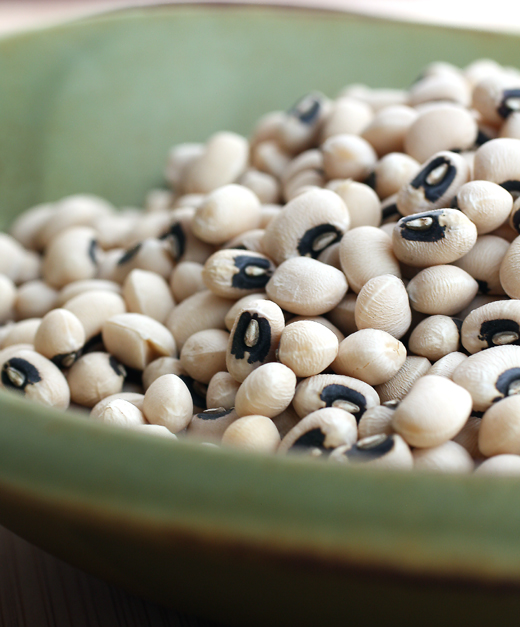
Organic dried black eyed peas for the new year.

That’s just what San Francisco’s The FruitGuys does.

The 12-year-old company delivers boxes of fresh fruit and vegetables — grown by small family farms — to offices and homes nationwide. Think of it as a convenient way to bring a taste of the farmers market right to your door.

Three years ago as a way to give back, the 12-year-old company also launched its Farm Stewart Program to support sustainable family farming. The company donates 88,000 pounds of fresh fruit annually to non-profit groups and regional food pantries.

Its gift boxes, which start at $39, make thoughtful presents for anyone who appreciates gourmet eats. The boxes can include items such as handpicked apples, pears, citrus, honey-roasted cashews, cinnamon pecans, regional honey and the Philo Apple Farm’s apple cider vinegar.
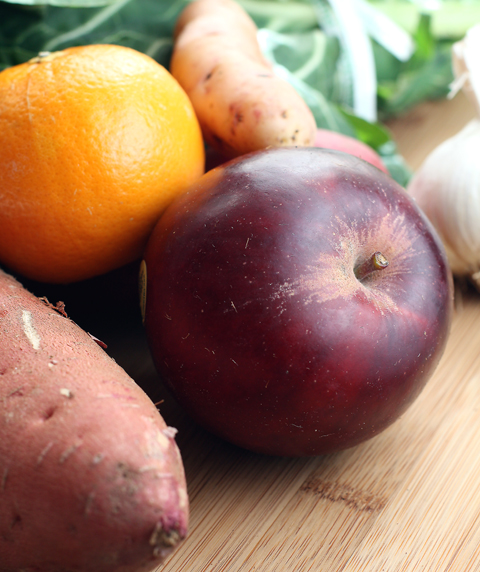
A sample of The FruitGuys' new TakeHome box.

Just before New Year’s, I had a chance to try a sample of The FruitGuys’ new TakeHome box, which starts at $24 and is filled with farm-fresh, regional organic produce. Choose from all fruit, all veggie or a mix of both.
Read more

A CSA That’s A Cut Above

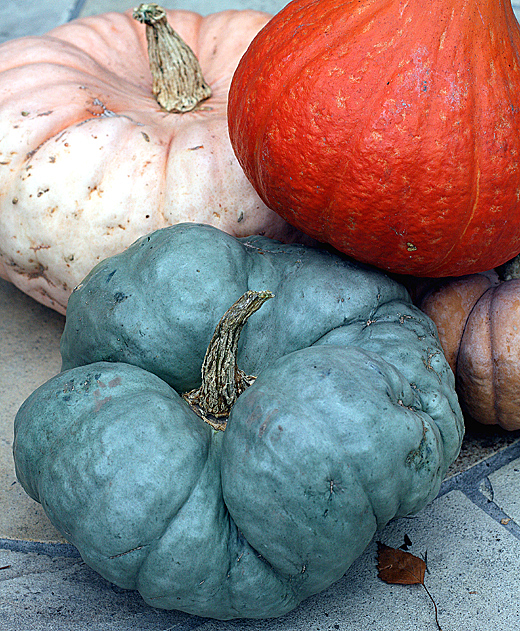
Baia Nicchia's unusual varieties of fall/winter squash.

If your New Year’s resolution includes eating more healthful, you just might want to make good on that by joining a CSA.

For a community supported agriculture program that’s a cut above the rest, look no further than Baia Nicchia’s. Fred Hempel, a geneticist turned farmer who owns the 9 1/2-acre Baia Nicchia Farm in Sunol, provides a weekly box of his fresh fruit, veggies and herbs to you. You pay $30 a week, but end up getting $35 or more worth of produce.

Recently, I had a chance to sample a couple of boxes and what a culinary treasure trove they were. Included was a brilliant rainbow of winter squash — from the deep orange-hued French Potimarron to the dusty peach-colored Kikuza (an heirloom Japanese variety) to the large pale creamsicle Terremoto to the haunting pale blue Australian Triamble that can be stored up to two years. Additionally, there was a bunch of my fave lacinato kale, as well as sweet Scotch Blue kale, peppery Dutch arugula, spigarello (a broccoli rabe relative), baby turnips, sprigs of pungent orange balsam thyme and fragrant yuzu.

Baia Nicchia supplies to top Bay Area restaurants (including Marché in Menlo Park), so Hempel will often include some fun, unusual items in his CSA boxes that he grows primarily for chefs, such as edible chrysanthemum and amazing finger limes. Because he operates a nursery, he sometimes includes seedlings as well, such as mustard greens that you can pot in your backyard and snip all winter long to enhance salads and stir-fry dishes.

Read more

Elegant Crackers and Dip for New Year’s Eve

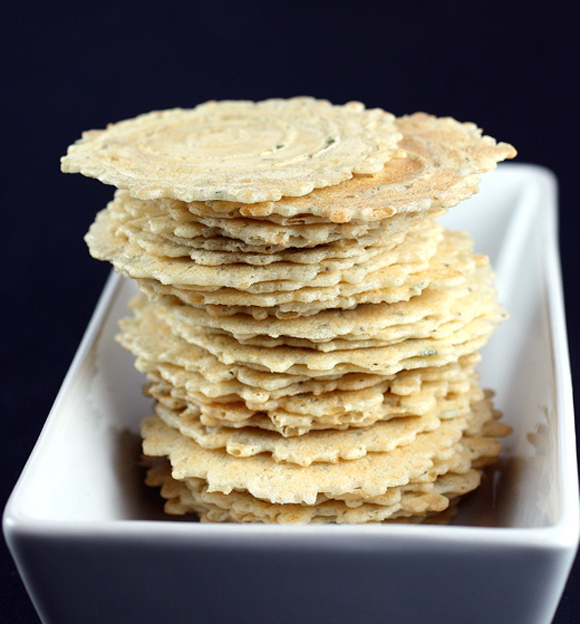
So thin and so crisp.

You could almost float away on these crackers as they’re so thin, light and delicate.

34° Crispbread is a wonder — round, fragile wafers that are made from whole wheat flour, salt and natural cheese flavor, then baked until shatteringly crisp. The name comes from the latitude of Sydney, Australia, where company founder Craig Lieberman hails from. The product is inspired by his favorite Australian crispbread.

Now made in Boulder, Colo., the crackers come in six varieties: Whole Grain, Natural, Sesame, Cracked Pepper, Rosemary, and Lemon Zest. They’re sold at Safeway, Whole Foods and Walmart. Nine crackers have a total of 35 calories. A 4.5-ounce box is about $4.99.

I had a chance to sample a couple of boxes recently. I especially liked the Cracked Pepper variety with is subtle hit of spice. The crackers crumble easily so handle them gently. But they can stand up to the likes of charcuterie, cheese and all manner of dips if you spread them on with a knife rather than dunking them.

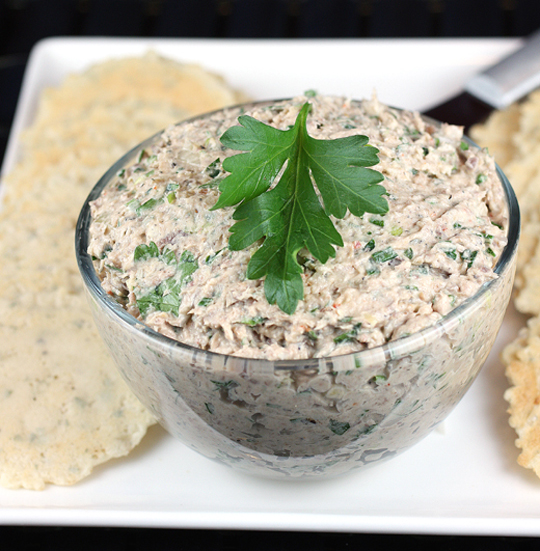
Sardine rillettes to whip up in 10 minutes.

I served them over the holidays to great acclaim with food writer and blogger superstar Dorie Greenspan’s “Sardine Rillettes.”

The recipe is from her new book, “Around My French Table” (Houghton Mifflin Harcourt).

Read more

Kodiak Cakes Take the Cake

To make these, just add water. Really.

When my husband hears the words, “whole grains,” he makes a face.

You might as well be uttering the words, “pickled eyeballs,” because he’ll make the same expression of disgust.

All too often, he fears “whole grains” means “too healthy to possibly taste any good.”

But Kodiak Cakes made a believer out of him.

The Salt Lake City, family-owned company recently sent me samples of its whole grain pancakes/waffles, cookies and brownie mixes to try.

Read more

One of the Most Fascinating Food Books Ever & Winner of the Gourmet Mushroom Kit

Cao Xiaoli, a professional acrobat, balances on one hand with her day's worth of food at Shanghai Circus World in Shanghai, China. (From the book What I Eat: Around the World in 80 Diets.) The caloric value of her day's worth of food on a typical day in June was 1700 kcals. She is 16 years of age; 5 feet, 2 inches tall; and 99 pounds. Cao Xiaoli lives in a room with nine other girls. She started her career as a child, performing with a regional troupe in her home province of Anhui. Now she practices five hours a day, attends school with the other members of her troupe, and performs seven days a week. She says what she likes best about being an acrobat is the crowd’s reaction when she does something seemingly dangerous. MODEL RELEASED.

Celeb chef cookbooks may dazzle on the coffee table and instructive cookbooks may be must-haves on the shelf.

But here’s a food book that is so captivating you’ll be hard-pressed to put it down.

“What I Eat” (Material World/Ten Speed Press) is a fascinating around-the-globe look at what 80 people eat over the course of one day.

The authors are Peter Menzel and Faith D’Aluisio, whose work you already might be familiar with, as they also were behind the James Beard Award-winning, “Hungry Planet” (Material World), which examined what families around the world eat over the span of one week.

In their newest book, the couple, who lives in Napa, spent three years chronicling the diets of these spotlighted individuals, who range the gamut from a sumo wrestler in Japan to an arctic hunter in Greenland to a model in the United States to an astronaut in space.

Each profile is accompanied by stunning photos, as well as every item each person consumed (from supplements to cigarettes), the total calorie count (from as little as 800 to as much as 12,300), and demographic information such as age, height, weight, occupation and activity level.

For instance, the 99-pound, 5-foot-2-inch Chinese acrobat (top photo) buys yogurt, European-style cakes and fruit for breakfast, then has a hefty lunch of deep-fried pork ribs, noodles, tea-cooked egg, stir-fried cucumber, rice and a salty vegetable broth with green onion in the Shanghai Circus World Employee Cafeteria. The 16-year-old doesn’t eat dinner because most days, she’s performing in a nightly show. Typically, she practices five hours a day and performs seven nights a week.  In all, she consumed 1,700 calories that particular day.

Read more

« Older Entries Recent Entries »