Category Archives: Seafood

Cupertino’s Alexander’s Steakhouse Opens A San Francisco Outpost

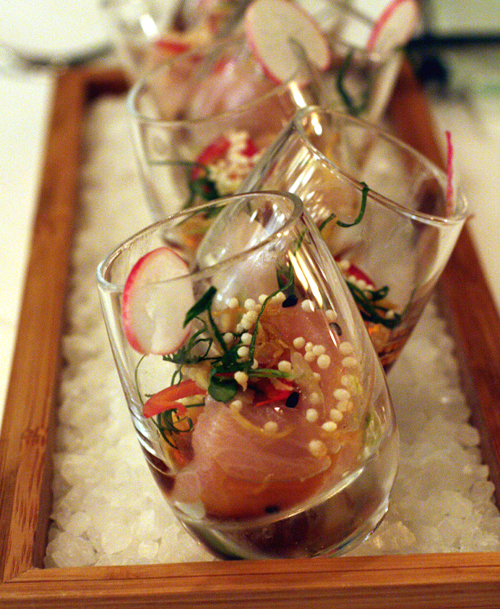
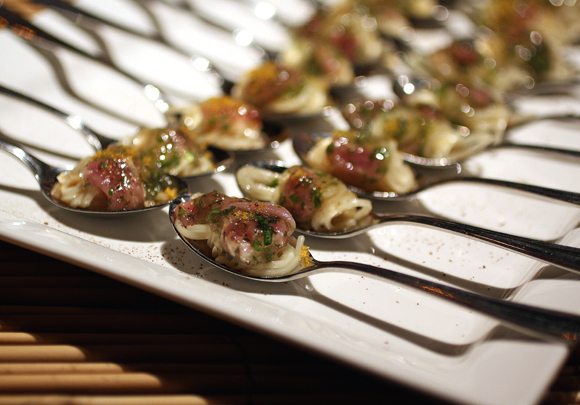
The famous hamachi shooters at Alexander's Steakhouse.

When Executive Chef Jeffrey Stout opened a branch of his Alexander’s Steakhouse in San Francisco’s South of Market district about two months ago, he didn’t think the crowds here would differ much from what he gets at his original location in Cupertino.

But how wrong he was.

While the Cupertino restaurant starts to shut down after 9 p.m. because folks in the South Bay are early eaters, the party is just getting started in San Francisco around 8 p.m. and is still going strong three hours later.

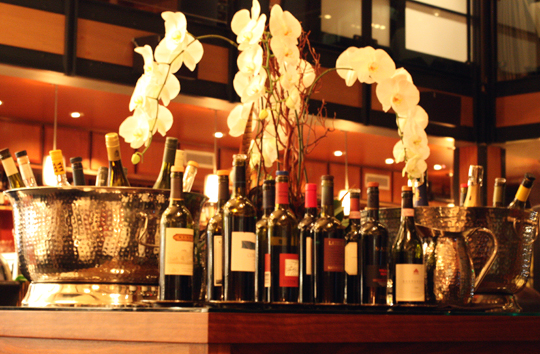
The three-story restaurant (formerly Bacar),  a short hop from the InterContinental San Francisco, epitomizes The City’s eclecticism with its exposed brick walls, dramatic wine displays, custom Japanese shoji screens and bustling exhibition kitchen with cooks dressed in trendy black chef’s coats.

Three floors of glam.

Stout, who is half Japanese, and his business partner, JC Chen, continue their unique, upscale, contemporary, Asian-inflected take on a steakhouse here. But unlike the Cupertino location, there is no jaw-dropping display of meat on display in an aging room right when you walk through the doors. Wasn’t room for it in the San Francisco locale, Stout says. Instead, all the meat is butchered at the Cupertino restaurant, then trucked to the San Francisco one twice a week.

As a result, there’s mega meat on the menu: Niman Ranch Prime T-Bone Steak with grilled lemon and a trio of salt; Strip Steak with kimichi butter and shishito pepper pistou; and pricey Japanese A5 Wagyu, the highest grade.

But what I’ve always enjoyed about Alexander’s is that it also offers a variety of Japanese seafood preparations for folks like me who crave that far more than a big hunk of meat.

Recently, I was invited in as a guest to try the new San Francisco outpost.

I couldn’t resist starting with the signature hamachi shots, a classic from the original Alexander’s in Cupertino. They’re $4 each or $22 for half a dozen. These little glasses are filled with a palate-awakening mix of raw hamachi, jalapeno, avocado, ginger, lime juice and truffled ponzu sauce. Don’t even bother ordering just one, because after you down it, you’ll surely want another.

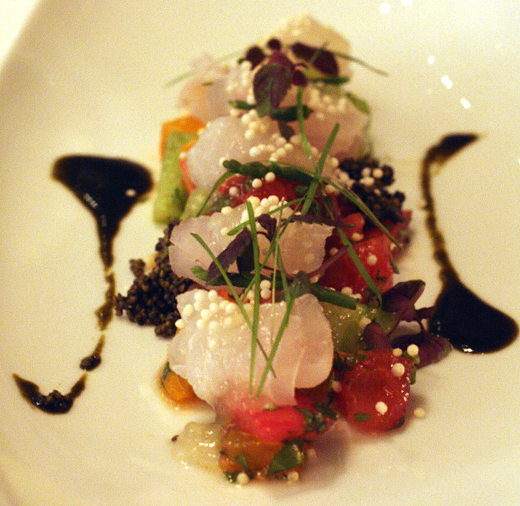
Dishes like this beautiful sashimi reinforce the notion that you're not an your average steakhouse.

Hirame sashimi ($15) brought delicate little rolls of raw fish accented by heirloom tomatoes and yuzu gelee.

Read more

Scenes from “Worlds of Flavor” 2010

Cold soba noodles in gelee at the 2010 "Worlds of Flavor'' conference on Japan.

Over the weekend, the Culinary Institute of America at Greystone in St. Helena presented its 13th annual “Worlds of Flavor International Conference & Festival.”

It was the first time that the conference — attended regularly by top chefs, restaurateurs, purveyors, food scientists and media — focused entirely on the cuisine of Japan.

For good reason.

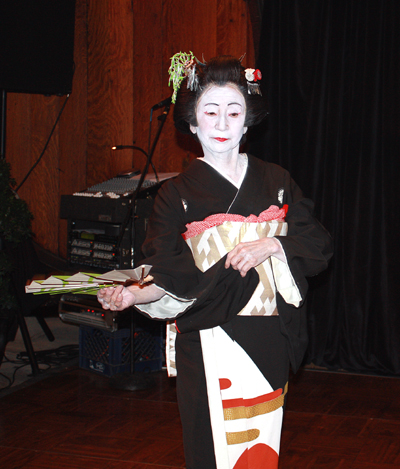
A Japanese dancer.

Everywhere you turn these days, you can’t help but notice the influence Japanese cuisine is having around the world — from sushi being sold in most every American supermarket to ingredients such as edamame, yuzu and nori finding their place in professional kitchens around the world.

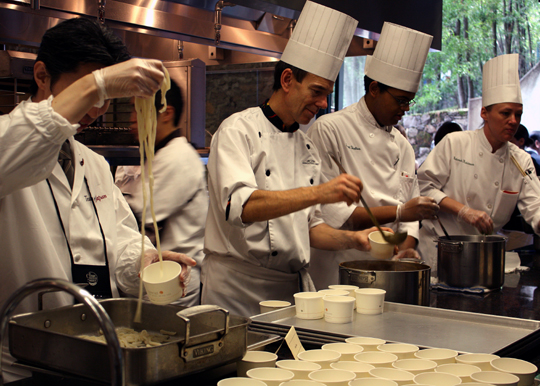
Assembling curry udon for the crowds.

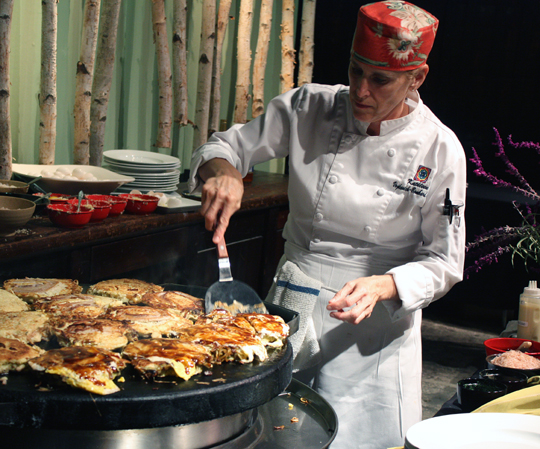
Okonomiyaki -- savory noodle pancakes -- get grilled.

Turn on the TV to watch the excitement of “Iron Chef”; visit New York to wait in line at Chef David Chang’s wildly popular Momofuku Japanese-style, street food-inspired restaurants; or pick up the latest Michelin Guide, which awarded its highest honor of three stars to an astounding 12 restaurants in the Kansai region of Japan — more than any other area in the world.

The conference, “Japan: Flavors of Culture, From Sushi and Soba to Kaiseki,” was attended by 750 people, including more than 54 presenters from Japan, some of whom were visiting the Napa Valley for the first time.

It was a kick to see Masaharu Morimoto, Hiroyuki Sakai and Yukio Hattori — all of “Iron Chef” fame — wandering around the storied culinary campus. And even more memorable to hear Morimoto belt out an a cappella song in Japanese at the end of his cooking demo.

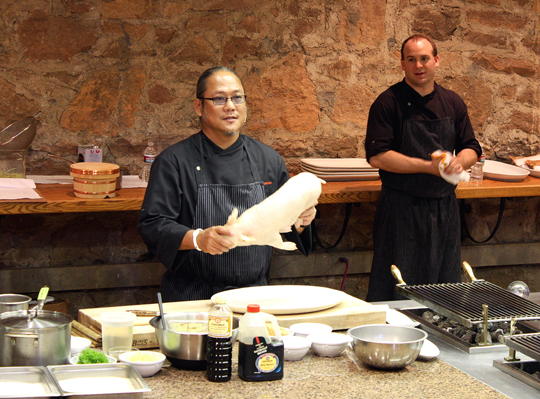
Morimoto cooking with suckling pig at a demo.

And what cooking demos there were — from watching a chef from Japan painstakingly make soba noodles from scratch on stage to the intricate details that go into making a perfect dashi stock to seeing Chef Doug Keane of Cyrus in Healdsburg prepare a broth made with his favorite matsutake mushrooms, which he confessed to loving even more than prized European truffles.

Read more

The One and Only Joyce Goldstein

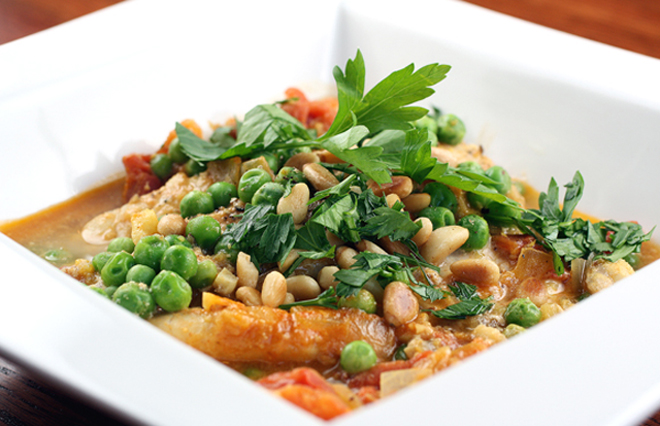
Fish fillets cooked Catalan-style -- with pine nuts. (Photo by Carolyn Jung)

For four decades, San Francisco’s Joyce Goldstein has been a cooking teacher, cookbook author, chef and restaurateur.

She introduced us to tapas long before the now-crazed small plates trend existed.

She was making couscous at her restaurant before most people even knew what it was.

Now, she’s hard at work on what will be her 26th book.

And oh, by the way, she just turned 75.

This tiny, bespectacled woman continues to teach us all about cooking, eating and culture. Read all about her in my story in the September issue of Food Arts magazine, in which she is spotlighted as this month’s recipient of its Silver Spoon Award.

Then, enjoy this dish from her book, “Tapas: Sensational Small Plates from Spain” (Chronicle Books).

As Goldstein notes, “Fish in Pine Nut Sauce,” which I spied on Epicurious.com, is typical of many Spanish fish dishes in that it features sauces made with nuts. Fillets of firm, white fish are either baked in the oven or cooked on the stovetop in a homestyle, brothy Catalan sauce of tomatoes, green peas, dry white wine, garlic, and sweet paprika that gets its body from ground pine nuts and bread crumbs.

Read more

Whole Foods Showcases Sustainable Swordfish & A “Next Iron Chef” Contestant

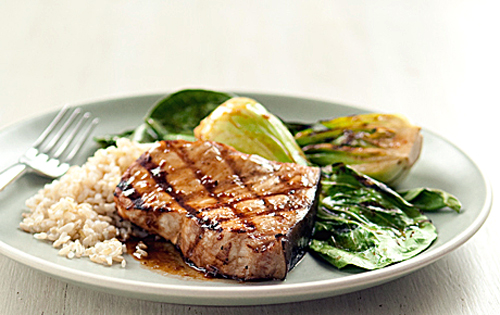
Through August or until supplies last, Whole Foods Markets are selling fresh, harpoon-caught Novia Scotia swordfish that have been certified by the Marine Stewardship Council as sustainable.

Whole Foods is the only major grocery store selling the MSC-certified swordfish, which retails for $18.99 per pound.

The Monterey Bay Aquarium’s “Seafood Watch Guide” lists harpoon-caught swordfish as a “best choice.”

Instead of being caught in giant gillnets, which can be destructive to ocean  habitats and capture unwanted fish, these swordfish are captured in a very primitive, time-honored method. Fishermen use harpoons to target individual, mature fish one by one. The fishing boats, many family-owned, usually return to shore within 72 hours, ensuring that swordfish arrive at stores within 48 hours.

The Canadian government also has worked to limit the fishing season to three, five-day intervals, to help maintain the swordfish population.

Read more

Good Eats in Australia

VICTORIA, AUSTRALIA — Traveling opens your eyes, as well as your taste buds.

My recent week-long trip to Australia, sponsored by Boundary Bend Ltd., was no exception.

Both in Melbourne and throughout the outlying countryside of the state of Victoria, there were so many wonderful new ingredients and dishes to revel in. Here are some of the highlights:

Prahran Market:

I could have stayed for hours meandering through the stalls at the famous Prahran Market, Australia’s oldest continuously running central marketplace. The covered marketplace, teeming with produce, seafood, fresh pasta, flower, soap and olive oil vendors, originated in 1864 at a smaller locale in Melbourne, and moved to its present location in 1881.

If there weren’t those pesky agriculture and customs laws (for good reason, of course), I would have brought back to the Bay Area armloads of the mesmerizing finger limes (above and below photos). The fragrance alone is intoxicating — beautiful enough to be a perfume that you’d want to dab on all the time. It smells of kaffir lime, with a bright floral, refreshing and very complex nose.

What’s really fascinating, though, is that this lime doesn’t have much juice at all. Instead, give one a squeeze and out will come these little globules that look for all the world like caviar. Damian Pike, a wild mushroom specialist, whose stand was selling these, explained that the fruit can be used in marmalade and all manner of dishes. One taste of the chewy globules that burst with tangy delight and I was dreaming of them atop sashimi.

Pike’s stand also sold fresh pepper berries, which I had never seen before, having only been used to the dried variety that fills my pepper grinder at home.

Read more

« Older Entries Recent Entries »